
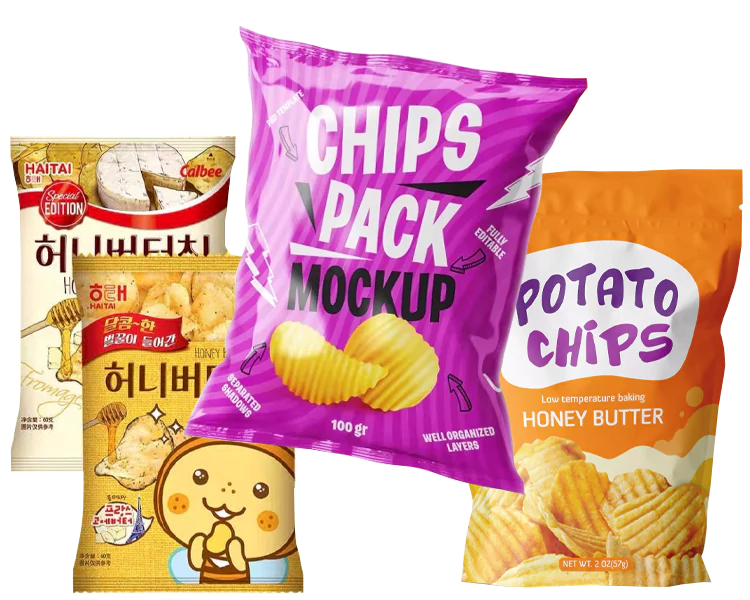
Custom Chip Bags
Elevate your brand and lock in freshness with our fully customizable chip bags. Generic packaging gets lost in the crowd, but a custom-designed bag makes your product unforgettable.
Perfect for snack brands, food trucks, corporate events, and private parties, our high-quality bags are engineered to protect your product’s flavor and crunch.
From the material and size to the colors and sealing mechanism, you have complete control. Let’s create packaging that not only looks incredible but also delivers the ultimate snacking experience for your customers.
The Perfect Material for Your Chip Bag
The foundation of a great chip bag is the right material. We offer a range of options to meet your needs for freshness, sustainability, and brand aesthetic.
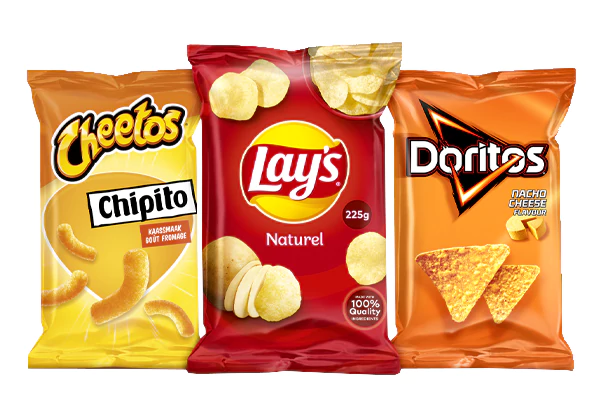
High-Clarity Plastic & Foil-Lined Chip Bags
Our premium plastic and foil-lined bags are the industry standard for a reason. They offer the highest level of protection against moisture, oxygen, and light, which are the primary enemies of freshness. The metallized or foil interior provides a superior barrier, guaranteeing that your chips stay crispy and flavorful from the production line to the final crunch.
This material is also perfect for vibrant, high-definition printing, allowing your brand’s colors and graphics to pop with photorealistic quality, creating a professional and eye-catching product.
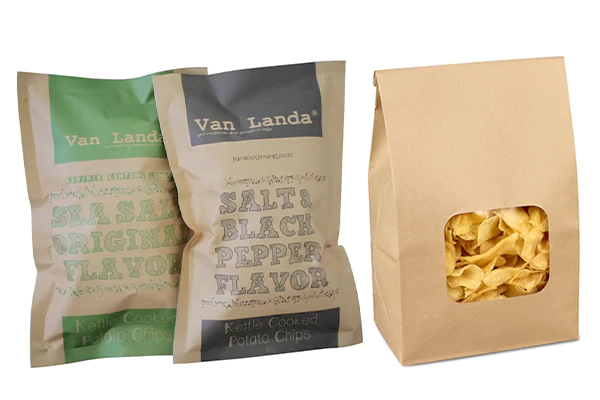
Natural & Rustic Paper Chip Bags
Capture the perfect blend of natural appeal and modern design with our Kraft pouches featuring a frosted window. The organic, earthy texture of the Kraft paper signals an artisanal, eco-conscious brand identity.
The elegantly designed frosted window offers a soft-focus glimpse of the contents, creating curiosity without sacrificing the high-end feel. Combined with a resealable ziplock, this pouch is perfect for specialty coffee beans, organic teas, bakery mixes, and natural snacks, appealing directly to consumers seeking authentic, high-quality products.
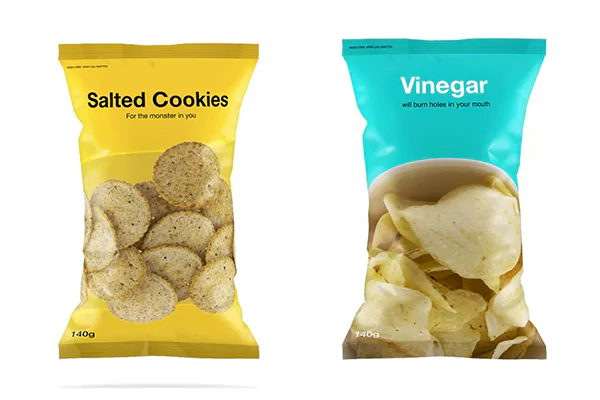
Sustainable & Eco-Friendly Options
Meet the growing demand for environmental responsibility with our sustainable packaging solutions. We offer fully recyclable materials that reduce landfill waste, as well as biodegradable and compostable options made from plant-based polymers (PLA). These eco-friendly bags provide excellent freshness protection while showcasing your brand’s commitment to the planet.
Choosing a sustainable option is not just good for the environment; it’s a powerful marketing tool that builds trust and loyalty with modern consumers who prioritize green products.
Fully Customizable Sizes & Sealing Solutions
From single-serving snacks to family-sized shares, we tailor every bag to your exact specifications. Control portion sizes and enhance user convenience with the right features.
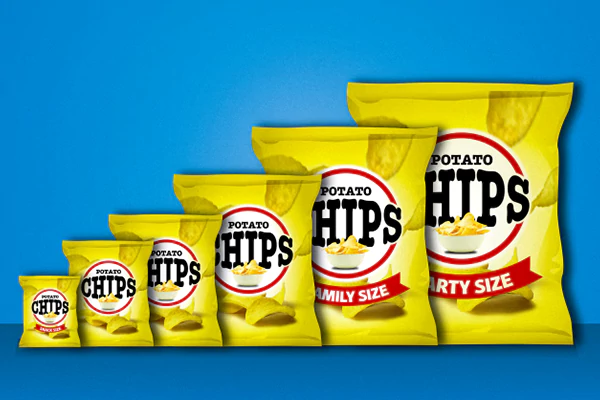
We provide complete sizing flexibility to match your product needs. Our range includes:
1oz – 2oz bags: Perfect for free samples, lunchboxes, or vending machines.
5oz – 8oz bags: The ideal single-serving size for retail stores and food trucks.
10oz – 18oz bags: Great for family-size or party-size offerings for supermarkets. Tell us your desired portion weight, and we will engineer the precise dimensions to ensure a perfect, professional fit for your chips.
Secure & Convenient Sealing Options
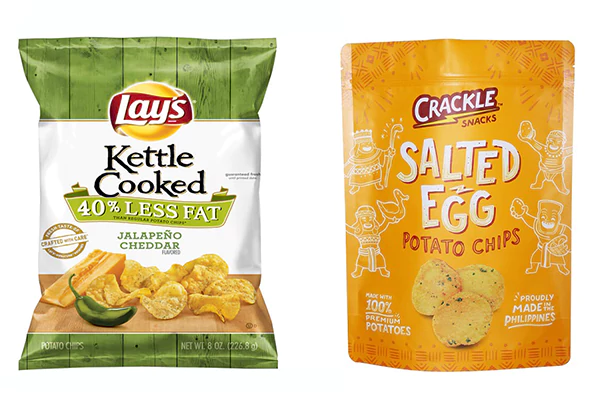
The right seal is critical for freshness and functionality. We offer:
Heat Seal: Provides a tamper-evident, airtight closure for maximum shelf life, ideal for retail products.
Resealable Zippers: A premium feature that adds convenience, allowing customers to keep chips fresh after opening.
Side Gusset Bags: These bags expand as they are filled, allowing them to stand upright on shelves for better visibility and merchandising.
Designed for Every Occasion
Our custom chip bags aren’t just for retail. They are the perfect way to make any event, brand, or celebration more memorable and professional.
For Retail & Food Trucks
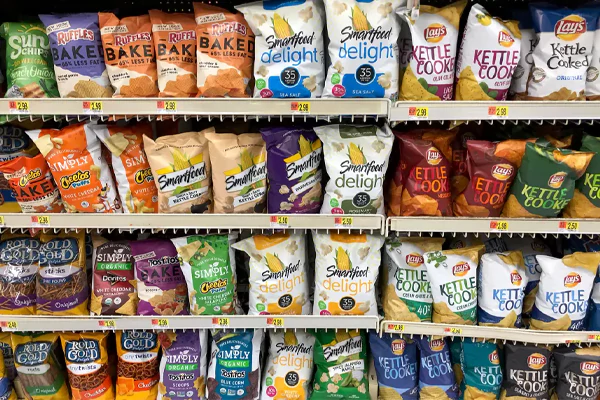
Your brand is your most valuable asset. We create professional, retail-ready bags that will stand out on crowded store shelves or in a fast-paced food truck environment.
For Weddings & Parties
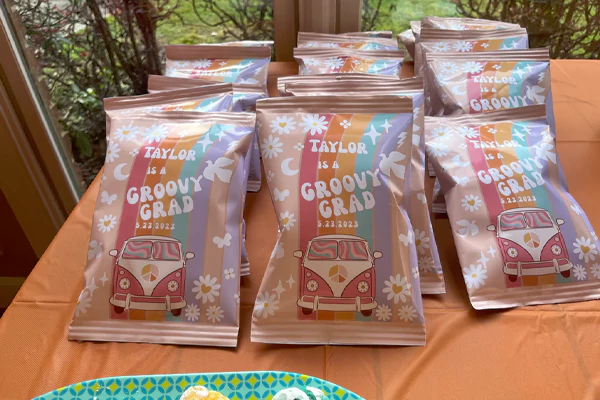
Create a unique party favor that guests will love. Customize bags with the names of the happy couple, a birthday message, or a fun theme to match your event’s decor.
For Holidays & Special Events
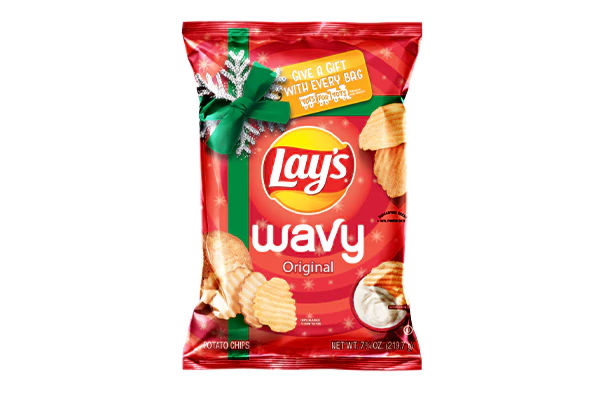
Design festive bags for Christmas, Halloween, or corporate events. A custom-branded snack is a fantastic and memorable way to celebrate any special occasion with style.
Our Advantages
Our custom chip bags aren’t just for retail. They are the perfect way to make any event, brand, or celebration more memorable and professional.
Vibrant, Food-Safe Printing
Our high-definition printing makes your designs pop, while our non-toxic, food-safe inks ensure your product is always safe for consumption.
Unmatched Material Expertise
From ensuring maximum freshness with foil barriers to promoting your brand with compostable films, we guide you to the perfect material.
Total Customization Control
You control every aspect—size, shape, material, color, and finish. We are your manufacturing partner in creating the perfect custom bag.
FAQs
How to fold a chip bag to keep it fresh?
The quest to keep leftover chips from going stale is a universal challenge, and while chip clips are a popular solution, mastering the art of folding a chip bag is a valuable life skill. The most effective method, often seen in viral social media videos, is a clever “fold and tuck” technique that creates a surprisingly secure, albeit temporary, seal. This method uses the bag’s own structure and tension to lock itself closed, far surpassing a simple roll-down.
Here is a step-by-step guide to the definitive chip bag fold:
First, begin by expelling as much excess air from the bag as possible without crushing the chips inside. Gently press down on the bag from the top, pushing the air towards the opening. The less air trapped inside, the less oxygen is available to react with the oils in the chips, which is a primary cause of staleness.
Next, with the bag standing upright, fold the top two corners of the bag inward at a 45-degree angle, creating a pointed, triangular top, similar to the start of making a paper airplane. Ensure these folds are crisp and symmetrical.
Then, starting from this newly formed point, begin tightly rolling the top of the bag downwards. Continue rolling down several times, creating a compact and dense fold. The tightness of this roll is crucial, as it will build the tension needed for the final lock. You should roll it down until the fold is just above the level of the remaining chips inside the bag.
Now for the locking mechanism. While holding the rolled section firmly in place with your thumbs, you will notice that the sides of the roll have small, triangular “pockets” or “ears” created by the initial corner folds. Carefully, take the outer edge of one of these pockets and invert it, pushing it inward and underneath the rolled section towards the center of the bag. You will feel it catch and hold the roll in place. Repeat this process on the other side. By tucking both ends under, you create a tension-based seal that locks the entire fold. The bag should now be able to be held upside down without unrolling.
While this folding method is brilliant for short-term storage (a day or two), it’s important to understand its limitations. It is not a truly airtight seal. Air can still slowly seep in, and the bag is not protected from humidity. For long-term freshness, the best practice remains transferring the chips to a dedicated airtight container, such as a glass jar or a plastic container with a rubber-sealed lid. However, for keeping chips fresh until the next day without any extra tools, the “fold and tuck” method is an elegant and effective solution that showcases the principles of simple engineering in everyday life.
How many potatoes are in a bag of chips?
This is a fascinating question that delves into the heart of food production, and the answer is more complex than a simple number. While there’s no exact count, a common industry estimate is that it takes approximately four to five medium-sized potatoes to produce a standard family-size bag of chips (around 10 ounces or 280 grams). However, this figure is influenced by a multitude of factors, making it a variable estimate rather than a hard rule.
The most significant factor is water content. Raw potatoes are composed of nearly 80% water. The process of turning a potato into a crispy chip is, essentially, a process of dehydration. During the deep-frying process, this water is rapidly cooked out and replaced by oil, drastically reducing the potato’s weight and volume. Therefore, it takes a surprisingly large volume of raw potatoes to produce a relatively lightweight bag of chips. A 10-ounce bag of finished chips might have started as over 35 ounces (more than two pounds) of raw, sliced potatoes.
The type of potato used also plays a critical role. Chip manufacturers prefer specific varieties, known as “chipping potatoes,” such as the Russet, Kennebec, or Atlantic varieties. These potatoes are chosen for their high starch content and low sugar content. High sugar levels cause the chips to brown too quickly and unevenly during frying. The size, density, and water content can vary between these types, affecting the final yield.
Furthermore, the manufacturing process itself involves steps that reduce the final count. The thickness of the slice is a major variable; thinner, classic-style chips will yield more slices per potato than thick-cut kettle-style chips. Additionally, quality control is rigorous. After slicing, the potato slices are washed to remove excess starch, and any slices with blemishes, green edges, or imperfections are discarded by optical sorters before they even reach the fryer. After frying, broken or overcooked chips are also removed.
Ultimately, chip bags are not filled based on a potato count but by net weight. Automated, highly precise scales ensure that every bag contains the exact weight of product advertised on the packaging. This is the only legally standardized and consistent measure. So, while you can be confident you are getting 10 ounces of chips, the number of potatoes that journey took could fluctuate daily based on the specific crop, the slice thickness, and the day’s quality control standards. The “four to five potatoes” rule is a helpful visualization, but the scale is the final arbiter.
What are chip bags made out of?
A modern chip bag is a marvel of materials science and food preservation technology, far more complex than it appears. It is not made of a single material but is a sophisticated multi-layer composite film, where each layer serves a distinct and critical purpose. This structure, known as flexible packaging, is engineered to provide the ultimate protection against the elements that degrade chips: oxygen, moisture, and light.
Typically, a chip bag consists of three primary layers laminated together:
The Outer Layer (Print Layer): This is the layer you see and touch, featuring the vibrant branding and product information. It is most commonly made from Biaxially-Oriented Polypropylene (BOPP). Polypropylene is a durable, versatile plastic. The “biaxially-oriented” process involves stretching the plastic film in two different directions, which aligns the polymer chains. This makes the film incredibly strong, stiff, and clear, providing an excellent, glossy surface for high-definition printing. It also offers a degree of scuff resistance and initial protection against moisture.
The Middle Layer (Barrier Layer): This is the most crucial layer for preservation and is what gives the bag its distinctive metallic sheen on the inside. This layer is usually made of one of two materials: aluminum foil or, more commonly, metallized film.
Aluminum Foil: A thin layer of actual aluminum provides a near-perfect barrier against light, oxygen, and water vapor. It is the gold standard for preservation.
Metallized Film: This is a more common and cost-effective alternative. It involves depositing a microscopic, vapor-thin layer of aluminum onto a polymer base film, such as PET (Polyethylene Terephthalate) or BOPP. While not as absolute a barrier as pure foil, it is highly effective at blocking the vast majority of light and oxygen, which is sufficient to provide a long shelf life. This layer is responsible for preventing the oils in the chips from going rancid due to oxidation and light exposure.
The Inner Layer (Sealant Layer): The innermost layer, which is in direct contact with the chips, is typically made of Polypropylene (PP) or Polyethylene (PE). This layer has two vital functions. First, it must be food-safe and inert, meaning it won’t react with the food or transfer any taste. Second, it is designed to melt at a lower temperature than the other layers. This allows machines to use heat to seal the top and bottom of the bag, creating an airtight closure without compromising the structural integrity of the outer layers.
These layers are bonded together using adhesives to form a single, cohesive sheet of film. This multi-layer construction is why chip bags are notoriously difficult to tear in a straight line and why they are not easily recyclable in most municipal programs. Each layer performs a specialized task that the others cannot, working in concert to deliver a product that is fresh, safe, and visually appealing.
How big is a standard 8 oz bag of chips?
This question often causes confusion because the “8 oz” on the front of a chip bag refers to its net weight, not its volume or physical dimensions. Ounces (oz) are a measure of mass, telling you how heavy the chips inside the bag are. The physical size of the bag can vary significantly between brands and types of chips, even if they all contain the exact same weight of product.
The primary reason for this variation is the difference in the chips themselves. The density and shape of the snack dictate how much space a certain weight will occupy. For example:
Traditional Potato Chips: These are relatively flat and dense. An 8-ounce bag of classic, thin-cut potato chips might have typical dimensions of around 13 inches tall by 8 inches wide.
Kettle-Cooked Chips: These are often thicker, curled, and more irregularly shaped, meaning they don’t settle as compactly. An 8-ounce bag of kettle chips might be slightly larger or appear fuller to accommodate their shape.
Puffed Snacks: Corn puffs, cheese curls, or other air-puffed snacks are far less dense. An 8-ounce bag of these would need to be significantly larger in volume to hold the same weight, often appearing much more substantial on the shelf.
Another critical factor influencing the bag’s size is the inclusion of “slack fill”—the empty space or “air” in the bag. This space is intentionally included for two reasons: to protect the fragile chips from breaking during shipping and handling, and because the bag is filled with nitrogen gas to prevent the chips from going stale (more on that below). Manufacturers design the bag to have enough cushioning to be effective, which contributes to its overall dimensions.
Finally, marketing and “shelf presence” play a role. A larger bag can be more eye-catching on a crowded supermarket shelf, creating the perception of a better value, even if the net weight is identical to a competitor’s smaller-looking bag.
To visualize it practically, an 8-ounce bag of chips is the standard “medium” or “sharing” size, larger than a single-serving vending machine bag (which is typically 1-2 ounces) but smaller than a large “party size” bag (which can be 13-18 ounces). It generally contains about eight servings, according to the nutritional information panel.
In conclusion, while a typical 8-ounce bag of standard potato chips is roughly 13×8 inches, it’s crucial to remember that this is just an estimate. The only standardized measurement is the Net Weight of 8 ounces, which is legally regulated to ensure you are getting the amount of product you paid for, regardless of the bag’s physical size.
How much does a typical bag of chips cost?
The cost of a bag of chips can vary dramatically based on a wide array of economic, branding, and logistical factors. While a consumer might see a price range from around $2.00 for a store brand to over $6.00 for a gourmet, specialty brand, the forces driving those prices are complex.
First and foremost are the Cost of Goods Sold (COGS). This includes the raw ingredients: potatoes, cooking oil, and seasonings. The price of these agricultural commodities can fluctuate based on weather, crop yields, and global supply chain issues. For example, a drought in a major potato-growing region or a surge in the price of sunflower or canola oil will directly increase the manufacturing cost. This category also includes the cost of the sophisticated, multi-layer packaging material itself.
Next are the Manufacturing and Operational Costs. This encompasses the energy required to run the factory (electricity and gas for fryers), the cost of labor for workers on the production line, and the maintenance and depreciation of expensive, specialized machinery like slicers, fryers, and automated bagging systems.
Branding, Marketing, and Advertising represent a significant portion of the cost for major national brands. A company like Frito-Lay spends hundreds of millions of dollars on television commercials, online advertising, celebrity endorsements, and in-store promotional displays. This massive marketing budget is factored into the price of every single bag. In contrast, a private label or store brand (like Kroger or Costco’s Kirkland Signature) has minimal marketing expenses, allowing them to offer a similar product at a much lower price point.
Distribution and Logistics are also major cost drivers. The journey from the factory to the supermarket shelf involves transportation, warehousing, and a complex network of distributors. Fuel costs, driver salaries, and slotting fees (fees paid to retailers to secure a specific spot on the shelf) are all built into the final price. The distribution model also matters; selling directly from a small, local factory is cheaper than managing a nationwide logistics network.
Finally, the Retailer’s Markup and the product’s Brand Positioning determine the final shelf price. A grocery store will add its own margin to the wholesale price to cover its own operational costs and generate a profit. Furthermore, a brand’s perceived value dictates its price ceiling. A chip marketed as “gourmet,” “organic,” “artisan,” or “kettle-cooked” can command a premium price because it targets a consumer willing to pay more for perceived higher quality, unique flavors, or healthier ingredients.
Therefore, the price of a bag of chips is a composite of agricultural costs, factory operations, massive marketing budgets, cross-country shipping, and the perceived value of the brand itself. The difference between a $2.50 bag and a $5.50 bag often has less to do with the potatoes inside and more to do with the vast economic ecosystem required to bring it to your pantry.
Why do chip bags have so much air, and why do they inflate at higher altitudes?
The “air” in a chip bag is one of the most common consumer complaints, but it is not air, and it serves two critical, non-negotiable functions in delivering a quality product. The space in the bag is technically called “slack fill,” and the gas inside is almost always nitrogen, not ordinary air.
The first crucial purpose of this gas-filled space is cushioning. Potato chips are incredibly fragile. Imagine a bag filled to the brim with no empty space. During its long journey from the factory to a truck, to a warehouse, to the store shelf, and finally to your home, the bag would be subject to bumps, drops, and stacking. Without that nitrogen cushion, the chips would be pulverized into a bag of crumbs and potato dust. The slack fill acts as a protective airbag, ensuring the delicate chips arrive intact for you to enjoy. The U.S. Food and Drug Administration (FDA) actually regulates slack fill, permitting it when it serves a functional purpose, such as protecting the contents.
The second, and equally important, reason is preservation. The gas inside the bag is nitrogen, an inert, odorless, and tasteless gas. Ordinary air is about 78% nitrogen, 21% oxygen, and small amounts of other gases. The oxygen in the air is the enemy of freshness. It causes the oils in the potato chips to oxidize, a chemical reaction that makes them taste stale and rancid. By using a process called “gas flushing,” manufacturers force the oxygen-rich air out of the bag and replace it with pure nitrogen before sealing it. Because nitrogen is inert, it doesn’t react with the chips, effectively preserving their flavor and crunch for a much longer shelf life.
The phenomenon of chip bags inflating at higher altitudes is a direct application of basic physics, specifically the Ideal Gas Law (PV=nRT) or, more simply, Boyle’s Law. At sea level, the air pressure outside the bag is relatively high, pushing against the bag and containing the nitrogen gas inside. As you travel to a higher altitude (like driving up a mountain or flying in an airplane), the surrounding atmospheric pressure decreases. The pressure of the nitrogen gas sealed inside the bag, however, remains the same as it was at the factory. With less external pressure pushing inward, the internal gas pressure is now greater, causing it to expand and push the walls of the bag outward, making it inflate like a pillow. The bag isn’t gaining more gas; the existing gas is simply expanding due to the change in external pressure. This is a clear demonstration that the bag is, indeed, airtight.
How do you recycle chip bags? Can you recycle foil chip bags?
Recycling chip bags is a significant environmental challenge, and the unfortunate reality is that chip bags cannot be recycled through most municipal curbside recycling programs. This is because of their complex, multi-layer material composition.
As previously discussed, a chip bag is not simply plastic or foil; it is a laminate of multiple materials, typically including an outer layer of Biaxially-Oriented Polypropylene (BOPP), a middle barrier layer of aluminum or metallized film, and an inner sealant layer of polyethylene or polypropylene. These layers are fused together with adhesives.
Recycling facilities are designed to sort and process single-stream materials, or “monomaterials,” like PET plastic bottles, HDPE milk jugs, aluminum cans, and cardboard. The machinery and processes are not equipped to separate the tightly bonded layers of a chip bag. When a chip bag enters a standard recycling facility, it is identified as a contaminant. It gets sorted out and sent to a landfill, and in a worst-case scenario, it can clog the sorting machinery, causing shutdowns and inefficiencies in the recycling process. This is why you will not see the standard recycling symbol with a number on most chip bags.
So, if you can’t put them in your blue bin, are there other options? Yes, but they are limited. The most prominent solution for hard-to-recycle items like chip bags is through specialized, third-party mail-in programs. Organizations like TerraCycle have become leaders in this space. TerraCycle partners with brands and individuals to offer free recycling programs for specific types of waste. You can sign up on their website, collect the specific brand’s packaging (including chip bags), and once you have enough, you can download a free shipping label to mail the waste to their facility.
At a TerraCycle facility, the chip bags undergo a different process. They are shredded, melted down, and turned into plastic pellets or lumber. These raw materials can then be used to manufacture new products like park benches, picnic tables, shipping pallets, and watering cans. While this process keeps the material out of landfills, it is a form of “downcycling” rather than “recycling,” as the material is not being used to create new chip bags.
For the average consumer, the most responsible action is to first check for a local specialized recycling program (some communities have drop-off points for plastic films). If none exists, the TerraCycle program is the next best option. However, for the majority of people, chip bags are currently destined for the landfill. This has put significant pressure on manufacturers to innovate with more sustainable packaging, leading to research into monomaterial films and compostable alternatives that could one day make chip bag recycling a widespread reality.
Why is the inside of a chip bag reflective and shiny?
The reflective, shiny silver interior of a chip bag is not a decorative choice; it is the visual evidence of the bag’s most critical preservation feature: the barrier layer. This layer is specifically designed to protect the chips from the two primary culprits that cause them to go stale and lose their flavor: light and oxygen.
This shiny layer is created using one of two materials: a very thin layer of aluminum foil or, more commonly, a metallized polymer film.
Aluminum Foil: In some premium or specialty packaging, a micro-thin layer of actual aluminum foil is laminated between the plastic layers. Aluminum is an exceptional barrier material, providing an almost perfect shield against light, moisture, and gases like oxygen. Its reflective nature is inherent to the metal itself.
Metallized Polymer Film: This is the more common and cost-effective method used in most modern chip bags. The process, called vacuum deposition, takes place in a large chamber. A roll of plastic film (often PET or BOPP) is placed inside, along with a small amount of pure aluminum. The air is pumped out of the chamber to create a vacuum. The aluminum is then heated until it evaporates, and the aluminum vapor condenses onto the cold surface of the plastic film, coating it in an incredibly thin, uniform, and highly reflective layer. This layer is so thin—often less than 100 nanometers—that it adds negligible weight or cost but provides significant barrier properties.
The reason this reflective barrier is so vital comes down to food chemistry. The cooking oils used to fry potato chips are susceptible to two forms of degradation. The first is photo-oxidation, which is a chemical reaction triggered by exposure to light, particularly UV light. Light provides the energy to start a chain reaction that breaks down the fatty acids in the oil, leading to rancidity and off-flavors. The reflective layer acts like a mirror, bouncing light rays away from the product and keeping the interior dark and protected.
The second form of degradation is oxidation, which occurs when the oils react with oxygen molecules in the air. This process also leads to rancidity. The tightly packed molecules of the metallic layer create a physical barrier that is very difficult for oxygen and water vapor molecules to penetrate, effectively sealing the chips in a controlled environment.
In essence, the shiny interior is the functional core of the packaging’s design. It works in tandem with the nitrogen gas inside the bag to create a fortress against the elements, blocking light from the outside and neutralizing the oxygen on the inside. This sophisticated system is why an unopened bag of chips can remain fresh and crispy on a shelf for months.
Why do chip companies only fill the bag about half full?
The perception that chip bags are “half empty” is a long-standing consumer grievance, but this empty space, known in the industry as “slack fill,” is not a deceptive practice to shortchange customers. Instead, it is an essential and functional part of the product’s packaging, designed to ensure both the quality and integrity of the chips.
The primary and most easily understood reason for slack fill is product protection. Potato chips are extremely brittle. They are destined for a rough journey that involves being packed into boxes, loaded onto trucks, transported across hundreds of miles, unloaded at warehouses, and finally stacked on store shelves. Without a significant cushion, the chips would be crushed into a disappointing pile of crumbs by the time they reached the consumer. The empty space in the bag is filled with nitrogen gas, which creates a puffy, pillow-like buffer that absorbs shocks and prevents the chips from being shattered during transit and handling. This is a functional requirement recognized by regulatory bodies like the FDA.
The second reason is directly tied to the manufacturing and sealing process. Chip bags are filled and sealed by high-speed automated machinery. The product (chips) drops from a hopper through a weighing system and down a tube into the bag, which is formed from a continuous roll of film. As the chips fall, nitrogen gas is flushed into the bag to displace oxygen. The machine then needs a clear, product-free area at the top of the bag to make a clean, strong heat seal. If the bag were filled to the brim, chips would get caught in the seal, compromising its integrity. This would lead to leaks, allowing nitrogen to escape and oxygen to enter, ruining the entire bag’s freshness. The empty space provides the necessary clearance for this critical sealing process to happen reliably at high speeds.
Finally, it’s important to reiterate that chip bags are filled and sold by net weight, not by volume. This weight is legally required to be printed on the package and is measured precisely by automated scales during production. While a bag might look half full, it is guaranteed to contain the weight of the product advertised, for example, 8 ounces. Different types of chips have different densities—wavy chips and kettle chips take up more space than thin, flat chips—so the amount of slack fill might vary to accommodate the same weight of product.
In summary, the space in a chip bag is a multi-functional feature, not an empty promise. It serves as an airbag for protection, a preservation system when filled with nitrogen, and a necessary component of the high-speed manufacturing process. While it might feel like you’re buying air, you’re actually paying for a system designed to deliver whole, fresh chips.
Can an unopened bag of chips actually go bad?
Yes, an unopened bag of chips can definitely go bad, although “going bad” for a product like potato chips typically means a significant decline in quality rather than becoming unsafe to eat in the way that fresh dairy or meat would. The expiration or “Best By” date on the bag is a reliable indicator of when this decline in quality is expected to begin. The sophisticated packaging is designed to prolong freshness, but it cannot defy the laws of chemistry forever.
The primary way chips go bad is through rancidity. This is a chemical process where the fats and oils in the chips react with any remaining traces of oxygen inside the bag. Even though the bag is flushed with nitrogen, it’s nearly impossible to remove 100% of the oxygen. Over time, this slow oxidation process breaks down the fatty acids in the oil, creating new chemical compounds that produce off-flavors and stale, cardboard-like or even paint-like smells. This process is accelerated by exposure to heat and light, which is why it’s always recommended to store chips in a cool, dark place. The metallic barrier inside the bag is designed to block light, but it can’t protect against storage in a hot car or a warm pantry.
The second way quality degrades is through moisture. The multi-layer bag is highly resistant to water vapor, but it is not perfectly impermeable. Over a very long period, an infinitesimal amount of moisture can migrate through the packaging material. If the chips absorb even a small amount of moisture from the air, they will lose their characteristic crispiness and become soft, chewy, and stale. This is less common with a perfectly sealed bag but can happen over time or if the bag has a microscopic, undetectable puncture in its seal.
So, are they safe to eat past the expiration date? Generally, yes. Chips have very low water activity, which means there isn’t enough moisture available for bacteria, mold, or yeast to grow. As a result, they are a shelf-stable product and are highly unlikely to harbor pathogens that would cause foodborne illness, even months after the date on the bag.
However, the eating experience will be severely compromised. Instead of a crispy, flavorful snack, you will likely encounter chips that are soft, have a stale taste, and may have a distinctly unpleasant, rancid flavor from the oxidized oils. The “Best By” date is the manufacturer’s guarantee that, up to that point, the product will meet its high standards for taste and texture. After that date, you’re venturing into territory where the quality is no longer assured. So, while an old bag of chips probably won’t make you sick, it certainly won’t be enjoyable to eat.