
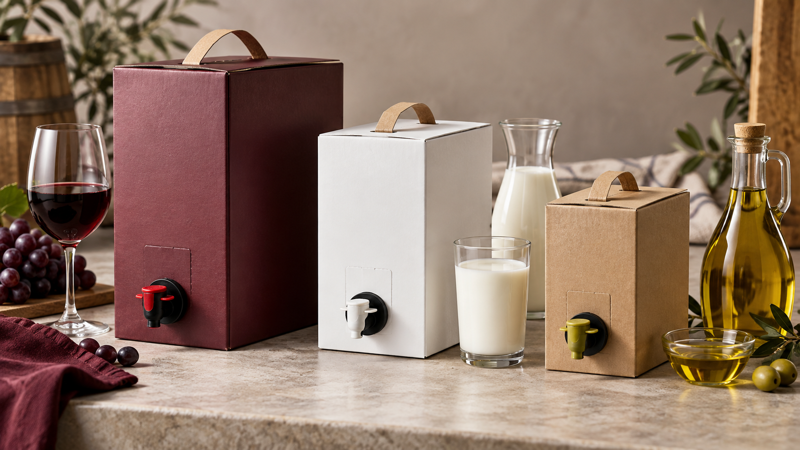
Bag-in-box size affects more than the amount of liquid sold. It changes how quickly the product is consumed, how much oxygen or contamination risk follows dispensing, whether the carton fits a refrigerator or shelf, how the tap flows, and how efficiently units ship. A 3-liter wine pack, 5-liter milk pack, and 10-liter edible-oil pack may use the same basic concept while requiring different films, fitments, boxes, and handling features.
The best size matches consumption rate and channel first. Product stability, filling equipment, dispensing behavior, carton geometry, and logistics then determine the final specification.
Start With Consumption After Opening
Estimate how much product the user dispenses each day and how long the pack remains open. A household wine pack and a café milk pack may both hold several liters, but their dispensing frequency and storage conditions differ.
The flexible inner bag contracts as liquid leaves, limiting air entry when the fitment and dispensing system function correctly. This advantage does not create unlimited open life. Oxygen transmission, fitment performance, hygiene, temperature, product formulation, and use practices still matter.
Choose capacity so the typical customer finishes the contents within the validated period. Oversizing may improve cost per liter but increase quality risk and make the carton difficult to store. Undersizing adds more packages, changeovers, and handling per liter.
When a 3-Liter Format Works
A 3-liter bag-in-box is well suited to many household and premium retail applications. It can fit a countertop or refrigerator more easily than larger formats and gives consumers a manageable carrying weight.
Wine is a familiar use because three liters corresponds to several conventional bottles while offering convenient dispensing. The pack needs oxygen barrier, a low-ingress tap, light protection, and a carton that remains stable as the bag collapses.
Three-liter formats can also support specialty oils or other liquids where slower consumption makes a larger box unsuitable. Calculate open-life performance from actual dispensing patterns rather than assuming the smaller size eliminates oxidation.
The tradeoff is packaging cost per liter. The fitment and carton are distributed over less product, and more units are required for the same sales volume. Retail shelf efficiency and premium positioning may justify that cost.
When a 5-Liter Format Works
Five liters often bridges household and light-commercial use. It offers more efficient packaging per liter while remaining manageable for many users. Cafés, small kitchens, hospitality rooms, and high-consumption households may find it practical.
Bag-in-box for milk must be designed around the dairy product and processing route. Chilled, aseptic, or other systems have different barrier, hygiene, filling, and distribution requirements. The fitment should support clean repeated dispensing without trapping residues.
Refrigerator dimensions matter. A five-liter carton may fit on a shelf but leave too little room to operate the tap. Prototype the box in target appliances and dispensers. Consider carton orientation, handle placement, and whether the user can see or estimate remaining volume.
For wine, five liters may suit events, foodservice, or value channels. The larger size increases the time after first dispense, so tap oxygen ingress and storage temperature deserve careful validation.
When 10 Liters or More Works
Ten-liter and larger formats usually fit foodservice, institutional, industrial, or high-throughput settings. They can reduce packaging and handling per liter, but total filled weight and dispensing force increase.
Edible oil is a strong candidate when kitchens use substantial daily volume. Bag-in-box for oil should resist grease, protect against oxidation and light, and dispense at the expected temperature. Viscosity can change with temperature, affecting flow speed and residual product.
Large milk formats may integrate with dedicated dispensing equipment. Connection hygiene, valve design, lifting, and cold-chain control become more important. The outer carton must tolerate condensation and stacking without losing strength.
Beyond 10 liters, manual handling risk rises. Use handles, lifting guidance, and case geometry appropriate to the filled weight. Confirm workplace requirements and pallet stability. A larger bag also creates more liquid pressure on seams and the fitment gland.
Match Film Structure to the Liquid
Wine needs oxygen protection because oxidation changes aroma, color, and flavor. Bag-in-box wine packaging may use multilayer barrier films selected around target shelf life, filling method, distribution, and tap performance.
Milk packaging must address light, oxygen, aroma, hygienic filling, and temperature according to the process. Edible oil requires oxygen and light protection plus compatibility with fats. High-acid liquids, particulates, or hot-filled products create other requirements.
Film selection should consider flex cracking as the bag collapses. A barrier structure that performs well as flat film may weaken after repeated folds. Test filled and dispensed bags through the complete use cycle.
Size the Fitment and Control Flow
Tap bore, valve design, gland location, product viscosity, carton elevation, and remaining head influence dispensing speed. A consumer wine tap should feel controlled, while a foodservice oil pack may need faster flow or a connector to equipment.
Measure flow at the coldest and warmest expected use temperatures. Milk and oil viscosity can change substantially. Test the first dispense, mid-pack, and final liters. Watch for glugging, air ingress, drips, stringing, and product trapped in folds.
Fitment placement must work with the box opening. The consumer should be able to pull the tap out and lock it without stressing the bag or tearing the carton. Large packs need enough support around the aperture to resist repeated operation.
Design the Carton Around Storage and Shipping
The outer box carries stacking load, protects the bag, provides graphics, and positions the tap. Board grade, flute, coating, handle, perforation, and internal dimensions should match filled weight and humidity exposure.
A smaller footprint improves shelf and pallet use but may create a tall, unstable box. A broad shallow box may dispense well in a refrigerator but use retail frontage inefficiently. Model case and pallet patterns before fixing dimensions.
Measure the filled bag’s shape, not only nominal liters. Headspace, fitment, liquid density, and filling method affect how the bag settles. Avoid sharp carton edges or rough internal surfaces that abrade the film during vibration.
For e-commerce, place the retail carton inside an appropriate shipping system. Test drops in multiple orientations, vibration, compression, and leakage. The tap area often needs additional protection from concentrated impact.
Validate Filling and Residual Product
Capacity tolerance should accommodate fill accuracy, thermal expansion, headspace requirements, and the bag’s usable volume. Overfilling can strain seals and the fitment; underfilling may create poor value perception or unstable bag placement.
Test the bag on the intended filler. Verify fitment handling, seal integrity, fill temperature, foaming, product contact, and sanitation. A size change can alter filling time and line balance even when the film is unchanged.
After dispensing, weigh residual product. Folds, carton orientation, tap height, and viscosity can trap liquid. A nominally economical large pack may waste more product if the last portion cannot be recovered easily.
Bag-in-Box Size Checklist
- Define user, channel, daily consumption, storage, and validated open life.
- Compare 3 L, 5 L, 10 L, and larger sizes by use—not price per liter alone.
- Select film and tap for the specific liquid and processing method.
- Test flow across temperature and through the entire dispensing cycle.
- Design carton strength, handle, aperture, and dimensions for filled weight.
- Model shelf, refrigerator, dispenser, case, and pallet fit.
- Validate filling, drops, vibration, compression, and tap protection.
- Measure residual product and total cost per delivered liter.
Bag-in-box sizing is a system decision. Three liters often favors household convenience, five liters balances convenience and efficiency, and ten liters or more serves higher-throughput users. The correct choice keeps consumption within the product’s open life, dispenses cleanly, fits its storage environment, and moves efficiently through the supply chain.