
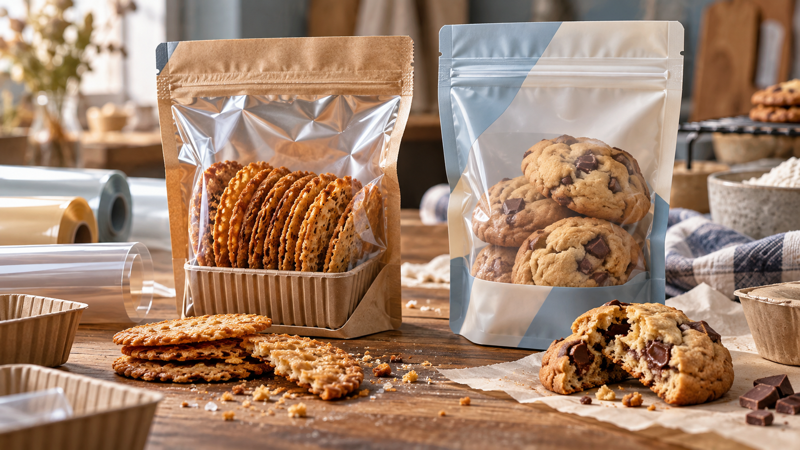
Crisp and soft cookies can look similar on a packaging line while requiring opposite moisture strategies. A crisp cookie fails when it absorbs humidity and loses its snap. A soft cookie may fail when it dries out and becomes hard. Both can oxidize, break, transfer oils, and absorb outside odors, but the desired texture determines the first packaging priority.
The right pouch is selected from product behavior, serving format, shelf life, and distribution—not from the word “cookie” alone. Barrier, headspace, trays, closures, and windows must support the texture the recipe was designed to deliver.
Compare Crisp and Soft Cookie Needs
| Design factor | Crisp cookies | Soft cookies |
|---|---|---|
| Main moisture risk | Humidity gain and loss of crunch | Moisture loss and hardening |
| Package objective | Strong moisture ingress barrier | Limit moisture loss and maintain internal balance |
| Physical concern | Brittle edges and breakage | Compression, sticking, or surface transfer |
| Typical pack style | Small portions, trays, flow wraps, barrier pouches | Sealed pouches, trays, or individually wrapped portions |
| Open-package challenge | Rapid softening in humid air | Gradual drying during repeated use |
| Useful validation | Crispness and fracture tests | Texture, moisture loss, and softness testing |
This comparison is a starting point. Fat, sugar, inclusions, coatings, water activity, and climate can change the final requirement.
Measure Product Moisture Behavior
Record moisture content and water activity after baking, cooling, and equilibration. A cookie packed too warm or before its internal moisture has stabilized may create condensation or change texture inside a high-barrier pouch.
Define sensory failure limits. For crisp cookies, identify the point at which snap or crunch becomes unacceptable. For soft cookies, determine the texture and moisture loss at which the product feels stale or hard. These limits allow packaging engineers to estimate the required barrier and then confirm it through shelf-life testing.
Mixed products need special attention. A soft filling between crisp wafers creates moisture migration inside the package even when external barrier is excellent. Chocolate, fruit pieces, nuts, and cream layers may add oxidation or temperature sensitivity.
Choose Moisture Barrier for Texture
Cookie Mylar bags can use multilayer structures with strong moisture, oxygen, aroma, and light protection. Confirm the actual construction and transmission data; a generic material name does not define shelf-life performance.
Crisp cookies usually benefit from low water-vapor transmission, especially in humid markets. Soft cookies also need moisture barrier, but the starting product condition and package headspace determine what the film retains. A high-barrier pouch cannot correct a cookie that enters the pack too dry.
Compare data under relevant temperature and humidity conditions. Then test the finished package, because seals, zipper profiles, folds, and punctures affect total performance. A small pouch has different surface area relative to product weight than a large family pack.
Add Oxygen and Light Protection
Butter, nuts, chocolate, and other fats can oxidize, producing stale flavors. Light may accelerate oxidation or fade decorations. Oxygen barrier and opaque layers become more important as fat sensitivity and shelf life increase.
Nitrogen flushing can lower initial oxygen and provide some cushioning. It works best when the barrier and seals prevent rapid re-entry. Delicate cookies may benefit from the gas cushion, but excessive headspace increases package and carton size.
Oxygen absorbers may suit selected products, provided capacity, activation conditions, food-contact status, labeling, and insertion control are validated. They do not manage every moisture problem and cannot compensate for a leaking pouch.
Protect Cookies From Breakage
Film alone cannot always protect a brittle product. Trays, paperboard supports, dividers, or individual cavities can reduce movement and distribute compression. The added component should provide measurable protection rather than decorative bulk.
Test the tray and pouch together. Sharp tray corners can puncture film, while an undersized pouch may put seals under tension. An oversized pouch allows the tray to move during drops. Rounded edges and controlled fit improve distribution performance.
For stacked cookies, count and orientation affect stress. For loose mini cookies, gas headspace and carton density may be enough. Use the heaviest and most fragile SKU in vibration, drop, and compression testing.
Select Single-Serve or Multi-Serve Packaging
Individual wrapping protects each cookie from repeated opening and supports portion control, but it adds material, seals, and packing operations. A multi-serve pouch uses fewer units and can create a stronger retail presentation, yet the remaining cookies are exposed every time the pack opens.
Pack size should match realistic consumption. A large crisp-cookie pouch may soften before a small household finishes it. A soft-cookie pack may dry out after repeated opening even when the zipper is closed correctly.
For multi-serve formats, test zipper operation with crumbs, sugar, and chocolate present. An intact top seal above the zipper provides first-opening evidence. Leave enough header for grip and a clean tear path.
Consider Paper Appearance Carefully
Paper cookie bags can create a bakery or natural look, but paper alone may not provide the required grease and moisture barrier. Many applications use a liner, coating, or laminated structure. The complete material should be evaluated for recyclability claims, food contact, sealing, and shelf life.
Grease spots can weaken visual quality even when food safety is unaffected. Test butter-rich and chocolate-coated cookies against the selected paper surface under warm storage. Folded closures and tin ties may suit short local distribution but should not be assumed to match a heat-sealed high-barrier pouch.
Use Windows Without Sacrificing Shelf Life
A clear window shows cookie shape and decoration, which is valuable for premium, bakery, and holiday cookie bags. It can also expose the product to light and create a lower-barrier area.
Keep the window no larger than needed and position it away from folds, seals, and tray edges. Validate the finished structure under retail lighting. Anti-fog performance may matter if temperature changes create condensation, but the first priority is preventing that moisture event.
Artwork should not hide breakage or create a misleading impression of quantity. Seasonal packaging also needs careful quantity planning because unused printed inventory can become obsolete quickly.
Protect the Seal Zone
Crumbs, sugar, chocolate, oil, and inclusions can create channel leaks. Control product placement and fill height so cookies remain below the seal. Trays should enter squarely without scraping or folding the pouch mouth.
Choose a sealant compatible with fats and production speed. Establish a validated window for temperature, pressure, and dwell time. Inspect seal strength and leak performance after packing and distribution.
If one machine lane shows repeated failures, check jaw alignment, contamination, temperature uniformity, and web tracking. Raising the set point may hide the symptom while damaging the film.
Validate Shelf Life by Cookie Family
The process for choosing cookie packaging for freshness should be applied to meaningful product groups. Test crisp, soft, filled, coated, and nut-containing cookies separately when their failure mechanisms differ.
Track water activity, moisture, texture, flavor, aroma, oxidation indicators where relevant, seal integrity, breakage, and appearance. Include normal and challenging storage, retail light where applicable, distribution simulation, and repeated opening for multi-serve packs.
Cookie Packaging Checklist
- Define whether success means retaining crispness or softness.
- Measure moisture, water activity, texture, and equilibration after baking.
- Choose moisture and oxygen barrier for the recipe and climate.
- Add trays or cushioning only when tests show protection.
- Match pack size and reclosure to realistic consumption.
- Validate paper layers, windows, and grease resistance.
- Keep crumbs, sugar, and fats away from heat seals.
- Test product families under storage and distribution conditions.
Crisp and soft cookies need packaging designed around their intended texture. Crisp products need protection from humidity gain, while soft products need protection from drying and internal moisture imbalance. When barrier, pack size, physical support, and opening pattern match the recipe, the consumer receives the texture the baker intended.