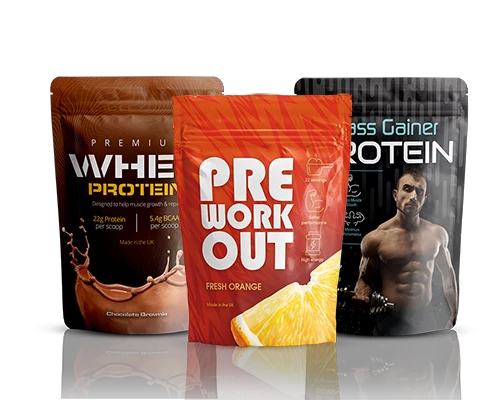
Walk into any supplement retailer and you’ll see a wall of protein powder pouches — but what you won’t see is what’s actually doing the work. The difference between a bag that keeps whey isolate fresh for 18 months in a humid tropical market and one that starts clumping after six weeks is almost entirely determined by the laminated film structure — the invisible stack of materials that forms the pouch wall.
This guide breaks down the four main barrier material options for protein powder pouches, explains exactly what each layer does, and gives you a decision framework matched to your product type, target market, and sustainability goals.
The Three Enemies of Protein Powder Freshness
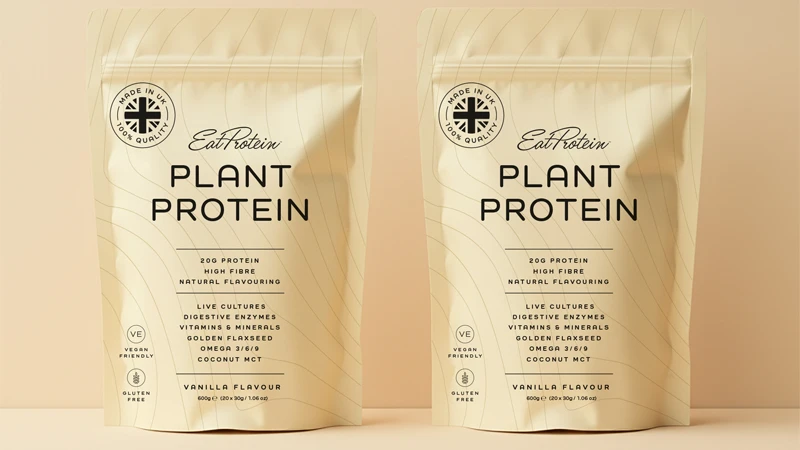
Before choosing a material, you need to understand what you’re defending against. Protein powder — whether whey concentrate, whey isolate, casein, collagen, or plant-based protein — is vulnerable to three environmental threats that degrade quality, taste, and nutritional value long before the expiry date printed on the label.
Moisture (WVTR)
Water vapor causes protein powders to absorb humidity, clump, harden, and develop microbial growth. Moisture is the primary cause of premature spoilage in flexible powder packaging.
Oxygen (OTR)
Oxygen oxidizes fats in the formula, creates rancid off-flavors, and degrades heat-sensitive vitamins, amino acids, and enzymes — particularly damaging to probiotic-enhanced blends.
Light (UV)
UV and visible light photodegrade vitamins (especially B vitamins and vitamin D), accelerate flavor loss in flavored protein powders, and cause natural colors to fade rapidly.
Every barrier material is rated against two key metrics: OTR (Oxygen Transmission Rate) — measured in cm³/m²/day — and WVTR (Water Vapor Transmission Rate) — measured in g/m²/day. The lower both numbers, the more protective the film. Your formula’s sensitivity determines which tier you actually need.
The 4 Main Barrier Material Structures
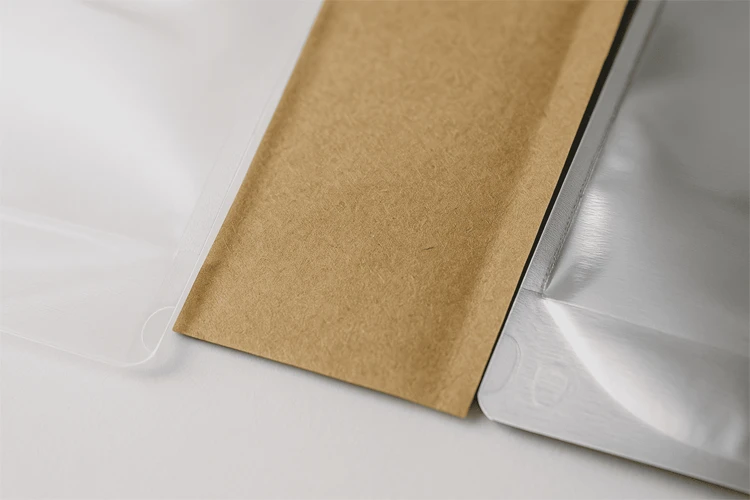
PET/VMPET/PE Metallized Laminate — Standard Barrier
This is the workhorse structure for standard protein powder packaging. The outer PET layer provides the printable surface and structural rigidity. The middle VMPET — polyethylene terephthalate with a vacuum-deposited thin layer of aluminum — significantly improves barrier performance over plain PET while keeping material costs lower than solid aluminum foil. The inner PE layer creates a food-safe, heat-sealable inner surface.
The metallized layer delivers a reflective, metallic aesthetic that many sports nutrition brands use to signal premium quality, and provides partial UV protection — though it is not an opaque light barrier. OTR values for PET/VMPET/PE typically sit around 5–10 cm³/m²/day, which is adequate for most standard whey protein concentrates sold in domestic markets with normal distribution conditions.
Best for: Standard whey protein concentrate (WPC), mass-market protein powders, domestic retail with ≤12-month shelf life targets, brands optimizing unit cost.
PET/AL/PE Aluminum Foil Laminate — High Barrier
Replacing the metallized film with a solid aluminum foil layer transforms barrier performance dramatically. The solid foil provides a near-perfect barrier to oxygen, moisture, and all forms of light — making PET/AL/PE the industry standard for premium protein powders, export products, and any formula sold into humid climates (Southeast Asia, Middle East, Latin America).
OTR values for PET/AL/PE drop to ≤ 0.5 cm³/m²/day — roughly 10–20x lower than metallized film — while WVTR falls to similarly negligible levels. The aluminum foil layer also provides complete opacity, blocking 100% of UV and visible light. This is the most common structure for leading sports nutrition brands packaging whey isolate, casein, and flavored protein blends for international distribution.
Best for: Whey isolate, casein, flavored blends, export markets, humid climates, retail shelf-life targets of 18–24 months. The default choice for most serious protein brands.
PET/AL/NY/PE Foil + Nylon Laminate — Ultra Barrier
The four-layer PET/AL/NY/PE structure is the highest-specification commonly used laminate for protein powder packaging. The addition of a nylon (polyamide) interlayer between the aluminum foil and the PE sealing layer serves two purposes: it significantly improves puncture and flex-crack resistance (critical when aluminum foil develops micro-pinholes during bag handling and shipping), and it reduces the OTR further to ≤ 0.1 cm³/m²/day.
This structure is the preferred specification for enzyme-enhanced protein blends, probiotic protein powders, and any formula where ingredient sensitivity demands the absolute lowest oxygen exposure. It is also the standard for large-format bags (2 kg–10 kg), where the additional wall strength prevents seal failures and flexing damage during palletized freight.
Best for: Probiotic protein blends, enzyme-fortified formulas, 2 kg–10 kg bulk bags, long-haul export logistics, ultra-premium sports nutrition positioning.
PE/EVOH/PE Mono-Material Recyclable — Eco Barrier
Mono-material PE pouches with an EVOH barrier interlayer represent the sustainable evolution of protein powder packaging. Unlike traditional multi-layer laminates that combine incompatible materials (PET + aluminum + nylon), mono-PE structures use only polyethylene-family materials throughout — making them fully recyclable in the PE film recycling stream that exists in most Western markets.
The barrier is delivered by a thin EVOH (ethylene vinyl alcohol) layer kept below 5% of total film weight — the threshold that maintains PE recyclability under CEFLEX and similar certification schemes. OTR values of 0.5–2 cm³/m²/day are adequate for most standard protein powders with a 12-month shelf life. Major brands including Myprotein have already transitioned entire product ranges to mono-material structures as part of their sustainability commitments.
Best for: Clean-label and organic protein brands, EU/UK market positioning, brands with sustainability commitments, standard whey and plant-based protein with 12-month shelf life.
“Basic whey protein concentrate may be adequately protected by PET/VMPET/PE film, while enzyme-based or probiotic protein blends require PET/AL/PE or even PET/AL/NY/PE for maximum barrier performance.”
Side-by-Side Barrier Comparison
| Structure | OTR (cm³/m²/day) | WVTR (g/m²/day) | UV Block | Recyclable | Cost Index |
|---|---|---|---|---|---|
| PET/VMPET/PE | ≤ 10 | ≤ 5 | Partial | ✗ No | $ |
| PET/AL/PE | ≤ 0.5 | ≤ 0.5 | 100% | ✗ No | $$ |
| PET/AL/NY/PE | ≤ 0.1 | ≤ 0.1 | 100% | ✗ No | $$$ |
| PE/EVOH/PE | 0.5–2 | 0.8–3.5 | None | ✓ PE stream | $$ |
How to Match Barrier to Your Formula
The right barrier specification is determined by three variables: your protein formula’s sensitivity, your target market’s climate and distribution conditions, and your shelf life target. Use this framework as your starting point:
- Whey protein concentrate (WPC 70–80%)
- Domestic retail, temperate climate
- 12-month shelf life target
- Cost-optimization priority
- Mass-market price positioning
- Whey isolate (WPI 90%+), casein
- Export markets, humid climates
- 18–24 month shelf life target
- Flavored blends (oxidation sensitive)
- Mid-premium retail positioning
- Probiotic or enzyme-fortified protein
- 2 kg–10 kg bulk format bags
- Long-haul ocean freight distribution
- 24+ month shelf life requirement
- Ultra-premium brand positioning
- Standard whey, plant-based protein
- EU/UK sustainability compliance
- Organic or clean-label positioning
- 12-month shelf life target
- ESG-driven brand commitments
5 Things to Confirm with Your Pouch Manufacturer
Once you’ve identified your target material structure, the conversation with your supplier is just beginning. Here are the critical questions and certifications to verify before you commit to a material specification:
- Request actual OTR and WVTR test data — not estimated values. Reputable manufacturers provide laboratory-tested transmission rate certificates for every film structure. Ask for the specific test conditions (temperature, humidity) to ensure they reflect your target market climate.
- Confirm food-contact certifications — all film layers must comply with FDA 21 CFR (for US distribution), EU Regulation 10/2011 (for EU), or equivalent local standards. Ask for a written declaration of compliance (DoC) and migration test reports from your supplier.
- Verify BPA-free status — all inner PE layers should be confirmed BPA-free. This is increasingly a mandatory claim for supplement brands and is required by many major retail buyers.
- Request a pre-production sample with your actual formula — fill a sample pouch with your protein powder, seal it, and conduct a real-world shelf-life or accelerated aging test. A material that passes theoretical specifications can still fail with your specific product if the formulation reacts unexpectedly with the inner PE layer.
- For recyclable mono-PE: verify CEFLEX or How2Recycle certification — not all mono-PE structures are certified recyclable. The EVOH content must remain below 5% of total film weight, and the structure must be certified by an independent scheme to support on-pack recyclability claims.
Making the Right Call for Your Brand
The barrier material decision is not one-size-fits-all. A mass-market whey protein brand selling in domestic retail can operate profitably with PET/VMPET/PE and keep unit costs low. A premium whey isolate brand exporting to Southeast Asia needs the full protection of PET/AL/PE or better. A probiotic-enhanced protein launching in 5 kg bags for the European market has no real alternative to PET/AL/NY/PE.
And for any brand building a sustainability story — particularly those targeting EU markets where the Single-Use Plastics Directive and recyclability requirements are tightening — the transition to PE/EVOH/PE mono-material is worth the modest barrier trade-off for the right product types.
The cost difference between these structures is typically a few cents per unit — small relative to the cost of a product recall, a reformulation triggered by quality failures, or the brand damage of consumer complaints about clumped or rancid protein powder.
Conclusion
Match your barrier to your formula, your market, and your shelf-life target — not to the cheapest option or the most expensive. Start with PET/AL/PE as your baseline for serious protein brands, step up to PET/AL/NY/PE for sensitive formulas and large-format bags, step down to PET/VMPET/PE for standard domestic products, and consider PE/EVOH/PE when your brand story and target market make recyclability a commercial asset.
Frequently Asked Questions
What is the best barrier material for whey protein powder pouches?
For standard whey protein concentrate with a 12–18 month shelf life, PET/AL/PE (aluminum foil laminate) provides an excellent balance of barrier performance and cost. For premium whey isolate or enzyme-enhanced blends requiring longer shelf life or export distribution, PET/AL/NY/PE adds a nylon layer for superior puncture resistance and ultra-low oxygen permeability.
What is the difference between PET/VMPET/PE and PET/AL/PE?
PET/VMPET/PE uses a metallized (vacuum-deposited aluminum) middle layer — thinner and more cost-effective, providing moderate barrier protection with OTR values around 5–10 cm³/m²/day. PET/AL/PE uses a solid aluminum foil middle layer (7–9 µm thick), providing a near-perfect barrier with OTR ≤ 0.5 cm³/m²/day and 100% light opacity. The foil laminate is the right choice for premium products, export markets, and any formula sensitive to oxygen or light.
Can recyclable mono-PE pouches protect protein powder adequately?
Yes, with the right specification. Mono-PE structures using an EVOH interlayer (PE/EVOH/PE) achieve OTR values of 0.5–2 cm³/m²/day — sufficient for most standard protein powders with a 12-month shelf life in normal distribution conditions. They are not recommended for probiotic or enzyme-sensitive formulas, humid tropical export markets, or products requiring longer than 15-month shelf life. Always verify CEFLEX or How2Recycle certification to support on-pack recyclability claims.
Why does protein powder clump in its pouch?
Clumping is almost always caused by moisture ingress — either through an inadequate barrier film, a failed or weak heat seal, or a zipper closure that allows air exchange during repeated opening. If you’re experiencing clumping, first check the WVTR specification of your current film structure and compare it against your target market’s average humidity. Upgrading from PET/VMPET/PE to PET/AL/PE typically eliminates moisture-related clumping in most markets.
What certifications should I ask my protein pouch supplier for?
Request: (1) FDA 21 CFR food-contact compliance declaration for US market; (2) EU Regulation 10/2011 migration test report for European distribution; (3) ISO 9001 quality management certification for the manufacturing facility; (4) BRC food packaging certification; (5) laboratory OTR and WVTR test certificates for your specific film structure. For recyclable mono-PE pouches, add CEFLEX certification or equivalent.