
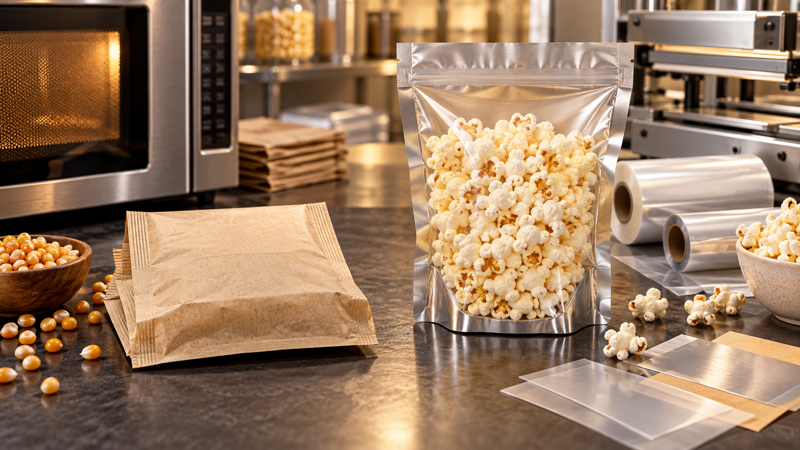
Microwave popcorn and ready-to-eat popcorn share a name, but their packages perform very different jobs. A microwave bag must contain kernels and oil during storage, interact safely with microwave energy, vent steam in a controlled way, and withstand high temperatures as the kernels pop. A ready-to-eat pouch receives already popped corn and mainly protects crispness, flavor, and physical volume through distribution and consumer use.
Treating these formats as interchangeable creates serious performance problems. The film structure, seal pattern, converting method, filling equipment, validation, and regulatory documentation should follow the product’s actual preparation and sales route.
Compare the Core Requirements
| Design factor | Microwave popcorn pack | Ready-to-eat popcorn pouch |
|---|---|---|
| Main function | Cook kernels while managing heat, oil, steam, and expansion | Preserve crisp texture and protect a bulky finished snack |
| Temperature exposure | High internal heat during preparation | Normally ambient storage, with distribution heat possible |
| Moisture task | Retain formulation moisture before use, then manage steam | Prevent humidity from softening popped corn |
| Seal behavior | Controlled strength and venting under cooking pressure | Strong seals through filling, shipping, and repeated handling |
| Material focus | Heat and grease resistance, microwave suitability, engineered paper or film system | Moisture barrier, aroma protection, toughness, low package weight |
| Typical presentation | Folded cooking bag inside a carton or overwrap | Pillow, stand-up, or large party-size bag |
The microwave column describes a specialized cooking package, not an ordinary pouch that can simply be placed in a microwave. Development requires qualified material suppliers, food-safety specialists, and appliance testing.
Microwave Popcorn Is a Cooking System
The package, popcorn kernels, oil, seasoning, susceptor where used, fold pattern, seals, and microwave instructions function together. Changes to kernel weight, oil distribution, paper porosity, adhesive, or seal strength can alter pressure, heating, expansion, and venting.
Materials must be suitable for the intended food-contact and microwave conditions. Grease resistance is essential because oil can weaken paper, affect bonds, or migrate toward seals. Thermal exposure is uneven, so local hot spots must be considered rather than relying only on an average temperature.
Some microwave bags use a susceptor to convert microwave energy into additional heat and promote popping. Its placement, dimensions, bonding, and interaction with the food are specialized design parameters. It should never be added as an unverified generic component.
The bag must expand as kernels pop while controlling steam release. If seals are too weak, they may open prematurely; if too strong or incorrectly placed, pressure may not vent as designed. Fold geometry also keeps the package compact before cooking and guides expansion.
Validate Microwave Performance Across Appliances
Microwave ovens vary in power, cavity size, energy distribution, and operating condition. Test the complete product and package across a justified range of appliances and preparation scenarios. Include different storage ages and realistic variation in kernel moisture and fill distribution.
Evaluate popping yield, unpopped kernels, scorching, smoke, seal behavior, bag expansion, venting, oil leakage, handling temperature, and opening safety. Instructions should reflect validated performance and warn consumers about steam and hot contents as required.
Shelf-life testing before cooking is also necessary. The package must retain the moisture balance needed for good popping while protecting oil and flavors from oxidation. A pack that stores safely but produces poor popping late in shelf life is not successful.
Ready-to-Eat Popcorn Needs Moisture Barrier
Popped corn has a crisp, porous structure that can absorb humidity quickly. Moisture gain softens the texture even when flavor and appearance seem normal. Barrier selection should therefore begin with the maximum moisture gain the product can tolerate before sensory failure.
Popcorn bags for ready-to-eat products can use metallized or clear barrier structures depending on shelf life, display, and brand goals. Review water-vapor transmission data under relevant test conditions, then verify with the final package.
Coated popcorn, caramel corn, cheese popcorn, and plain salted popcorn may need different structures. Coatings can reduce or redistribute moisture sensitivity, introduce oils, or create aroma and oxygen-protection needs. Seasoning dust also affects seal cleanliness.
Transparent plastic popcorn bags show the product but expose it to light and may provide different barrier from an opaque metallized laminate. Visibility should be balanced against texture, oxidation, color, and shelf-life requirements.
Use Nitrogen to Protect Texture and Shape
Nitrogen flushing can displace oxygen and create a cushion around ready-to-eat popcorn. The cushion helps reduce crushing during case packing and distribution, while lower oxygen can protect flavors and oils.
Control gas flow, pouch headspace, nozzle position, and sealing delay. Excessive gas creates oversized packs and inefficient cartons. Too little headspace leaves the product vulnerable to compression and can make gas displacement inconsistent.
Measure residual oxygen in production-equivalent packs. Recheck after a holding period to detect leaks or film damage. Nitrogen cannot protect crispness if moisture enters through an inadequate laminate or channel seal.
Size the Ready-to-Eat Package by Volume
Popcorn is light and bulky, so net weight alone is a poor guide to pouch dimensions. Expansion varies with kernel variety, popping method, coating, broken-piece percentage, and settling. Fill representative production samples and measure the settled volume without crushing the product.
Popcorn bag sizes should reflect portion role as well as weight. A single-serve pack needs compact shipping and easy opening. A sharing bag requires enough volume, strong seals, and possibly reclosure. A party-size bag may prioritize cost and carrying comfort but must still fit cases and retail shelves efficiently.
Avoid a bag so tight that sealing or case packing crushes the popcorn. Excessive space, however, increases film use and dimensional shipping cost. Optimize the complete case count, not only the individual bag’s shelf appearance.
Choose the Ready-to-Eat Format
Pillow packs formed from film roll packaging are common for higher-speed snack production. Rollstock must match the forming collar, coefficient of friction, registration, jaw design, and line speed. The long back seal and cross seals need protection from oil and seasoning.
Stand-up pouches provide a premium retail face and can include a zipper for larger sizes. The bottom gusset must open fully without creating folds that trap product near the seal. Flat-bottom bags offer structure but may add material and converting cost.
For club, cinema, or party formats, large pillow or side-gusset bags can use volume efficiently. Carrying, pouring, and reclosing should be tested with the filled package. Large areas of unsupported film may need adequate stiffness and puncture resistance.
Protect Seals From Oil and Seasoning
Ready-to-eat popcorn is fragile, and broken pieces or seasoning can enter the seal zone. Oil from coatings may reduce seal strength. Control the product drop, dust extraction, settling time, fill height, and jaw cleaning.
Choose a sealant with appropriate hot tack and contamination tolerance. Establish a broad operating window for temperature, pressure, and dwell time at production speed. A higher temperature is not always better; excess heat can distort the film or cause seal thinning.
Use seal-strength and leak testing, then inspect the failure mode. A channel created by cheese powder needs a different correction from a wrinkle caused by poor web tracking.
Test Distribution and Shelf Life
Microwave and ready-to-eat packs require separate test protocols. Microwave packs need cooking validation, pre-use storage stability, grease resistance, seal and fold performance, and safe handling evaluation. Ready-to-eat packs need moisture and oxygen shelf-life testing, seal integrity, residual-gas control, and crushing protection.
For ready-to-eat products, test the final cases through vibration, drops, compression, and temperature or humidity conditioning. Measure breakage, bag inflation, leaks, seal damage, and texture after distribution. Large bags at the bottom of a pallet may experience loads that small laboratory samples do not reproduce.
Repeated-opening studies are important for resealable sharing packs. Each opening introduces humid air, and seasoning can contaminate the zipper. Define a realistic open-life experience rather than extending the sealed shelf-life assumption.
Popcorn Packaging Checklist
- Classify the product as microwave cooking or ready-to-eat before selecting materials.
- Validate microwave bags as a complete food, package, and appliance system.
- Choose ready-to-eat barrier from the product’s crispness limit and climate.
- Size pouches with actual popped volume, coating, settling, and breakage.
- Control nitrogen headspace without oversizing cartons.
- Keep oil, crumbs, and seasoning out of sealing surfaces.
- Match rollstock properties to the intended machine and line speed.
- Test cooking performance or distribution performance as appropriate.
Microwave popcorn packaging manages a high-temperature cooking event, while ready-to-eat packaging protects an already fragile snack. Their common branding should not obscure their technical differences. When material, seal, size, and testing follow the actual use case, both formats can deliver the texture, safety, and convenience consumers expect.