
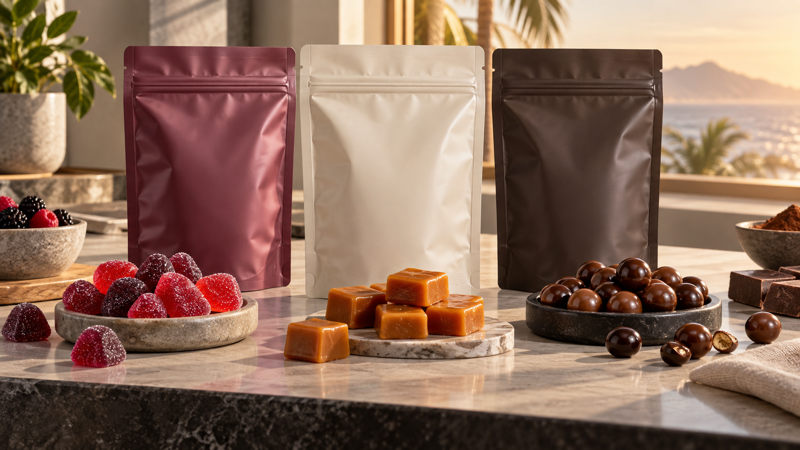
Heat-sensitive candy can leave the factory in perfect condition and arrive as a fused, oily, or deformed mass. Gummies soften, caramels flow, chocolate-coated pieces bloom or smear, and flavored candies may transfer aroma into the package or nearby products. Sticky residues then interfere with zippers and heat seals, turning a texture problem into a package-integrity problem.
Packaging cannot replace temperature control, but it can reduce moisture exchange, oxygen and aroma transfer, surface abrasion, and physical compression. The best result comes from matching formulation, processing, pouch structure, filling conditions, and distribution protection.
Define the Product’s Heat and Moisture Limits
Identify the temperature at which the candy softens, deforms, releases oil, loses coating, or blocks together. Evaluate realistic exposure time, not only a short melting-point test. A parcel may spend hours in a vehicle or loading area at elevated temperature.
Measure water activity and moisture behavior as well. Gummies and fruit chews may absorb humidity and become sticky, while some candies harden when they lose moisture. Sugar crystallization, acid migration, and coating stability can change with temperature cycling.
Set acceptable sensory limits for shape, separation, chew, gloss, flavor, and surface feel. These product limits become packaging and logistics design inputs. If the distribution environment routinely exceeds the candy’s tolerance, insulated shipping or route controls may be necessary.
Choose Barrier Around the Failure Mode
Custom candy bags can be built with moisture, oxygen, aroma, light, and grease barriers. The priority depends on the candy. A hygroscopic gummy may be driven by moisture control, while chocolate, nuts, or oil-containing fillings add oxidation and light sensitivity.
Foil stand-up pouches can provide strong moisture, oxygen, light, and aroma protection. Metallized or clear high-barrier structures offer different appearance, flex resistance, cost, and recycling tradeoffs. Select from transmission data and product testing rather than visual opacity alone.
Heat can increase permeation and accelerate product changes. Review barrier data under relevant test conditions, then test finished pouches in normal and challenging environments. Seals, zippers, windows, and flex damage may become the weakest pathways.
Prevent Blocking and Surface Damage
Blocking occurs when pieces stick together under heat, humidity, pressure, or surface oil. Formulation, curing, coating, and product temperature at packing often matter more than the pouch alone. Candy should enter the package within a validated condition range.
Avoid sealing warm product unless the process is designed for it. Cooling inside a closed pouch may change headspace humidity or create condensation. Control room temperature and humidity, minimize exposure, and verify that coatings have set before filling.
Pack size and headspace influence movement and compression. Too little space can force candies together; excessive space lets them collide and abrade during vibration. Fill representative pieces and test the settled pouch in the final carton.
Interleaving, individual wraps, trays, or coatings may be needed for very tacky or decorated products. Each added component should solve a measured problem and remain compatible with food contact and the brand’s material goals.
Protect Seals From Sticky Residue
Syrup, sugar, oil, powder, and product fragments can contaminate sealing surfaces. A residue-coated seal may look closed while containing fine channels. High temperature during storage can make contamination migrate or weaken the bond further.
Control the filler cut-off, drop height, fill level, settling time, and pouch handling. Keep the product below the zipper and top seal. Use validated cleaning or shielding methods that do not spread residue across the film.
Choose an inner sealant compatible with oils, acids, flavors, and the expected process temperature. Establish a sealing window for temperature, pressure, and dwell time at production speed. Excessive heat may squeeze out sealant or distort the pouch, while insufficient energy creates partial fusion.
Inspect seal strength, leakage, and failure mode after packing, warm conditioning, and distribution. A seal that passes at room temperature immediately after production may behave differently after oily candy contacts it for weeks.
Select a Closure for Real Use
Small candy sachets are often consumed at once and need a clean tear rather than a zipper. Larger pouches may be opened repeatedly. The zipper must close even when sugar crystals, sticky film, or oil reaches the track.
Gummy bags should be tested after actual pieces have moved through the opening. Shake, transport, open, dose, and reclose the pouch through the expected use cycle. Confirm that consumers can feel when the profile is fully engaged.
An intact top seal provides first-opening evidence. Leave enough header for grip, and keep tear notches away from the zipper. Reclosure slows environmental exposure but does not restore the original atmosphere, so open-life testing remains essential.
Manage Aroma and Flavor Migration
Strong mint, fruit, spice, or sour flavors may move through films or affect adjacent products. The package must retain desired aroma and resist outside odors. Sensory testing should store candy beside neutral samples to detect cross-transfer.
Flavor oils can interact with sealants, inks, adhesives, or coatings. Conduct compatibility studies with the complete commercial candy, not only a base recipe. Watch for bond weakening, swelling, staining, odor changes, and print degradation.
If several flavors share a carton, individual package aroma barrier becomes more important. A variety pack should still allow each candy to taste distinct at the end of shelf life.
Design Printing for Heat and Abrasion
Warm, oily, or sticky packs experience rubbing during distribution. Surface print or coatings may scuff, transfer, or lose gloss. Reverse printing within a laminate can protect graphics, while suitable varnishes can improve surface resistance on other constructions.
Test rub resistance under dry and conditioned states. Filled pouches should be vibrated against one another and the carton. Matte and soft-touch finishes may show oil or abrasion differently from gloss surfaces.
Leave a reliable area for lot and date codes. The code must adhere to the final finish and remain legible after heat, handling, and rubbing. Do not place critical information on highly curved gussets or tear-off headers.
Plan Small Packs Carefully
Small sachets magnify filling and seal tolerances. A few candies can occupy unpredictable volume, and one misplaced piece can bridge the seal. Use accurate counting or weighing equipment and confirm that the opening is wide enough for the largest piece.
Three-side-seal or pillow packs can support samples, portion control, and variety sets. The tear path should open cleanly without cutting through candy or scattering small pieces. Compact packs also have high film area relative to product, so shelf-life validation remains necessary.
Larger bags for candy provide more artwork and reclosure options but may extend the consumer use period. Choose net weight from consumption behavior, not only shelf impact.
Validate Hot-Weather Distribution
Condition filled packs at expected high temperatures and humidity, including temperature cycles that simulate day and night. Evaluate deformation, blocking, oil migration, coating damage, aroma, flavor, seal strength, zipper function, print rub, and package appearance.
Run drops, vibration, and compression while packs are warm where practical. Soft candy behaves differently under load than a cool laboratory sample. Test the actual parcel or case, including worst-case pallet positions.
If cold packs or insulation are used for e-commerce, validate coolant placement, condensation control, shipping duration, and consumer instructions. Moisture from a cooling system must not weaken cartons or labels.
Candy Packaging Checklist
- Define temperature, humidity, and pressure limits for the candy.
- Pack only after cooling, curing, and coating reach a stable condition.
- Select barrier for moisture, oxygen, light, grease, and aroma risks.
- Size headspace to avoid compression without excessive movement.
- Keep syrup, oil, sugar, and fragments out of seals and zippers.
- Test material compatibility with acids, flavors, oils, and coatings.
- Validate print and coding after heat and abrasion.
- Simulate warm storage, shipping, repeated opening, and recovery.
Packaging for sticky and heat-sensitive candy succeeds when it protects the product without pretending film can stop heat. A compatible barrier pouch, clean seal, workable closure, controlled fill condition, and realistic distribution plan reduce sticking and deformation. Product-specific warm testing shows where packaging ends and temperature management must begin.