
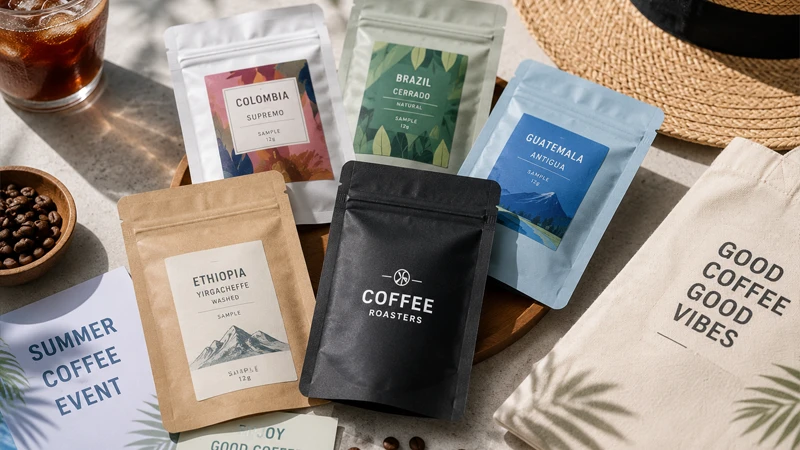
Coffee samples give customers a low-risk way to discover a new roaster, origin, blend, or roast profile. At trade shows, farmers’ markets, coffee festivals, retail launches, and summer promotional events, a well-designed sample pack can turn a short interaction into a future purchase.
For these applications, small coffee pouches are more effective than simply reducing the size of a standard retail bag. A successful sample pouch must protect freshness, contain the right amount of coffee, communicate the brand clearly, and remain easy to transport and distribute.
Among the most common sample sizes, 30g, 50g, and 100g pouches each serve a different purpose. Selecting the correct size and structure helps coffee roasters control promotional costs while giving potential customers a meaningful product experience.
Why Small Coffee Pouches Work for Coffee Marketing

A full-size bag may be too expensive to distribute freely at an event. It also asks the customer to commit to a larger quantity before they know whether they enjoy the coffee. A smaller pouch reduces that barrier.
Samples are particularly useful for specialty roasters introducing single-origin coffees, seasonal blends, limited releases, or unusual processing methods. Instead of describing the flavor in a brochure, the brand allows the customer to brew and evaluate the coffee at home.
The pouch continues promoting the roaster after the event ends. A customer may receive the sample at a coffee festival, place it in a bag, and brew it several days later. During that period, the packaging must preserve the coffee and keep the brand visible.
This is why small coffee pouches should be treated as miniature retail packages rather than disposable giveaway bags.
Choosing Between 30g, 50g and 100g Pouches
The correct pouch size depends on the brewing method, promotional objective, and value of the coffee.
| Sample size | Typical purpose | Suitable coffee format | Customer experience |
|---|---|---|---|
| 30g | Single tasting, event giveaway, subscription insert | Whole beans or ground coffee | One small brew or tasting session |
| 50g | Coffee festival sample, new-origin trial, gift set | Whole beans or ground coffee | One standard brew or two small tastings |
| 100g | Premium sample, paid trial pack, retail promotion | Primarily whole beans | Several brews and a fuller product evaluation |
A 30g pouch is suitable when the goal is broad distribution. Roasters can hand out a large number of samples without creating excessive product or packaging costs. It works well for a single pour-over, a cupping-style tasting, or a small cold brew test, depending on the brewing ratio.
A 50g pouch provides more flexibility. It gives customers enough coffee to prepare a full brew or compare two smaller brewing methods. This size is often ideal for coffee festivals and market stalls because it still feels compact while providing more perceived value than a very small sachet.
A 100g pouch is closer to a trial-size retail product. It allows customers to brew the coffee several times and adjust the grind, water temperature, and extraction method. For premium or complex coffees, repeated brewing may create a more accurate impression than a single sample.
Small Coffee Pouches for Trade Shows
Trade shows bring roasters, importers, distributors, cafés, equipment suppliers, and packaging buyers together in one location. Sample pouches can support both consumer marketing and business development.
A roaster meeting a potential distributor may provide a small set containing several origins or roast profiles. Each pouch can include the coffee name, origin, roast date, tasting notes, and recommended brewing method. This is more memorable than distributing a product sheet alone.
Trade-show samples must be easy to carry. Large or bulky packages quickly become inconvenient for visitors collecting materials from multiple exhibitors. Flat 30g or 50g pouches fit easily into tote bags, sample boxes, and presentation folders.
The pouch should also remain visually recognizable after it is separated from the booth. Clear branding, readable product information, and a QR code connecting to the product page can help the recipient remember where the sample came from.
For business buyers, the QR code may lead to wholesale information, private-label services, certifications, or a meeting-booking page. For consumers, it may lead to brewing instructions or a discount on a full-size bag.
Packaging for Farmers’ Markets and Coffee Festivals
Farmers’ markets, street markets, and coffee festivals create direct contact between roasters and customers. Visitors can smell the beans, speak with the roaster, and taste freshly brewed coffee. Small pouches extend this experience beyond the event.
At a market stall, a 50g sample may be offered as a low-priced trial product. A 30g pouch may be included free with a larger order or given to customers who join a mailing list. A 100g pouch can serve as an entry-level retail option for customers who want to try several coffees without purchasing multiple full-size bags.
The packaging should reflect the event environment. Market shoppers often respond well to kraft-style pouches, handwritten-style labels, and natural finishes. Coffee festivals may support brighter colors, metallic effects, or more experimental graphics.
However, appearance should not replace functionality. Outdoor markets can expose coffee to sunlight, heat, and humidity. Even though the pouch is small, it still needs sufficient resistance to oxygen and moisture.
Suggested image: A coffee festival display featuring coordinated 30g, 50g, and 100g sample pouches in different colors.
Summer Promotions Need Better Freshness Protection
Summer campaigns often include outdoor events, travel promotions, subscription inserts, gift boxes, and seasonal coffee launches. These promotions may place coffee samples in conditions that are warmer and more humid than normal retail storage.
Heat accelerates the loss of coffee aroma, while humid air increases the pressure for water vapor to move through the packaging. Samples may also spend hours in vehicles, outdoor booths, or customer bags before reaching a stable indoor environment.
For this reason, summer promotional pouches should not rely on simple paper or low-barrier film. A laminated structure with dependable oxygen and moisture resistance is more appropriate.
Metallized film provides a strong balance of barrier performance, low weight, and cost. Aluminum foil laminates offer stronger protection when the coffee is especially valuable or the expected storage period is longer. Kraft paper can be used as the outer layer, but it should be combined with an internal barrier film.
Opaque packaging also limits light exposure. If a transparent window is included, it should be small and produced from a film that does not significantly reduce the overall barrier.
Whole Beans or Ground Coffee Samples?
Whole beans are generally preferred when freshness and aroma retention are the main priorities. They expose less surface area to oxygen and allow customers to choose their own grind size.
However, ground coffee can make sampling more accessible. At a public event, some customers may not own a grinder. A pre-ground sample matched to a common brewing method can remove this obstacle.
A roaster may produce separate sample versions for pour-over, French press, espresso, or cold brew. The grind type should be printed clearly on the pouch to prevent confusion.
Ground coffee requires stronger oxygen protection because grinding increases the exposed surface area. Nitrogen flushing can reduce the amount of oxygen remaining inside the sealed pouch. The package should then have a low oxygen transmission rate so that outside air does not quickly replace the protective atmosphere.
For 30g ground samples intended for immediate use, a flat sachet may be sufficient. For 50g or 100g packs that may be opened more than once, a resealable zipper provides greater convenience.
Suitable Pouch Styles for Small Coffee Packs
Three-side-seal pouches are one of the most practical formats for 30g coffee samples. They are compact, economical, and easy to insert into event bags, subscription boxes, or promotional mailers. A tear notch allows customers to open the package without scissors.
Small stand-up pouches are suitable for 50g and 100g products. Their bottom gusset allows them to stand on a table or retail shelf, improving visibility during events. They can also include a zipper, hang hole, or degassing valve.
Flat-bottom bags create a premium appearance but may be less economical at very small capacities. They are more appropriate for 100g trial packs, luxury gift sets, or high-value specialty coffees.
Side-gusset bags can also be produced in small dimensions, although their primary advantage becomes more noticeable in larger coffee packs. For promotional use, their traditional coffee-bag appearance may still support certain brand styles.
| Pouch style | Recommended size | Main advantage |
|---|---|---|
| Three-side-seal pouch | 30g or 50g | Compact and economical |
| Small stand-up pouch | 50g or 100g | Strong display and resealability |
| Mini flat-bottom bag | 100g | Premium shelf appearance |
| Small side-gusset bag | 50g or 100g | Traditional coffee packaging style |
Does a Small Coffee Pouch Need a Degassing Valve?
Whether a valve is necessary depends on how soon the coffee is packed after roasting, the coffee format, and the sample size.
Freshly roasted whole beans continue releasing carbon dioxide. If they are packed immediately in an airtight pouch, pressure may build inside. A one-way degassing valve allows the gas to escape while limiting outside oxygen entry.
For a 100g whole-bean sample, adding a valve is often practical, especially when the sample is sold rather than distributed for immediate use. A 50g pouch may also benefit from a valve when filled soon after roasting.
For very small 30g samples, the cost and space required for a valve may be less attractive. The roaster may instead allow the beans to degas for a controlled period before packing. The correct approach depends on roast level, filling schedule, pouch headspace, and expected distribution time.
Ground coffee usually releases gas faster than whole beans. Nitrogen flushing and rapid sealing may be more important than a valve for some pre-ground sample products.
Printing and Branding for Promotional Coffee Pouches
Small pouches provide less printable space, so the design must be focused. The front should communicate the brand, coffee name, and key flavor message quickly. The back can include origin, process, roast level, brewing instructions, and contact information.
Digital printing is particularly suitable for sample programs because it supports smaller order quantities and multiple designs. A roaster can produce different graphics for several origins, event locations, seasonal campaigns, or promotional partners without requiring a large volume of each version.
Variable QR codes can connect each coffee to its own product page or brewing guide. This helps the brand measure engagement after the event and makes it easier for customers to purchase the full-size product.
For short promotional campaigns, custom labels applied to stock pouches may provide a lower-cost option. Fully printed pouches create a stronger professional impression and are more suitable when the samples will be distributed through retailers or business partners.
Turning Samples Into Full-Size Sales
The purpose of a sample is not only to give away coffee. It should create a clear next step.
The pouch can include a QR code, promotional code, website address, or invitation to join a subscription. A 30g giveaway may offer a discount on the first full-size bag. A 100g paid sample may be part of a discovery set in which the purchase value can be applied to a later order.
Consistent packaging also makes the connection between the sample and the full-size product easier to recognize. Using the same color system, typography, and product naming across all pouch sizes helps customers find the coffee again.
Roasters can also use sample pouches to test market interest before committing to a major launch. Different blends or roast profiles can be distributed at an event, and customer responses can guide future production and marketing decisions.
Conclusion
Small coffee pouches are powerful tools for trade shows, markets, coffee festivals, product launches, and summer promotions. They allow customers to experience a coffee before purchasing a full-size bag while giving roasters a practical format for distributing new origins and seasonal blends.
A 30g pouch is ideal for broad giveaways and single-brew samples. A 50g pouch provides a balanced trial experience, while a 100g pack gives customers enough coffee for several brewing sessions.
The packaging structure should protect against oxygen, moisture, heat, and light, particularly during outdoor summer events. Three-side-seal sachets offer an economical option for the smallest samples, while stand-up and flat-bottom pouches provide stronger display value for larger trial packs.
When barrier performance, pouch style, printing, and promotional strategy are considered together, small coffee pouches become more than containers. They become portable brand experiences that help turn event visitors and first-time tasters into long-term coffee customers.