
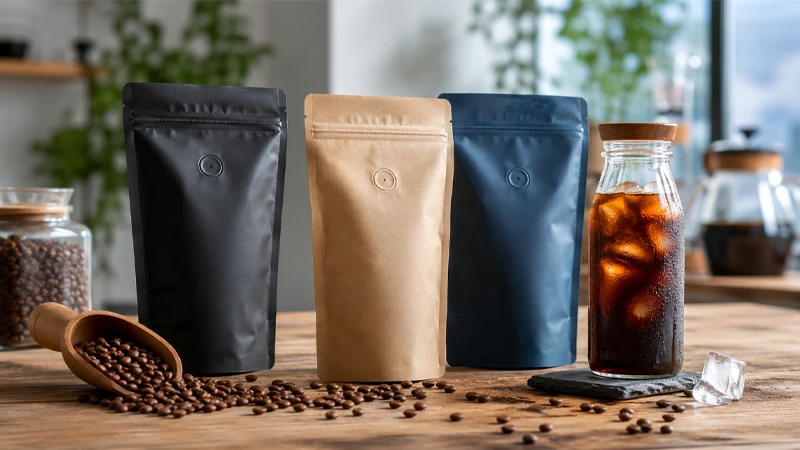
Cold brew coffee is associated with a smooth body, low perceived bitterness, and a flavor profile that works especially well with chocolate, caramel, nut, and dark-fruit notes. Although almost any properly roasted coffee can be used for cold brewing, many commercial cold brew products rely on medium, medium-dark, or dark roasts that produce a rich and recognizable taste after long extraction.
The packaging selected for these beans or grounds has a direct influence on the flavor customers eventually experience. Poor cold brew coffee packaging can allow oxygen, moisture, heat, and light to affect the coffee before brewing begins. The result may be a flat concentrate with less aroma, weaker sweetness, or unpleasant oxidized notes.
The best pouch depends on whether the product is sold as whole beans, coarse-ground coffee, or a pre-portioned cold brew pack. Each format has different barrier, degassing, sealing, and convenience requirements.
Why Cold Brew Coffee Requires Careful Packaging
Cold brewing uses cooler water and longer contact times than conventional hot extraction. Research has shown that grind size, temperature, brewing ratio, and steeping time all influence extraction rate and yield. Smaller particles extract more quickly, while coarse particles require a longer extraction period and are widely used to support controlled immersion and easier filtration.
Because the brewing process is relatively gentle, stale or poorly stored coffee cannot be hidden by high extraction temperature. The final beverage depends heavily on the condition of the roasted coffee before it enters the brewing vessel.
Cold brew producers may use whole beans and grind them shortly before production, or purchase coffee that has already been coarsely ground. Whole beans generally retain freshness longer because less surface area is exposed to air. Research comparing whole and ground coffee during aerobic storage found that storage-related changes were much smaller in whole beans than in partially or fully ground coffee.
This means pre-ground cold brew products usually need a stronger packaging specification than an equivalent whole-bean product.
Medium and Dark Roasts for Cold Brew
There is no rule requiring cold brew to use dark-roasted coffee. Light roasts can produce fruity, floral, and tea-like cold brews, while medium roasts often create a balance of sweetness, acidity, and body. Medium-dark and dark roasts are popular in commercial products because their chocolate, caramelized, roasted, and nutty characteristics remain recognizable when the concentrate is diluted with water, milk, or ice.
A pilot study of cold brew preparation practices identified considerable variation but found a preference for medium-roasted Arabica coffee among the surveyed users. Research by the Coffee Science Foundation has also shown that roast level has a pronounced effect on the chemical and sensory characteristics of cold-brewed coffee.
Darker roasting changes the physical structure of the bean and can make the coffee more porous and fragile. Darker beans may also display more surface oil, particularly after storage. This does not automatically mean they require a completely different pouch, but it increases the importance of oxygen resistance, reliable sealing, and an inner film that will not be compromised by contact with coffee oils.
For brands selling medium-dark or dark-roasted cold brew blends, a high-barrier pouch is normally more appropriate than a simple paper bag or low-barrier plastic film.
Whole Beans or Coarse-Ground Coffee?
Whole-bean cold brew products give cafés and consumers the greatest control over grind size. They also reduce the exposed surface area during storage, helping slow the effects of oxygen until the beans are ground.
Whole beans continue releasing carbon dioxide after roasting. A one-way degassing valve is therefore normally recommended when the coffee is packed soon after roasting. The valve allows internal gas to leave while limiting the movement of outside air into the pouch. Research on coffee degassing has shown that roasted coffee can continue releasing carbon dioxide for an extended period, with whole beans generally degassing more slowly than ground coffee.
Coarse-ground coffee offers greater convenience. Customers can empty the grounds directly into a cold brew brewer, filter bag, or commercial extraction tank without using a grinder. However, grinding breaks the bean structure and exposes a much larger area to oxygen. Aroma loss and oxidation can therefore occur more rapidly.
For this reason, coarse-ground cold brew coffee packaging should usually combine a strong oxygen barrier with nitrogen flushing, dependable heat seals, and an appropriately sized pack. Smaller packs reduce the number of times the pouch must be opened before all the coffee is used.
Essential Barrier Requirements
The first requirement is resistance to oxygen. Oxygen contributes to the deterioration of volatile aroma compounds and the oxidation of coffee oils. Studies of roasted coffee storage consistently identify oxygen control as an important factor in extending sensory freshness.
Oxygen transmission rate, commonly abbreviated as OTR, describes the amount of oxygen that passes through a packaging material under defined test conditions. A lower OTR generally indicates stronger oxygen protection.
Moisture resistance is equally important. Roasted coffee is dry and can absorb water vapor from the surrounding atmosphere. This risk becomes greater in humid warehouses, cafés, kitchens, and distribution environments. Water vapor transmission rate, or WVTR, measures moisture moving through a flexible barrier. ASTM D3985 and ASTM F1249 are commonly used to evaluate oxygen and water-vapor transmission through films and laminates.
Light protection may also be necessary, especially for products displayed on retail shelves. An opaque foil or metallized layer can protect the coffee while also giving the pouch a premium appearance.
Suitable Material Structures
A cold brew pouch is normally produced from several functional layers. The outer layer provides printing and mechanical strength, the middle layer supplies most of the barrier performance, and the inner layer provides food-contact compatibility and heat sealing.
| Packaging structure | Barrier level | Best suited for |
|---|---|---|
| PET / aluminum foil / PE | Excellent oxygen, moisture, aroma, and light barrier | Coarse-ground coffee, exports, long shelf life |
| PET / metallized PET / PE | High barrier with lower weight and cost | Whole beans and mainstream cold brew blends |
| Kraft paper / metallized film / PE | High barrier with a natural appearance | Specialty and craft cold brew brands |
| High-barrier mono-PE | Recyclable potential and strong sealability | Sustainability-focused whole-bean products |
| High-barrier mono-PP | Good stiffness and heat resistance | Flat-bottom and premium retail pouches |
An aluminum foil laminate provides the strongest conventional barrier and is especially suitable for coarse-ground coffee or products expected to remain in distribution for several months. PET/AL/PE is a common example. The outer PET supports printing, the foil blocks oxygen, moisture, and light, and the PE inner layer creates the heat seal.
Metallized PET uses a very thin aluminum coating rather than a separate foil sheet. A PET/VMPET/PE structure is lighter and often more economical while still delivering strong barrier performance. It is frequently suitable for whole-bean cold brew blends and products with moderate shelf-life targets.
Kraft paper may be added as the outer layer when the brand wants an artisanal or natural appearance. However, paper by itself is not sufficient cold brew coffee packaging. It must be combined with a barrier film and sealant layer.
Recyclable mono-material pouches can also be considered, but their OTR, WVTR, zipper compatibility, valve performance, and finished-pouch integrity should be tested before commercial use. A sustainability claim should not come at the expense of premature coffee staling.
Suggested image: A cross-section of a cold brew coffee pouch showing the outer printing layer, barrier layer, and inner sealing layer.
Choosing the Best Pouch Style
Flat-bottom coffee bags are well suited to premium cold brew blends. They stand upright, offer five printable panels, and provide enough internal space for whole beans or coarse grounds. Their wide top opening also makes filling and scooping easier.
Stand-up pouches are a flexible option for smaller retail packs and pre-ground coffee. They use less material than many box-style bags and can accommodate a zipper, valve, hang hole, or transparent window. When a window is included, it should be kept relatively small because clear films may provide lower light and oxygen protection than the main barrier structure.
Side-gusset bags are practical for larger volumes supplied to cafés, restaurants, and commercial cold brew producers. Their compact rectangular shape makes them efficient for cartons and bulk storage. A tin tie can provide simple reclosure, although a properly integrated zipper usually offers better protection after opening.
For single-batch brewing, three-side-seal sachets or small stand-up pouches can contain pre-measured coarse grounds. This format reduces exposure because the entire package is opened and used at once. It also helps cafés maintain consistent coffee-to-water ratios across multiple locations.
Zippers, Valves, and Nitrogen Flushing
A zipper is valuable when customers will open the pouch repeatedly. It should close securely even when coarse particles or fine coffee dust reach the zipper track. The original top heat seal should remain above the zipper so the unopened package maintains maximum integrity during transportation.
A degassing valve is generally important for freshly roasted whole beans. For coarse-ground coffee, the decision depends on how soon the product is packed after grinding, how much gas remains, and whether the manufacturer uses a holding period before packaging. The valve must be welded securely because an imperfect valve attachment can become an entry point for oxygen and moisture.
Nitrogen flushing replaces much of the air inside the pouch before the final seal is made. It is particularly valuable for pre-ground coffee because the increased surface area makes the product more vulnerable to residual oxygen. The barrier film must then prevent outside oxygen from gradually replacing the protective atmosphere.
Selecting the Right Pack Size
Pack size should reflect the customer’s brewing routine. A home customer may prefer enough coffee for two or four batches, while a café may require a one-kilogram or five-pound pouch for daily production.
Oversized packages remain open longer and expose the remaining coffee to repeated air exchange. Smaller pouches may cost more per unit, but they can provide better secondary shelf life and more consistent flavor.
For commercial buyers, a resealable side-gusset or flat-bottom bag may be practical. For consumers, a smaller stand-up pouch or single-batch sachet often provides greater convenience.
Conclusion
The best cold brew coffee packaging must match the coffee format, roast profile, distribution period, and brewing method. Medium, medium-dark, and dark roasts are commonly selected for their body and chocolate or caramel notes, but every roast level benefits from protection against oxygen, moisture, light, and heat.
Whole beans generally retain freshness longer and normally require a one-way valve when packed soon after roasting. Coarse-ground coffee offers convenience but needs stronger oxygen protection, nitrogen flushing, and carefully controlled pack sizes.
Aluminum foil laminates are suitable for maximum barrier performance, while metallized structures offer a practical balance of protection, weight, and cost. Flat-bottom, stand-up, side-gusset, and single-batch pouches can all work when their material structure and closure system are properly designed.
A well-engineered pouch ensures that the coffee reaches the brewer with the aroma, sweetness, and body needed to produce a consistent cold brew from the first batch to the last.