
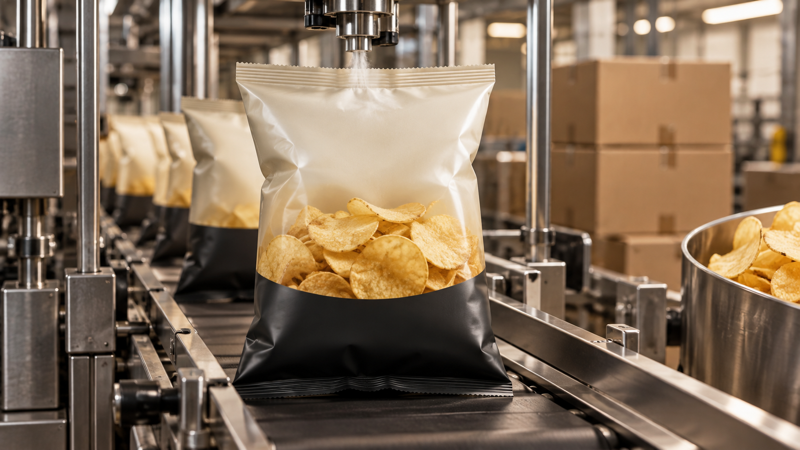
A chip bag that appears only partly filled can look wasteful, but the space above and around the product performs important work. Chips are light, brittle, and rich in surface area. They can absorb moisture, oxidize, lose flavor, and break under surprisingly modest pressure. Properly controlled nitrogen headspace slows oxidation and creates a protective cushion during case packing, shipping, and retail handling.
The objective is not to make the largest possible bag. It is to create enough headspace for consistent gas flushing and physical protection while controlling residual oxygen, material use, carton volume, and consumer expectations.
Why Chips Need Headspace
Freshly fried or baked crisps contain many fragile edges and internal pores. If the film hugs the product tightly, pressure from adjacent bags or corrugated cases transfers directly to the chips. A gas cushion distributes some of that load and allows pieces to move without immediately being crushed.
Headspace also gives nitrogen somewhere to flow. The gas displaces oxygen-containing air before the final seal is made. With too little open volume, air can remain trapped between chips and in irregular pockets. With excessive space, gas consumption rises and the bag occupies more shelf and shipping volume than necessary.
The correct level depends on chip shape, thickness, breakage tolerance, fill weight, pouch proportions, line speed, case configuration, distribution hazard, and altitude. A dense tortilla chip and a delicate kettle crisp may need different protection even at the same net weight.
Nitrogen Protects Flavor and Oil
Oxygen reacts with fats and flavor compounds. Over time, oxidation can create stale aromas, rancid notes, color change, and reduced consumer appeal. Nitrogen is inert under normal packaging conditions and displaces much of the air in the bag, giving the product a lower-oxygen starting environment.
Residual oxygen should be measured in finished production packs. Gas pressure or flow rate alone does not prove that displacement is effective. Sample at start-up, during steady running, after film or product changeovers, and across all machine lanes.
Recheck selected bags after a holding period. A good initial result followed by rising oxygen may indicate channel leaks, weak seals, poor film barrier, or punctures. Trend results with packaging lots and sealing settings rather than treating each measurement in isolation.
Nitrogen does not preserve crispness if moisture enters the pack, and it cannot repair a bad seal. It must operate as part of a complete barrier system.
Balance Cushioning and Package Efficiency
More gas does not automatically mean less breakage. An overinflated bag may be difficult to case, vulnerable to pressure change, and expensive to transport. It may also create a poor value impression if the pack looks oversized for the declared weight.
Too little cushion exposes chips to compression, but case design matters just as much. A tightly packed carton may crush bags even when the nitrogen level is correct. A loose carton lets packages accelerate during drops. Optimize bag, gas volume, case count, and corrugated strength together.
Test the complete distribution unit through vibration, drops, compression, and altitude or reduced-pressure exposure where relevant. Measure broken-piece percentage before and after testing. Visual inspection of the outer bag alone will not show whether the cushion protected the product.
Choose a High-Barrier Film
Chip packaging normally needs moisture, oxygen, aroma, and light protection. The article on what chip bags are made of explains why multilayer structures are common: one layer supports printing and strength, another provides barrier, and an inner layer provides sealing.
Metallized films are widely used because they can combine strong barrier and visual opacity at relatively low weight. Other structures may be appropriate depending on shelf life, equipment, recycling goals, and market conditions. Material names alone are not enough; compare actual oxygen and water-vapor transmission data under relevant test conditions.
Barrier can be lost through flex cracking, pinholes, poor lamination, or seal damage. Test the converted bag after filling and distribution, not only flat film from a supplier data sheet.
Protect the Seal From Crumbs and Oil
Chip fragments, salt, seasoning powder, and oil can contaminate cross seals. A particle trapped between sealant layers creates a channel through which gas escapes and oxygen or moisture enters.
Control product timing, drop height, cut-off, dust extraction, film movement, and jaw cleaning. The seal should close after the product has cleared the area. If seasoning buildup recurs on one lane, inspect the filler and product distribution rather than simply raising temperature.
Select a sealant with suitable hot tack and contamination tolerance. Establish a validated window for temperature, pressure, and dwell time at normal line speed. Excessive heat can thin or distort the film, while insufficient energy creates incomplete fusion.
Seal-strength and leak tests should accompany residual-oxygen checks. Examining the failure surface helps distinguish contamination, wrinkles, jaw misalignment, and inadequate heat.
Size the Bag With Real Product
Chip bag sizes should be chosen from actual bulk volume, settling, breakage tolerance, and channel requirements. Weight alone is misleading because chip thickness, curl, coating, and broken-piece content change how much space the product occupies.
Fill candidate bags with representative production lots. Run them through the intended gas-flush and sealing equipment, then measure finished width, length, thickness, headspace, residual oxygen, and broken pieces. Check shelf appearance and case fit after normal settling.
If several flavors share one bag size, validate the bulkiest and most fragile products. A heavy coating may also change seal contamination and oxygen sensitivity. Common packaging simplifies purchasing only when every SKU remains protected.
Explain Headspace Through Design
Consumers may interpret a large flexible bag as underfilled if package proportions and communication create the wrong expectation. The printed front should clearly state net quantity and present an honest scale. Avoid graphics that imply the entire pouch is packed solid.
Custom chip bags can use graphics, windows, finishes, and formats to support brand position. A transparent window may demonstrate product quality, but it can reduce light protection and barrier. Validate any window as part of the complete shelf-life study.
Compact proportions can reduce the visual impression of empty space without sacrificing cushion. A wider bag may spread chips into a thinner layer, while a narrower bag may need more length. Compare filled prototypes rather than judging flat dielines.
Decide Whether the Bag Should Reseal
Single-serve packs are usually consumed immediately, so a zipper adds cost and material without much benefit. Family and party packs may remain open for days and can benefit from resealable chip bags.
The zipper must close despite crumbs, oil, and seasoning. Test repeated cycles after the bag has been shaken and partly emptied. The opening should allow serving without crushing chips or coating the closure.
Reclosure slows moisture exposure but does not recreate the original nitrogen atmosphere. Open-life testing should simulate actual use, including daily opening in the target climate. Storage instructions can encourage consumers to remove crumbs and close the profile fully.
Validate the Whole System
Shelf-life studies should track sensory freshness, crispness, moisture, oxidation indicators where relevant, residual oxygen, seal integrity, and package appearance. Use production-equivalent bags and normal as well as challenging storage conditions.
Distribution testing should precede or accompany storage because flexing and pinholes can change barrier. Evaluate the final case and pallet, including the lowest bags under compression. If e-commerce is planned, test the actual parcel configuration separately.
Production controls should include film verification, fill weight, gas settings, residual oxygen, seal checks, leak performance, code legibility, and case count. Record broken-chip complaints by product, line, and route to find patterns.
Chip Bag Headspace Checklist
- Define product volume, fragility, oil content, and acceptable breakage.
- Set headspace for gas displacement and cushioning, not appearance alone.
- Measure residual oxygen in finished packs and after holding.
- Select moisture and oxygen barrier for the intended shelf life.
- Keep crumbs, oil, salt, and seasoning out of the seal.
- Optimize bag dimensions and carton configuration together.
- Test vibration, drops, compression, and altitude where relevant.
- Validate sealed and opened product quality under target conditions.
Headspace is valuable only when it is controlled. The right amount enables nitrogen to lower oxygen, cushions fragile crisps, and supports reliable seals without creating unnecessary material or shipping volume. When gas, film, pouch size, and carton are designed together, the space in a chip bag becomes a functional part of product protection rather than wasted capacity.