
With over 30 years dedicated to the craft of coffee, I’ve learned that most brewing problems don’t start in the coffee pot—they start in the grinder. You can have the world’s best, most expensive beans and a state-of-the-art brewing machine, but if your grind is wrong, the cup will never be right. It’s the single most overlooked, yet most powerful, step in the entire process.
The secret to unlocking the full spectrum of flavor that a roaster like me works so hard to create isn’t some arcane technique; it’s a fundamental principle of control. Grind size is the most important variable you have at your disposal to perfect your coffee extraction.
This guide will be your masterclass in grinding. We will demystify the world of coffee grind sizes, provide a definitive chart to guide you, and give you the expert knowledge to transform your daily brew from something good into your perfect cup.
The “Why”: Understanding Extraction, Surface Area, and Time
Before we touch a single bean, we must understand a basic principle of chemistry: extraction. Brewing coffee is simply the process of using water as a solvent to pull flavors, oils, acids, and sugars out of the solid coffee grounds. The goal is to extract the perfect amount—not too much (which causes bitterness) and not too little (which causes sourness).
The rate of this extraction is controlled almost entirely by the surface area of the coffee grounds, which you control with your grinder. This leads us to the Golden Rule of Grinding:
- Coarse Grind = Long Contact Time (e.g., French Press, Cold Brew)
- Fine Grind = Short Contact Time (e.g., Espresso)
Think of it like dissolving sugar in water. A solid sugar cube (a coarse grind) will take a long time to dissolve. Granulated sugar (a fine grind) will dissolve almost instantly. The same is true for coffee. A fine grind exposes a massive amount of surface area to the water, so flavor is extracted very quickly. A coarse grind has much less surface area, so it requires a much longer contact time with the water to achieve a balanced extraction. Every brewing method is simply a different way of managing this relationship between time and surface area.
The Definitive Coffee Grind Size Chart
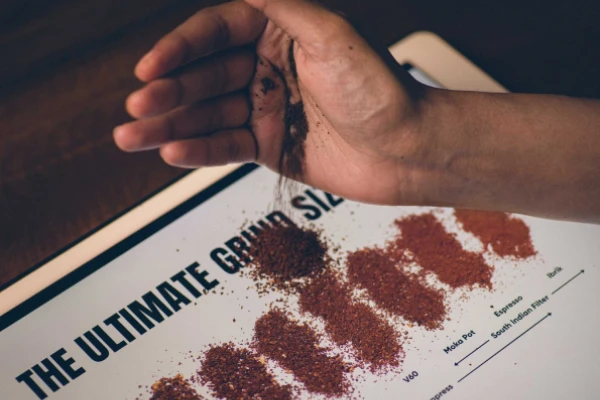
Consider this chart your starting map. Every coffee bean and every grinder has its own unique characteristics, so you will always need to make small adjustments—a process we call “dialing in.” But this chart will put you in the right ballpark every single time.
| Grind Level | Visual & Textural Cue | Primary Brewing Methods |
| Extra Coarse | Looks like cracked peppercorns | Cold Brew, Cowboy Coffee |
| Coarse Grind | Looks like coarse sea salt | French Press, Percolators, Coffee Cupping |
| Medium-Coarse | Looks like rough, coarse sand | Chemex, Clever Dripper, Flat-Bottom Drip Makers |
| Medium Grind | Looks like regular table salt | Cone-Shaped Pour-Overs, Automatic Drip Coffee Makers, AeroPress (for longer infusions) |
| Medium-Fine | Slightly smoother than table salt | Pour-Over Cones (V60, Kalita), Siphon Brewers, AeroPress (for shorter infusions) |
| Fine Grind | Looks like fine sugar or flour | Espresso, Moka Pot, AeroPress (espresso-style) |
| Extra Fine | Looks like powdered sugar | Turkish Coffee (Ibrik) |
A Deep Dive: Grinding for Your Brew Method
Let’s break down the most popular brewing methods and explore the “why” behind their ideal coffee grind size.
The Drip Coffee Maker
This is the workhorse of many kitchens. The standard drip grind coffee is a medium grind, similar in consistency to table salt. This size provides the perfect balance for the brewing process of an automatic machine. If the drip coffee grind is too coarse, the water will flow through too quickly, resulting in a weak, sour, and under-extracted pot. If it’s too fine, the water will back up in the filter basket, spending too much time with the coffee and creating a bitter, over-extracted brew.
The French Press
The French press is an immersion brewer, meaning the coffee grounds and water steep together for a long period (typically 4 minutes). This long contact time demands a very coarse grind for french press. A fine grind would over-extract in that amount of time, creating a horribly bitter cup. Furthermore, a coarse grind is essential for proper filtration. A fine grind would pass through the metal mesh filter, resulting in a cup full of unpleasant sediment, often called “sludge.”
The Pour Over
Pour over is a category, not a single method, and the grind is nuanced. The goal is to control the flow rate of water through the coffee bed.
- Chemex: With its thick paper filter, a Chemex requires a medium-coarse grind. This allows for a proper flow rate and prevents the filter from clogging during the longer brew time.
- Hario V60 / Kalita Wave: These brewers have thinner filters and a different flow dynamic, so a medium-fine grind is often the best starting point. This provides enough resistance to the water, allowing for a balanced extraction in about 2-3 minutes.
The Espresso Machine
This is where precision becomes a game of micrometers. An espresso grind is a fine grind, but that’s just the beginning. The goal of an espresso shot is to force hot, pressurized water through a compacted puck of coffee to produce a 25-30 second extraction.
- If your shot runs too fast (under 20 seconds), your grind is too coarse.
- If your shot runs too slow or chokes the machine, your grind is too fine. “Dialing in” an espresso machine means making tiny adjustments to the espresso grind size until you achieve that perfect extraction time and a balanced, delicious shot. This is why a high-quality burr grinder is absolutely essential for making good espresso.
The Percolator
A percolator continually cycles hot water through the coffee grounds. This constant re-brewing and high heat demand a coarse grind for the same reasons as a French press: to prevent over-extraction and to stop fine particles from passing through the metal filter basket and into the final cup.
The Keurig® & Reusable K-Cups
If you’re using a reusable K-cup, the goal is to mimic the grind inside a disposable pod. The ideal keurig grind size is a medium grind, identical to what you’d use for an automatic drip coffee maker. Grinding too fine will cause the water to back up and potentially overflow the machine, while grinding too coarse will result in a weak, watery cup.
The Unseen Hero: Why a Perfect Grind Starts with a Fresh Bean
As a master roaster, my work is complete when the beans are perfected inside the bag. But all that potential flavor is lost if the coffee isn’t fresh the moment you grind it. The truth is, the best grind always starts with the freshest possible bean.
Pre-ground coffee is a promise already broken. The moment coffee is ground, its surface area is increased a thousand times over, and the clock of staling starts ticking at a frantic pace due to oxygen exposure. Grinding your coffee just seconds before you brew is the single greatest leap you can take in improving your coffee quality at home.
This is why the packaging we choose for our beans is a non-negotiable part of the quality chain. To achieve that perfect grind, you must start with a perfectly preserved bean. The high-performance coffee bags from BN Pack are engineered to be a vault for freshness. Their multi-layer, high-barrier construction locks out the enemies of coffee—oxygen, UV light, and moisture. The one-way degassing valve is crucial, ensuring that freshly roasted beans can rest and mature without going stale. Great coffee deserves a great bag.
Conclusion
The complexity of coffee grinding can seem daunting, but the core message is simple: grind size is the most powerful variable you control in your quest for better coffee. By understanding the fundamental relationship between surface area and time, you can move beyond guessing and start making intentional, impactful adjustments.
Remember the Golden Rule: match your grind size to your brew time. Use the chart in this guide as your starting map, but don’t be afraid to explore. The true joy of coffee comes from experimentation and discovery. A small tweak to your grinder setting is a small step on the path to finding your perfect cup. Happy brewing.