
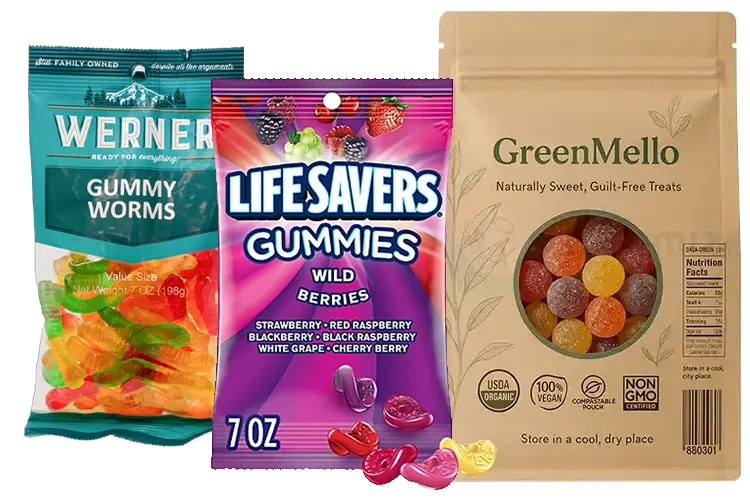
Are you watching your profits melt away because of sticky, clumped, or sweating gummy candies?
As a confectionery brand or production manager, you already know that gummy candies are highly hygroscopic—meaning they greedily absorb moisture from the air the second they get the chance. A poor packaging choice disrupts your product’s water activity ($a_w$), destroying textures, cutting shelf life short, and ruining your brand’s reputation on retail shelves.
To prevent your products from turning into a single, unmarketable block during transit or storage, you need to master the science of moisture-resistant packaging.
In this complete buyer’s guide, we will break down the exact engineering metrics you need to look for—from calculating the Water Vapor Transmission Rate (WVTR) to selecting high-barrier flexible film laminates and hermetic stand-up pouches.
Let’s dive right in.
How to Choose Moisture-Resistant Packaging for Gummy Candies: A Complete Buyer’s Guide
Ever opened a bag of gummies only to find a sticky, melted mess? If you are a confectionery brand in the United States, you know that ambient moisture is your biggest enemy. Gummy candy packaging isn’t just about pretty graphics; it is a critical shield that protects your product from the elements.
Why Gummies Sweat: The Science
Gummies are inherently hygroscopic, meaning they act like tiny sponges that naturally absorb water from the air.
- High Sugar & Gelatin Content: These ingredients naturally attract moisture molecules.
- Ambient Humidity: High humidity levels during shipping or on retail shelves force moisture into the candy.
- The “Sweating” Effect: When the environment gets warm and humid, moisture draws out the sugars, creating a sticky liquid layer on the surface.
The Cost of Poor Moisture Management
When gummy candy flexible packaging fails to keep the outside air out, your product suffers instantly. Choosing the wrong materials leads to a chain reaction of quality issues:
- Sticky Clusters: Individual gummies fuse into a single, unmarketable block.
- Loss of Geometric Definition: Bears, worms, and custom shapes lose their sharp details and melt together.
- Texture Degradation: The signature chewy bite turns mushy and unappealing.
- Microbiological Risks: Excess moisture creates a breeding ground for mold and bacteria, ruining food safety.
Packaging as a Strategic Asset
Investing in high-quality moisture barrier film laminates directly correlates to a longer shelf life and better brand reputation.
| Packaging Quality | Impact on Product | Business Result |
|---|---|---|
| Low-Barrier Bags | Moisture ingress, clumping, rapid staling | High product returns, lost revenue |
| High-Barrier Pouches | Stable texture, retained shape, fresh flavor | Extended shelf life, happy repeat buyers |
Using a reliable moisture barrier is the most effective method for clumping prevention in starch gummies. By controlling the internal microclimate of your bag, you ensure that the product looks and tastes exactly as intended from the factory floor to the consumer’s hand.
Understanding Technical Metrics in Gummy Candy Packaging
When sourcing gummy candy packaging, relying on guesswork will ruin your product. To protect your brand reputation and ensure a premium customer experience, you must understand the technical metrics that keep gummies fresh, chewy, and free from clumping.
Water Vapor Transmission Rate (WVTR)
WVTR measures how much moisture passes through a packaging film over a specific period. For gummy candies, ambient humidity is the ultimate enemy. High humidity causes gummies to absorb water, sweat, and melt into a single sticky mass.
- The Golden Rule: The lower the WVTR rating, the better the moisture barrier.
- Retail Reality: In high-humidity retail environments across the United States, a low WVTR is non-negotiable to prevent clumping in starch gummies.
Oxygen Transmission Rate (OTR)
While moisture ruins texture, oxygen destroys flavor and appearance. OTR measures how much oxygen penetrates the film. High oxygen exposure leads to candy oxidation prevention failures, causing flavor loss, color fading, and off-tastes.
| Metric | Focus Area | Impact on Gummy Candies | Target Performance |
|---|---|---|---|
| WVTR | Moisture Control | Prevents sweating, stickiness, and structural melting. | Ultra-Low (Critical for shelf stability) |
| OTR | Gas Barrier | Prevents flavor migration, scent loss, and color fading. | Low to Medium (Critical for taste preservation) |
The Shelf-Life Equation
Achieving an extended shelf-life extension for edibles requires balancing the initial moisture content of your gummies with the ambient humidity of your distribution channels. If your packaging film fails to maintain this equilibrium, your product quality degrades rapidly.
For brands utilizing automated machinery, choosing high-performance moisture barrier film laminates ensures the structural integrity of the pouch remains intact from the factory floor to the consumer’s hands. Balancing these two metrics is the only way to guarantee your gummies taste exactly as intended upon opening.
Core Barrier Materials and Laminate Configurations for Gummy Packaging
Choosing the right moisture barrier film laminates is the most critical decision you will make for your brand. Standard, single-layer plastics cannot keep ambient humidity out. To prevent stickiness and preserve shelf life, we engineer multi-layer gummy candy flexible packaging structures that combine different specialized materials into a single, high-performance shield.
Analyzing Flexible Plastic Films
Each layer in a flexible pouch serves a distinct, vital purpose:
- PET (Polyethylene Terephthalate): Used as the outermost layer. It provides excellent structural stability, scratch resistance, and serves as the perfect canvas for high-definition custom flex pack printing.
- VMPET (Vacuum Metallized PET): A thin layer of aluminum vaporized onto PET film. It delivers exceptional gummy candy packaging protection by reflecting light and blocking moisture vapor at a fraction of the cost of solid foil.
- BOPP (Biaxially Oriented Polypropylene): Ideal when you want high-clarity windows so customers can see your colorful gummies inside the retail store.
- PE / LLDPE (Linear Low-Density Polyethylene): The innermost layer. It melts at specific temperatures to create a reliable, hermetic heat seal that locks out the elements.
The Ultimate Shields: High-Barrier Multi-Layer Structures
Depending on your product formulation—especially if you manufacture active vitamin gummies or organic starch-based candies—you need to match your shelf-life goals with the right structural thickness.
| Structure Level | Layer Configuration | Best Used For |
|---|---|---|
| Standard Barrier | PET / PE | Local distribution, rapid-turnover snack items, and basic clumping prevention in starch gummies. |
| High Barrier | PET / VMPET / PE | The US industry standard for retail confectionery. Offers robust protection against candy oxidation prevention and sweating. |
| Ultra-High Barrier | PET / Alu Foil / PE | Maximum protection. Zero light transmission and near-zero moisture transmission for premium or medicated edibles. |
Sustainable Alternatives For Modern Brands
American consumers demand eco-friendly options, but you cannot sacrifice product quality. We offer advanced sustainable high-barrier films that keep your inventory fresh without hurting the planet:
- Recyclable Mono-Material Polyolefin Laminates: Made entirely from PE-to-PE structures, making them fully recyclable in standard US store drop-off programs while retaining excellent moisture-resistant properties.
- Compostable Structural Barriers: Plant-based films designed to break down naturally in commercial composting facilities, perfectly suited for organic and natural gummy brands looking to minimize their carbon footprint.
Functional Pouch Designs for Gummy Candy Packaging
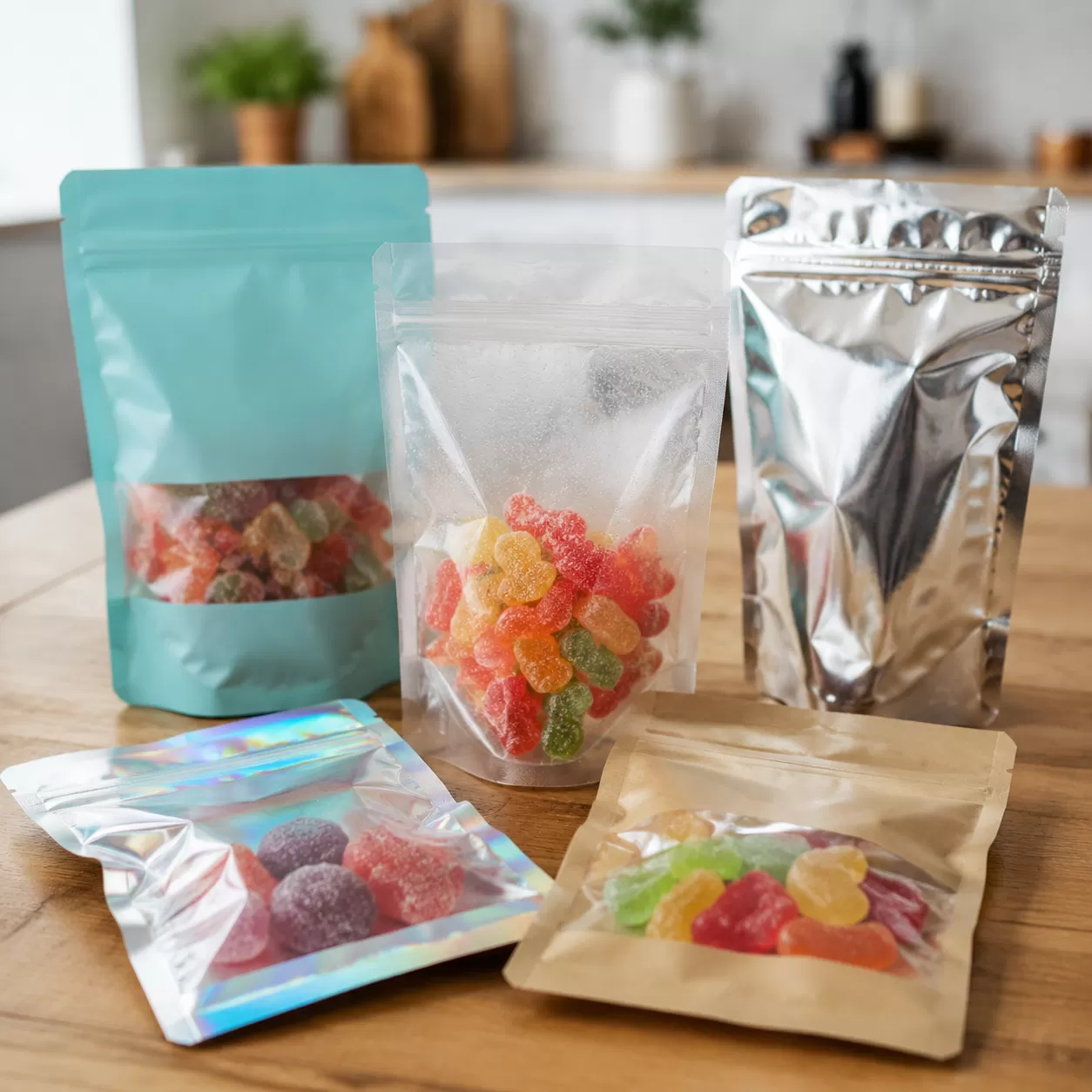
The physical structure of your packaging dictates how well your gummies survive the retail shelf and how consumers interact with your brand. Choosing the right bag profile and protective features prevents moisture ingress while maximizing shelf impact.
Selecting the Ideal Bag Profile
Different retail environments and product volumes require specific pouch shapes. We manufacture three primary styles optimized for high-barrier confectionery applications:
| Bag Profile | Best Used For | Key Advantage |
|---|---|---|
| Stand-Up Pouches (Doypack) | Premium retail, sharing sizes, and artisanal gummies. | Excellent shelf presence and stable footprint. |
| Flat Pouches (Three-Side Seal) | Single-serve portions, sample packs, and checkout lane items. | Cost-effective and maximizes interior volume. |
| Gusseted Bags | Bulk packaging and high-volume candy products. | Compact storage with high filling capacity. |
High-barrier stand-up pouches remain the industry standard for the US market due to their commanding presence on grocery shelves and stable bottom gusset that prevents tipping.
Hermetic Closures & Protection Features
A beautiful bag profile fails if the closure allows humid air to seep inside. Integrating robust structural enhancements ensures a airtight seal from the factory to the consumer’s pantry.
- Resealable Zipper Locks: Essential for multi-serve candy bags. A reliable press-to-close zipper maintains a barrier against ambient moisture after the initial opening, preventing clumping in starch gummies.
- Tear Notches & Laser Scoring: Clean openings prevent consumers from ripping the bag down the side, which destroys the resealable zipper functionality. Laser scoring guides a straight tear every single time.
- Opaque vs. Windowed Formats: While clear windows showcase your colorful gummy shapes, UV light accelerates color fade and degradation. If a window is necessary for branding, we utilize UV-blocking transparent films. For maximum shelf-life extension, full opaque barriers offer total protection.
When shifting towards eco-conscious branding, these functional features must seamlessly integrate with your base materials. You can explore how sustainable choices align with product protection in our guide on eco-friendly packaging materials.
Operational Factors to Consider When Buying Gummy Packaging
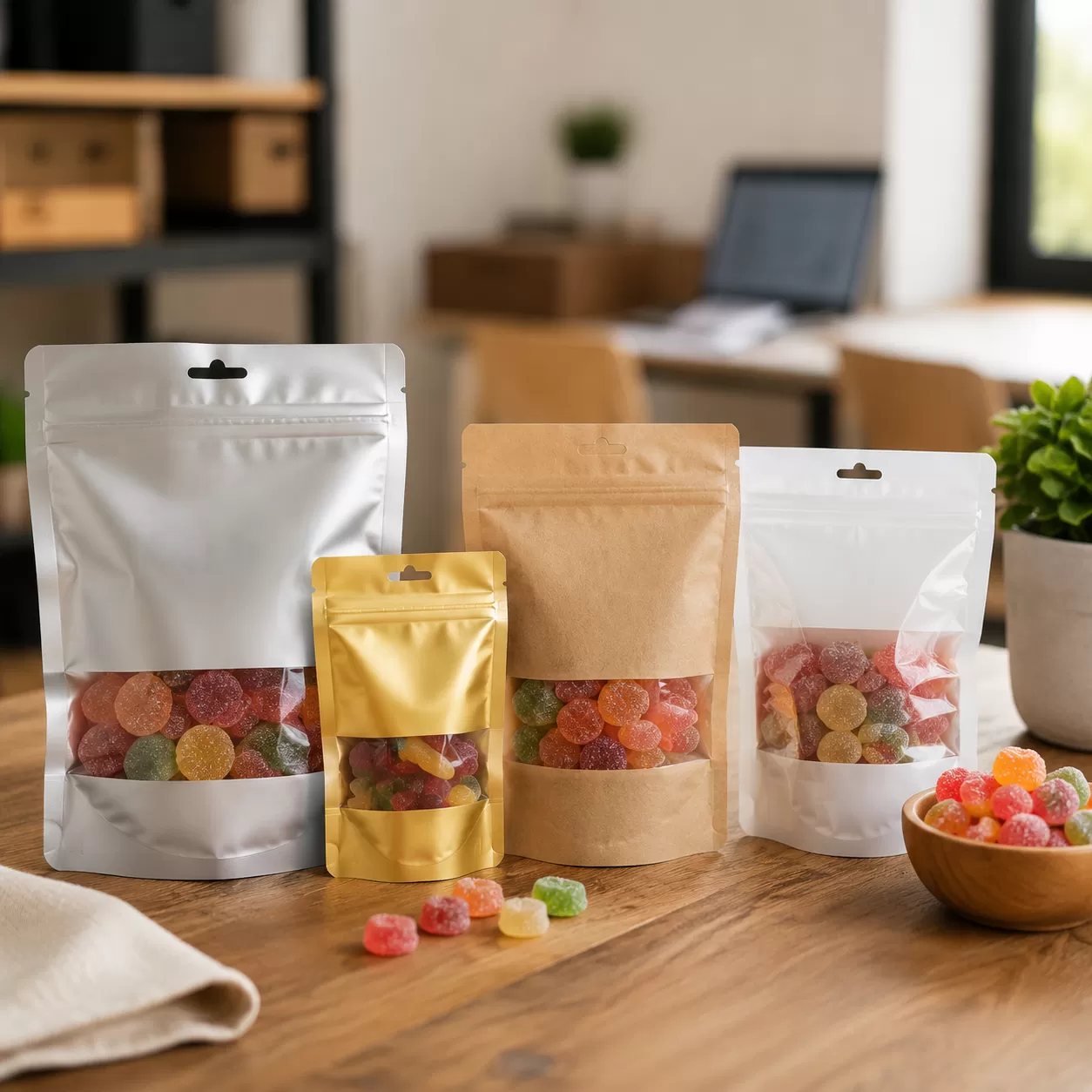
Choosing the right material is only half the battle; your gummy candy packaging must also perform flawlessly on the production line and withstand the rigors of the supply chain. If the film doesn’t run smoothly on your machinery or cracks during transport, your moisture barrier is compromised.
Automated Packaging Machine Compatibility
To keep your production line running at peak efficiency, your packaging material must be optimized for your specific machinery, whether you use horizontal or Vertical Form Fill Seal (VFFS) packaging films.
- Coefficient of Friction (COF): The film needs the right amount of slip. If the COF is too high, the film drags and jams the machine; if it’s too low, the film slips, causing misaligned feeds and wasted material.
- Heat-Sealing Window Optimization: Different materials melt and seal at different temperatures. A broad, forgiving heat-sealing window ensures a perfect, hermetic seal without burning through the outer layers of your flexible packaging structures.
Storage, Logistical, and Environmental Realities
The journey from our manufacturing floor to the retail shelf is full of hazards. United States climate zones vary drastically, meaning your gummies might experience extreme temperature and humidity swings while sitting in a freight truck or a distribution warehouse.
| Logistical Challenge | Impact on Gummy Candies | Packaging Solution |
|---|---|---|
| Temperature Swings | Melting and structural deformation | High thermal stability films |
| Humidity Spikes | Moisture ingress, sticky clumping | Ultra-low WVTR barrier layers |
| Physical Hazards | Punctures from sharp edges, drops | High puncture-resistance laminates |
Food Safety Compliance and Certifications
When sourcing food-grade packaging material for the US market, regulatory compliance is non-negotiable. Every film layer that touches your confectionery must meet strict safety standards to protect both your consumers and your brand reputation.
- FDA-Approved Raw Materials: All resins, inks, and adhesives used in our manufacturing process are 100% compliant with FDA regulations for direct food contact.
- Global Safety Standards: Our production facilities maintain rigorous quality control protocols, holding trusted industry certifications including BRCGS and ISO. This guarantees that every batch of custom printed snack pouches you receive is free from contaminants and structurally sound.
Sourcing Gummy Candy Packaging: The Ultimate Buyer’s Checklist
Finding the right manufacturing partner for your gummy candy packaging requires looking past standard price quotes. To safeguard your product from melting, clumping, or losing its flavor on retail shelves, you need a systematic approach to evaluating potential packaging suppliers.
1. Define Your Critical Product Metrics
Before reaching out to a manufacturer, you must outline your specific product vulnerabilities. Gummy formulations vary wildly—pectin-based gummies handle heat differently than gelatin-based ones, and sour sanded gummies are highly sensitive to moisture absorption.
- Formulation & Ingredients: Note if your gummies have oil coatings, acid sanding, or active ingredients (like vitamins) that require advanced candy oxidation prevention.
- Expected Shelf Duration: Establish your target shelf life (typically 12 to 24 months for the US market).
- Sales Channels & Environments: Consider the climate of your distribution networks. High-humidity regions require strict moisture barrier film laminates to prevent shipping disasters.
2. Assess Supplier Technical Capabilities
A reliable manufacturer must possess the exact production and quality control protocols required for food-grade packaging material.
- Advanced Printing & Finishes: Verify if the supplier offers both rotogravure and digital printing to handle different run sizes. Ask about their range of matte vs glossy candy bags to ensure your brand stands out on crowded US retail shelves.
- Strict QC Laboratory Testing: Ensure the factory can provide verified certification for Water Vapor Transmission Rate (WVTR) and Oxygen Transmission Rate (OTR) testing on the actual co-extruded packaging structures they produce.
- Regulatory Compliance: The manufacturer must offer full traceability and hold updated food safety certifications, such as FDA-approved raw materials, BRCGS, or ISO standards.
3. The BN PACK Advantage
We engineer custom high-barrier stand-up pouches designed specifically to combat ambient humidity and extend the shelf life of your confectionery products. By partnering with us, you gain access to top-tier material science and agile manufacturing.
- Customized Material Engineering: We don’t believe in one-size-fits-all solutions. We tailor multi-layer films—utilizing an aluminum foil barrier layer or sustainable high-barrier films—to match the exact water activity level of your gummy formulation.
- Advanced Co-Extrusion Lines: Our state-of-the-art machinery ensures perfect layer adhesion, eliminating the risk of delamination and ensuring seamless integration with your automated VFFS packaging films.
- Rapid Prototype Sampling: We provide physical prototypes quickly so you can run real-world compatibility and sealing tests on your machinery before committing to a full production run.
Frequently Asked Questions (FAQs) About Gummy Candy Packaging
Why do my gummy candies sweat inside their bags?
Gummies sweat because they are inherently hygroscopic, meaning they naturally absorb water from the surrounding air. If your gummy candy flexible packaging lacks a sufficient moisture barrier, ambient humidity penetrates the film. Temperature swings during transit or storage then cause this trapped moisture to condense inside the bag, leading to sticky clusters and a loss of geometric definition.
What is the best packaging material to prevent gummy clumping?
To completely stop clumping prevention in starch gummies and gelatin formulas, you need a high-barrier multi-layer laminate. A structure combining PET for stability, an aluminum foil barrier layer or VMPET for maximum moisture reflection, and a PE/LLDPE inner layer for hermetic heat sealing yields the lowest Water Vapor Transmission Rate (WVTR). For brands utilizing automated machinery, choosing high-barrier stand-up pouches ensures the product remains free-flowing and pristine from the factory floor to the consumer.
Can sustainable or eco-friendly candy packaging protect against moisture?
Yes, modern packaging technology allows you to protect your confectionery without harming the planet. Next-generation sustainable high-barrier films, such as recyclable mono-material polyolefin laminates and compostable structural barriers, are engineered specifically to match the barrier properties of traditional plastics. These eco-friendly candy bags keep your treats fresh while meeting the environmental demands of today’s market.
How does zipper lock resealability affect gummy candy shelf life?
Resealable zipper locks for confectionery are critical for long-term shelf-life extension for edibles. Once a consumer opens a bag, the internal controlled atmosphere is lost. A premium, airtight zipper lock allows customers to reclose the bag, blocking out ambient humidity and preventing candy oxidation, color fade, and texture degradation over multiple uses.