
SACHET
STAND-UP
STAND-UP
FLAT BTM
Order the wrong pouch size and you’re looking at one of two problems: a bag that looks half-empty on the shelf, undermining your premium positioning before a consumer even reads the label — or a bag so tight you can’t seal it properly, leading to leaks, clumping complaints, and product returns. Both outcomes are avoidable. Both stem from the same error: sizing a pouch based on weight alone, without accounting for your product’s bulk density.
This guide gives you the exact dimensions — width, height, bottom gusset — for every standard protein powder pouch size, across four bag formats. It also explains the two concepts most brands don’t think about until it’s too late: bulk density and headspace. Get these right upfront, and you’ll never need to reorder because the bag doesn’t fit.
Why Fill Weight ≠ Bag Volume (The Density Problem)
Here is the fundamental misconception in protein powder pouch sizing: you’re selling by weight, but the pouch holds volume. And different protein formulations occupy dramatically different volumes per gram.
The Density Gap Is Real — and Expensive
Standard whey protein isolate (WPI) has a bulk density of approximately 0.45–0.55 g/mL. Many plant-based proteins — pea, rice, hemp — sit at 0.35–0.42 g/mL. That means 1 kg of pea protein can require 25–35% more bag volume than 1 kg of whey isolate. A bag dimensioned for one will be wrong for the other.
Measure your product’s bulk density before you spec any bag. The method is straightforward: fill a 1-litre graduated cylinder with your protein powder (pour naturally — do not pack or shake), then weigh the filled volume. Divide grams by millilitres. That ratio is your bulk density. Repeat three times and average.
// Bulk Density Formula
Bulk Density (g/mL) = product weight (g) / product volume (mL)
// Example: 1kg whey isolate
Fill a 1,000mL cylinder → weigh contents → 480g
Bulk Density = 480g / 1000mL = 0.48 g/mL
// Required volume for 1kg fill:
Required Vol = 1000g / 0.48 = 2,083 mL ≈ 2.1 litres
// Add 15% headspace allowance:
Target Bag Vol = 2,083 × 1.15 = 2,395 mL ≈ 2.4 litres
Once you know the required bag volume, you can cross-reference it against the dimension tables below to identify the right pouch size for your format of choice.
Understanding Headspace: The Space You Can’t Fill
Every protein powder pouch has a zone at the top that cannot be filled with product. This headspace is not wasted space — it’s essential engineering. A bag filled to the absolute top cannot be sealed properly, will bulge and pop under transit pressure, and makes the zipper closure unusable.
PROTEIN POWDER STAND-UP POUCH — CROSS SECTION (290mm height example)
20–30mm
Heat-seal area. Never fillable. Required for a strong, airtight closure that passes drop and compression testing.
15–25mm
Zipper track clearance. Powder that enters the zipper channel causes closure failure. Coil zippers need slightly more clearance than press-to-close.
Effective fill height
Total height minus top seal, zipper, and bottom seal deductions. This is the only zone your product occupies. For a 290mm bag, effective fill height ≈ 190mm.
80–130mm (expanded)
Bottom gusset creates bag depth when filled. Volume = Width × (Gusset × 2) × Fill Height. A larger gusset = more capacity without increasing bag height.
Stand-Up Pouch Sizes (Doypacks)
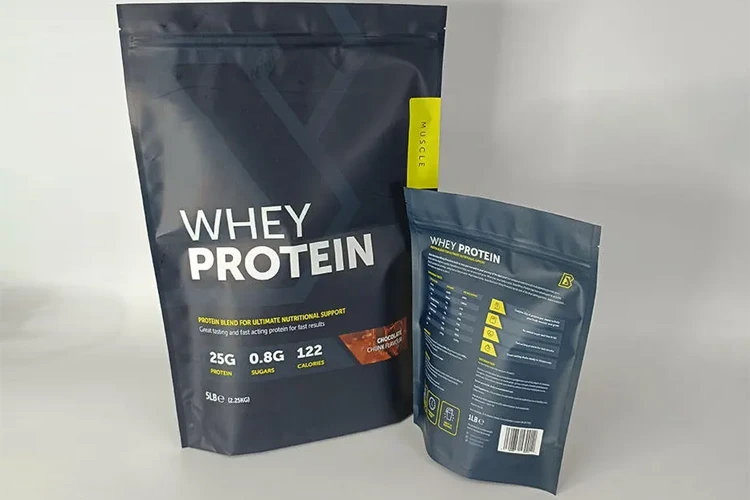
Stand-up pouches are the most common format for retail protein powder packaging, from 250g trial sizes to 2kg value packs. Their bottom gusset expands when filled, allowing the bag to stand upright on shelves and kitchen counters. The dimensions below are standard industry benchmarks for whey protein at an approximate bulk density of 0.48–0.52 g/mL.
Retail Sizes: 100g – 2kg
| Fill Weight | Width (W) | Height (H) | Bottom Gusset (G) | Bag Volume | Notes |
|---|---|---|---|---|---|
| 100–150g sample | 100–115mm | 170–185mm | 55–65mm | ~380 mL | Trial / starter packs |
| 250g | 120–130mm | 200–215mm | 70–80mm | ~650 mL | Single-flavor trial |
| 500g popular | 145–160mm | 235–250mm | 80–90mm | ~1,200 mL | ~15–20 servings |
| 1 lb (454g) | 140–155mm | 230–245mm | 80–85mm | ~1,100 mL | US market standard |
| 2 lb (907g) popular | 160–175mm | 265–280mm | 90–100mm | ~2,000 mL | Most common US retail |
| 1 kg | 185–195mm | 285–300mm | 100–110mm | ~2,400 mL | ~25–30 servings (EU standard) |
| 2 kg | 220–235mm | 335–355mm | 120–130mm | ~4,500 mL | Add handle hole for 2kg+ |
Flat Bottom Bag Sizes
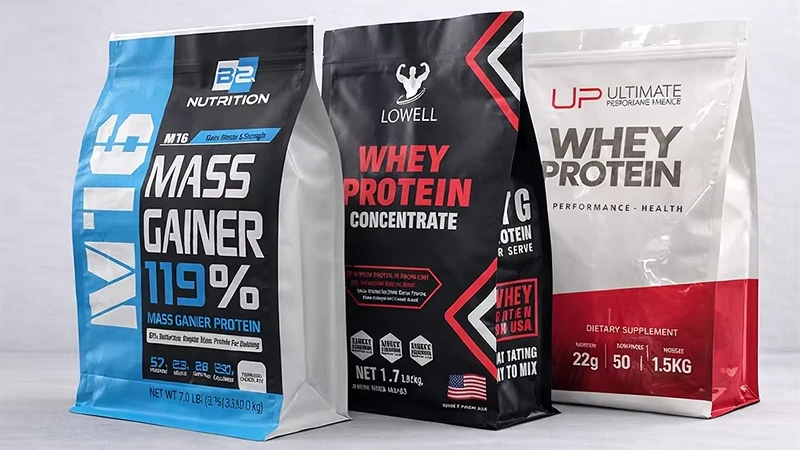
Flat bottom bags (also called box pouches or block bottom bags) have a pre-formed rectangular base and side gussets rather than a folded bottom. They stand with exceptional stability, offer five printable panel surfaces, and are the preferred format for brands targeting premium shelf positioning at 1kg and above.
Premium Shelf Format: 500g – 5kg
| Fill Weight | Width (W) | Height (H) | Side Gusset (G) | Bag Volume | Notes |
|---|---|---|---|---|---|
| 500g | 140–155mm | 230–245mm | 75–85mm | ~1,200 mL | Wide-mouth for easy scooping |
| 1 kg popular | 180–195mm | 280–295mm | 95–105mm | ~2,400 mL | 5 printable panels |
| 2 kg popular | 215–230mm | 330–350mm | 115–125mm | ~4,500 mL | Handle cutout recommended |
| 5 lb (2.27kg) | 235–250mm | 375–395mm | 120–135mm | ~5,000 mL | US gym-channel standard |
| 5 kg | 285–305mm | 460–480mm | 150–165mm | ~10,500 mL | PET/AL/NY/PE recommended |
Single-Serve Sachet & Stick Pack Sizes
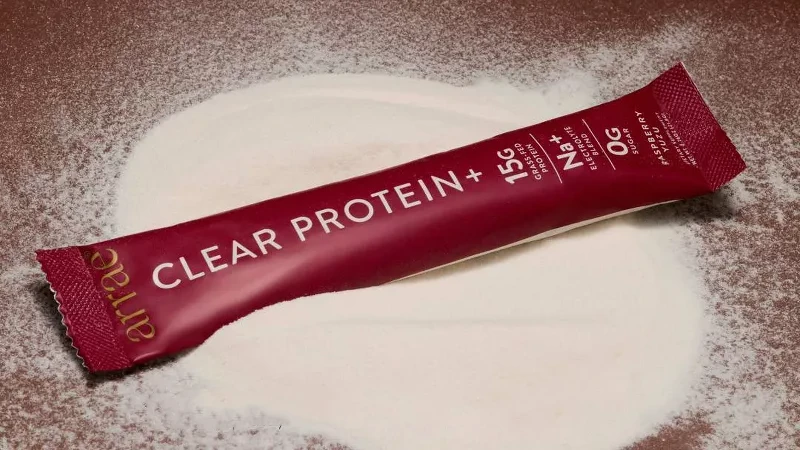
Single-serve formats serve a different commercial purpose: sampling, subscription box inserts, travel convenience, and gym-bag portability. The sizing logic here is simpler — match the sachet to your serving size — but the scoop opening width matters enormously for usability.
Single-Serve: 15g – 100g
| Fill Weight | Width (W) | Height (H) | Style | Use Case |
|---|---|---|---|---|
| 15–25g | 30–40mm | 110–130mm | Stick pack | BCAA, collagen shots |
| 30–35g 1 serving | 80–95mm | 120–140mm | 4-side seal sachet | Standard whey serving |
| 50g | 100–115mm | 150–165mm | 3-side seal sachet | Plant protein (higher volume) |
| 100g | 120–135mm | 185–200mm | Stand-up mini sachet | Gym sample packs |
Scoop Width: The Detail Most Brands Overlook
A correctly sized bag is useless if the opening is too narrow to fit your scoop. This is one of the most common complaints in consumer reviews of protein powder pouches — and it’s entirely avoidable at the design stage. The rule is simple: your usable bag opening width (the distance between the two side seams at the top of the bag, after the zipper area) must comfortably accommodate the scoop diameter with room to tilt.
diameter: ~55–65mm
diameter: ~70–80mm
diameter: ~85–95mm
For flat bottom bags — where the full-width rectangular opening allows much easier access — scoop clearance is rarely a problem. It’s primarily an issue with stand-up pouches at smaller fill weights (250g–500g), where the bag width is narrow relative to a standard protein scoop.
Choosing the Right Format by Use Case
Once you know your fill weight and bulk density, the format choice shapes everything else: stability, branding surface, fill-line ergonomics, and shipping efficiency. Here’s how to think through each option:
The dominant format for retail protein powder sales. Cost-effective, widely understood by consumers, and compatible with most filling equipment. Bottom gusset creates standing stability when filled. Best for brands that want broad sizing range coverage at competitive unit cost.
→ Add a euro slot hang hole for retail peg display. Plan zipper position 25–30mm below the top seal, not flush with the top.
Superior shelf presence with five printable panels (front, back, two sides, and base). Stands firmly even at heavy fills. Wide-mouth rectangular opening makes scooping easier. The preferred choice for premium protein brands competing at eye level in specialty retail or gym-channel sales.
→ Flat bottom bags are 15–25% more expensive per unit than stand-up pouches at the same fill weight. The ROI is in brand perception and shelf stability, not unit cost.
The choice for bulk and wholesale protein distribution. Side gussets (rather than bottom gussets) allow the bag to expand horizontally under heavy fills, providing greater structural stability for 5 kg–25 kg formats. Reinforced seals handle palletized freight. Branding surface is reduced, but cost-per-kilogram is the lowest of any format.
→ Specify PET/AL/NY/PE material for any bag above 2kg to prevent foil flex-cracking during transit.
Not a primary retail format, but a high-value commercial tool. Sachets are used for DTC trial acquisition, subscription box inserts, gym-counter sampling, and on-the-go serving convenience. Revenue per gram is much higher than bulk formats. 4-side seal sachets are the most common choice — fast to fill on auger equipment and consistent in portion delivery.
→ Always add a tear notch on both sides. A single notch on one side is frustrating for left-handed consumers — double notch adds less than $0.001 per unit.
“A 1kg of pea protein can require 25–35% more bag volume than 1kg of whey isolate. If you ignore density when specifying your pouch, you’ll either overflow the bag at the filler or receive complaints that your packaging looks half-empty.”
Before You Place Your Order: A 5-Point Sizing Checklist
- Measure bulk density before specifying anything. Weigh three sample fills of a known volume (1 litre works well), average the results, and divide grams by millilitres. This number is the single most important input to your sizing calculation — more important than your target fill weight.
- Calculate required bag volume with a 15% headspace buffer. Required Volume = Fill Weight (g) ÷ Bulk Density (g/mL). Multiply this by 1.15 to account for top seal, zipper, and fill-line clearance. Cross-reference the resulting volume against the dimension tables above.
- Check scoop diameter against bag width. Before approving your dieline, physically test whether your standard scoop can enter the bag through the zipper opening with room to tilt. For pouches under 150mm wide, consider offering a wider-mouth re-close option or a dedicated scoop opening feature.
- Request a pre-production fill test before bulk order approval. A reputable manufacturer will produce a small run of bags for you to physically fill with your actual product. Weigh the filled bag, check the fill line relative to the zipper, verify the seal holds under compression. This step catches density miscalculations before 50,000 units are printed.
- For plant-based proteins, spec up by at least one size tier. If whey isolate fits comfortably in a 190×290+100mm stand-up pouch at 1kg, a pea or rice protein blend at the same weight will need the next size up — approximately 205×310+110mm — due to lower bulk density. This is the most common sizing error we see from brands launching their first plant protein SKU.
Size Right the First Time
Pouch sizing is engineering, not guesswork. Start with your bulk density. Calculate the volume you actually need. Add your headspace buffer. Then select the format — stand-up, flat bottom, side-gusset, or sachet — based on your market channel and brand positioning. Use the dimension tables in this guide as your starting point, validate with a physical fill test, and you’ll only ever need to order once.
Frequently Asked Questions
What size pouch do I need for 1kg of protein powder?
For a stand-up pouch holding 1kg of standard whey protein powder (bulk density ~0.48 g/mL), recommended dimensions are approximately 190mm (W) × 290mm (H) + 100mm bottom gusset. For flat bottom bags at 1kg, dimensions shift to approximately 185mm (W) × 285mm (H) with 100mm side gussets. Always verify with a physical fill test — plant-based proteins with lower bulk density will require a larger bag for the same fill weight.
What is the standard size for a 2lb protein powder pouch?
A 2lb (approximately 907g) protein powder stand-up pouch typically measures 160–175mm (W) × 265–280mm (H) + 90–100mm bottom gusset. This is the most common retail size in the US market and balances fill volume with a comfortable scoop opening. For flat bottom bags at 2lb, dimensions are approximately 155–170mm (W) × 260–275mm (H) with 85–95mm side gussets.
Why does my protein powder pouch look half empty?
Almost always a bulk density mismatch. The pouch was sized for a denser product — typically whey protein at ~0.50 g/mL — but your formula is less dense (common with plant-based proteins, fluffy blended formulas, or spray-dried products). The result is correct fill weight but excess headspace that makes the bag look under-filled. Measure your actual bulk density, recalculate the required volume, and downsize the bag dimensions accordingly.
How much headspace does a protein powder pouch need?
For stand-up pouches with a zipper closure, plan for 40–60mm of total headspace above the fill line: 20–30mm for the top heat seal and 15–25mm for the zipper band clearance. Filling powder into the zipper channel causes closure failure and airtight seal problems. For sachets without a zipper, the top seal alone requires 15–20mm of clearance.
Do plant-based proteins need a bigger pouch than whey?
Yes, in most cases. Pea, rice, hemp, and blended plant proteins typically have bulk densities of 0.35–0.42 g/mL compared to whey protein concentrate at 0.45–0.55 g/mL. This means the same fill weight occupies 15–35% more volume. If you’re launching a plant-based protein in the same pouch you use for whey, the bag will appear partially empty. Size up by at least one tier in the dimension tables, or recalculate using your measured bulk density.