
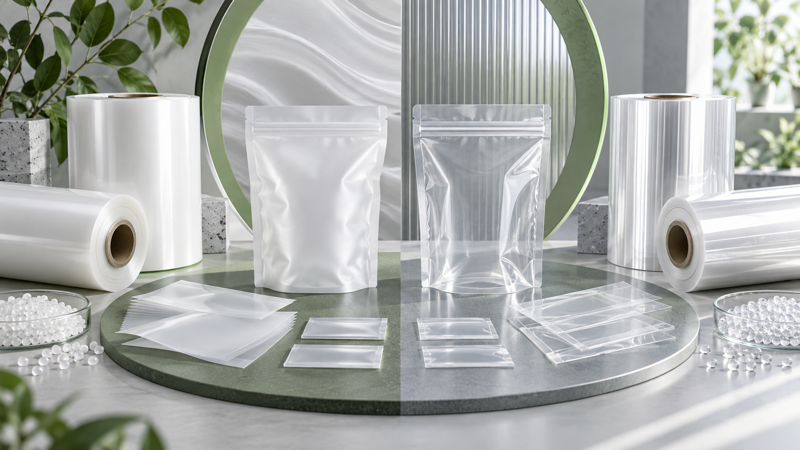
Mono-material pouches are designed so the main flexible components belong to one polymer family, improving compatibility with an appropriate recycling stream. Polyethylene and polypropylene are the leading options, but neither is automatically suitable for every product or filling line. They differ in stiffness, heat resistance, sealing behavior, barrier options, optics, and machine response.
Recyclability also depends on more than the base film. Inks, coatings, adhesives, barriers, zippers, valves, labels, fitments, and local collection systems all affect the result. A practical design begins with product protection and the intended recycling pathway, then builds the pouch within the rules of both.
Compare PE and PP Platforms
| Design factor | PE mono-material pouch | PP mono-material pouch |
|---|---|---|
| General feel | Often softer and more flexible | Often stiffer with stronger shape retention |
| Heat response | Broad sealing options but lower heat resistance in many structures | Higher temperature resistance in many applications |
| Seal behavior | Strong sealant options and low-temperature sealing potential | Requires carefully matched CPP or other PP sealing layers |
| Machine behavior | Flexibility may need stiffness optimization | Stiffness can support handling but may affect folding |
| Optical options | Clear, matte, or opaque structures available | Clear and high-gloss presentation can be strong |
| Typical design focus | Sealability, toughness, freezer use, broad pouch applications | Stiffness, clarity, heat tolerance, selected food applications |
These are general tendencies, not specifications. Film orientation, resin grade, coating, thickness, and converting method can change performance significantly.
Define What “Mono-Material” Means
Mono-material packaging is usually built predominantly from compatible forms of one polymer family. A PE pouch may combine oriented PE with a PE sealant. A PP design may combine oriented PP with cast PP.
Small amounts of ink, adhesive, coating, or barrier may be necessary, but their acceptability depends on the relevant design-for-recycling guideline and market. The package should be evaluated as a finished construction rather than marketed from the identity of one layer.
Claims such as recyclable, recycle-ready, or store-drop-off compatible have different implications across regions. Confirm collection, sorting, reprocessing, labeling, and minimum-content rules with qualified local guidance. A technically compatible pouch has little practical recovery if consumers cannot access the intended stream.
Start With Product Protection
The package must still protect food, supplements, pet products, or household goods. Define required oxygen and moisture barrier, light protection, aroma retention, chemical resistance, shelf life, fill temperature, and distribution hazards before choosing PE or PP.
Conventional foil or mixed-polymer laminates may provide very high barrier in a thin structure. Replacing them with mono-material films may require coatings, deposited barriers, orientation, extra thickness, or a shorter shelf life. Each option has tradeoffs in flex durability and recycling compatibility.
Run shelf-life testing on the finished pouch. Flat-film transmission data does not include seals, zipper profiles, folds, or damage. Avoid reducing product protection so far that food waste or product loss increases.
When PE Is a Strong Candidate
PE structures are widely used for flexible pouches because they can provide toughness and dependable sealing. Oriented PE can add stiffness and printability, while PE sealants support strong seals and contamination tolerance in suitable applications.
PE may be attractive for frozen products, powders, dry foods, and many stand-up pouch formats. Its flexibility helps resist impact, but very soft structures may be harder to run, display, or open cleanly. Film design must balance stiffness and toughness.
Heat resistance can limit certain filling or sterilization processes. Confirm the actual temperature and dwell time during filling, sealing, transport, and consumer use. A structure suitable for ambient dry food may not fit hot fill or retort.
PE zippers, spouts, and fitments can support polymer compatibility, but dimensions and seal methods must be validated. A component labeled PE may use additives or attached materials that affect the complete assessment.
When PP Is a Strong Candidate
PP often provides higher stiffness, clarity, and temperature resistance. Oriented PP can create a crisp printed web, while CPP can act as a sealing layer. These features can suit snacks, dry foods, and products that benefit from a structured retail appearance.
PP seal windows and low-temperature impact behavior should be checked carefully for the intended process and climate. Stiffer film may form attractive pouches but can concentrate stress at folds or seals if geometry is poor.
Higher heat resistance may support applications that challenge PE, but “PP” alone does not guarantee hot-fill or sterilization performance. Resin, orientation, adhesive or coating, sealant, and package design must be qualified as a system.
Clear PP structures can show the product, though strong light or oxygen barrier may require added technology. Confirm that coatings or metallization remain acceptable within the targeted recycling guidance.
Design Barrier Without Breaking Compatibility
Barrier coatings, thin deposited layers, and compatible tie systems can improve oxygen or moisture performance while maintaining a predominantly PE or PP structure. The acceptable amount and type depend on the recycling protocol.
Test barrier after flexing, printing, pouch making, filling, and distribution. Some high-barrier layers are sensitive to folds or cracks. A structure that meets laboratory targets before conversion may lose performance at the gusset.
Opaque pigmentation and metallization affect sorting and reprocessing differently across markets. Dark colors may reduce detectability in some systems. Design teams should review current regional guidance before fixing appearance.
Match Printing and Finishes to the Structure
Surface energy, orientation, and coating influence ink adhesion. Reverse printing can protect graphics, but lamination must remain compatible with the mono-material strategy. Surface printing may simplify construction but needs adequate rub and chemical resistance.
Heavy ink coverage, metallic effects, varnishes, soft-touch coatings, and labels can affect recyclability or reprocessed material quality. Use only what supports the brand and verify against the intended guideline.
Both PE and PP films can stretch or shrink under printing and pouch-making heat. Control web tension, drying temperature, registration, and curing. Approve color and dimensions on production-equivalent film rather than a paper proof.
Engineer Zippers, Valves, and Labels
Recyclable pouches are strongest when ancillary components follow the base polymer family. A PE pouch should generally use compatible PE closures where feasible; a PP pouch should follow the same principle with PP components.
Coffee valves, child-resistant zippers, spouts, and high-barrier fitments may be harder to align. Their function and safety cannot be compromised merely to simplify a claim. Work with suppliers to document materials and assess the full package.
Labels should use compatible facestock and adhesive or be readily separable according to the chosen system. Avoid adding a large incompatible label to an otherwise optimized pouch.
Validate on Filling Equipment
Mono-material films may behave differently from conventional PET/PE or PET/foil/PE laminates. Stiffness, coefficient of friction, curl, hot tack, seal initiation, tear, and thermal stability affect performance.
Run trials at target line speed. Check web tracking, pouch opening, static, registration, seal contamination, jaw release, cooling, wrinkles, and finished dimensions. Establish a sealing window rather than forcing the new structure into old settings.
Plastic pouches can be premade or formed from rollstock. Premade pouches require reliable opening and zipper alignment; form-fill-seal structures must match collars, jaws, and tension controls. Equipment changes may be small or substantial depending on the original laminate.
Consider PCR Carefully
PCR packaging incorporates post-consumer recycled content, which addresses material sourcing rather than package recyclability. A pouch can be recyclable without PCR, contain PCR without being widely recyclable, or combine both goals.
Food-contact use, odor, color, mechanical consistency, supply, and regulatory status influence where PCR can be placed. Printed outer layers or non-food-contact applications may offer different options from direct food-contact sealants. Validate quality and compliance by market.
PCR content can change appearance and processing. Set realistic color standards and test seals, toughness, migration where required, and shelf life. Claims should state the basis and percentage clearly.
PE vs PP Selection Checklist
- Define product barrier, temperature, seal, shelf-life, and distribution needs.
- Identify the real collection and recycling pathway in each sales market.
- Compare PE and PP structures using converted-package data.
- Keep coatings, inks, adhesives, and components within applicable guidance.
- Match zippers, spouts, labels, and valves to the polymer strategy.
- Test printing, pouch making, filling, sealing, and distribution at scale.
- Validate barrier and product quality after flexing and transport.
- Separate recyclability claims from PCR-content claims.
PE and PP mono-material pouches offer credible routes toward more recyclable flexible packaging, but the better platform is the one that protects the product, runs reliably, and fits an accessible recycling system. Careful choices across every layer and component turn a polymer preference into a package that can be produced, sold, used, and responsibly claimed.