Stand Up Pouch Sizes: The Quick Chart
Stand up pouch sizes run from 1 oz sample bags to 5 lb bulk formats, and choosing the right one starts with three numbers: fill weight, pouch width, and finished height. A 4 oz pouch is typically 3.5″ wide, an 8 oz pouch 4.5–5″, and a 16 oz (1 lb) pouch 6–6.5″. The full chart below maps every standard size to real fill weights by product density. The format itself is the stand up pouch that reshaped retail packaging, and the same sizing logic applies across every industry that uses it.
| Pouch Width | Typical Fill (Coffee/Grains) | Typical Fill (Protein Powder) | Common Use |
|---|---|---|---|
| 3″–3.5″ | 1–2 oz (30–60 g) | 1 oz | Samples, single-serve |
| 4″ | 3–4 oz (85–115 g) | 2 oz | Snacks, spice retail |
| 4.5″–5″ | 8 oz (225 g) | 4 oz | Standard retail 8 oz |
| 5.5″–6″ | 12 oz (340 g) | 8 oz | Popular food retail size |
| 6″–6.5″ | 16 oz / 1 lb (454 g) | 12 oz | Coffee, protein standard |
| 7″–8″ | 2 lb (900 g) | 2 lb | Value size, pet food |
| 9″–10″ | 5 lb (2.27 kg) | 5 lb | Bulk, gym protein |
Treat these numbers as starting points, not gospel. Fill weight depends on bulk density, and a dense product like salt fills a smaller pouch than the same weight of puffed snacks. When in doubt, run a fill test with the actual product before committing to a die line.
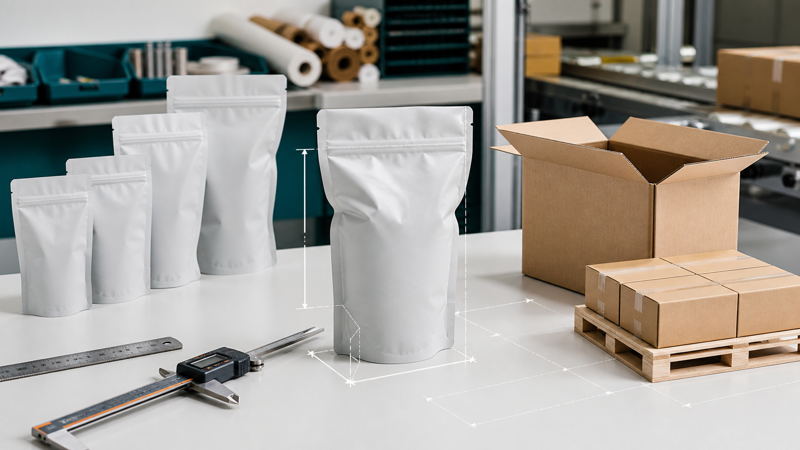
This guide maps stand up pouch sizes to real fill weights, so you can answer the only question that matters at ordering time: will my product fill this bag properly?
In this guide:
- How to match pouch size to your product
- Key dimensions explained
- How to measure a stand up pouch
- Features that change the size you need
- FAQ
How to Match Pouch Size to Your Product
Volume, not weight, decides what fits. Run this three-step method used by packaging engineers and stand up pouch sizes stop being a guessing game:
- Measure bulk density: fill a known container with your product as it will be filled (settled for powders, loose for snacks), then divide weight by volume. Protein powder runs about 0.5 g/ml; whole coffee beans about 0.35 g/ml; popped snacks as low as 0.05 g/ml.
- Add 20–30% headspace: sealed food pouches need headspace for nitrogen flush, zipper clearance, and shelf handling. A “16 oz pouch” that you fill with a full 16 oz of product will bulge and burst seams.
- Check the gusset: the bottom gusset depth (typically 2–4″) determines how much the pouch can actually stand. Wide, flat products like jerky sheets need a wider base; tall dense fills need a deeper gusset.
For powder brands, our breakdown of protein powder pouch sizes shows this math applied to a real product line, and the tea version covers leaf volume in 25 g to 250 g tea pouch sizes.
Key Dimensions Explained: Width, Height, Gusset, Seal
Stand up pouch sizes are always quoted as three numbers, and when a supplier says “5 x 8 x 2.5 inch”, here is what each number controls:
- Width (first number): the face width. Retail shelf planograms usually assume 3–7″ faces, so anything wider may need side-by-side placement approval.
- Height (second number): overall height including the top seal area. Usable fill height is roughly 1.2–1.5″ less than finished height.
- Bottom gusset (third number): base depth. Under 2″ the pouch stands poorly when more than half full; 3″+ gives a stable platform for 1 lb+ fills.
- Seal tolerance: add 0.4–0.5″ at top (and sometimes sides) that is not printable or fillable. If your art runs to the edge, confirm the bleed area first — our guide to flexible packaging dielines explains safe zones.
Headspace matters too: nitrogen-flushed products like coffee or crisps need 20–30% empty volume at the top. The reasoning is the same one behind nitrogen flush headspace in chip bags — the gas cushion is part of the preservation system. Comparing stand up pouch sizes across suppliers is easier once you standardize on these four dimensions and ignore marketing names like “medium” or “family size”.
How to Measure a Stand Up Pouch Correctly
Stand up pouch sizes only mean something when everyone measures the same way, so lock this method in before your next quote.
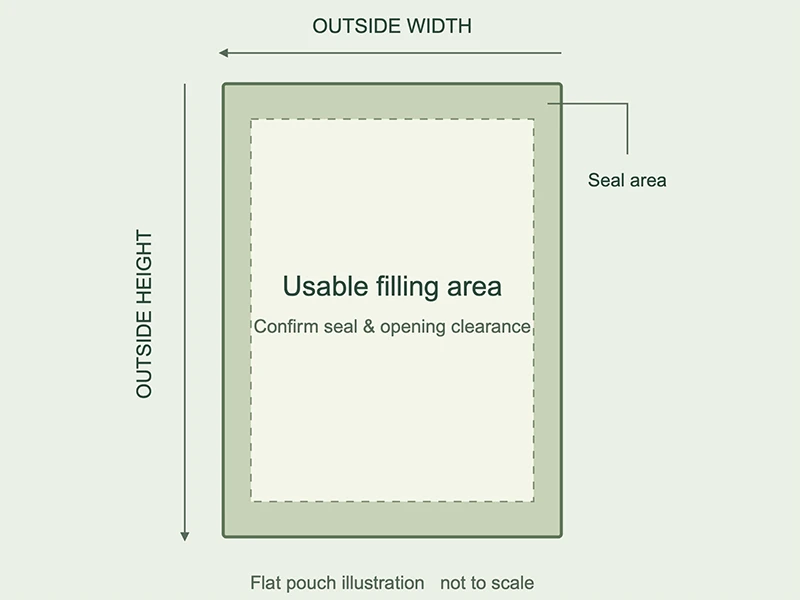
Measure with the pouch empty, standing upright, gusset fully extended:
- Width: across the front face at the widest point, gusset lying flat.
- Height: from the bottom edge to the top seal (include the seal).
- Gusset: open the base flat and measure its depth.
- Fill capacity check: if a competitor pouch is your reference, fill it with water to your target fill line — 1 fl oz water ≈ the volume of 1 oz of most powders by bulk density.
Receiving samples? Measure all three dimensions on every sample; two suppliers quoting “the same” 6 x 9 pouch routinely differ by half an inch of gusset, which is the difference between standing tall and slumping on shelf.
Features That Change Which Size You Need
- Zipper: reclosable zippers eat 0.6–0.8″ of interior height above the fill line. Our overview of zipper closures for stand up pouches covers the clearance rules.
- Degassing valve: coffee valves need a clear 1″ circle on the face — fine on any pouch, but it constrains artwork placement more than size.
- Barrier layer: a foil or high-barrier film adds negligible thickness, but if your product needs maximum shelf life the extra structure changes stiffness, which changes how tall a pouch can safely stand. See barrier films for stand up pouches.
- Flat bottom alternative: if your fill is heavy and you want maximum shelf presence, compare the same fill in a flat bottom format — flat bottom vs stand up pouches breaks down when the switch pays off.
FAQ
What is the most popular stand up pouch size?
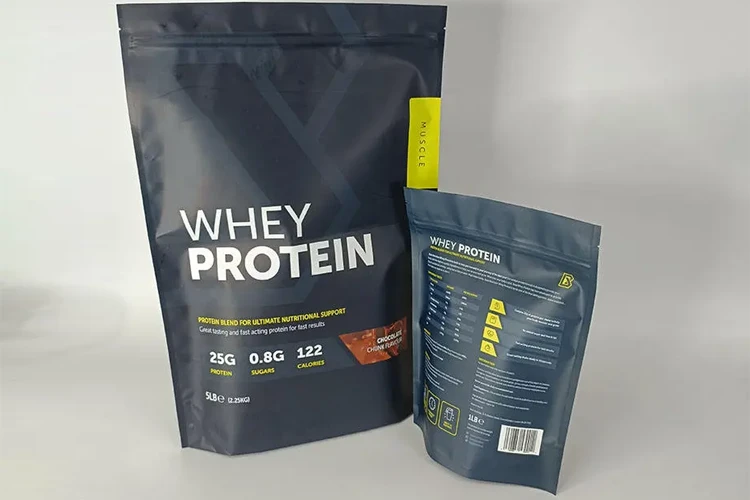
Among all stand up pouch sizes, one dominates. Globally, the 6–6.5″ wide pouch holding 12–16 oz (340–454 g) is the workhorse of food retail — it fits standard shelf clips, holds a mainstream price point, and stands stable at 80% fill. Coffee, protein, and pet treat brands all cluster here. If you audit any supermarket aisle you will see stand up pouch sizes concentrate in this band for exactly those reasons.
How much does a stand up pouch hold in grams?
Bulk density is what turns stand up pouch sizes into real fill weights. By product, at 80% fill: a 4″ pouch holds roughly 100–120 g of dense powders or 80–100 g of whole beans; a 6″ pouch holds 350–450 g of powder; a 10″ pouch holds 2–2.5 kg. Always convert with your own bulk density number rather than a generic chart.
Do stand up pouches need a minimum fill to stand up?
Yes, and this is where stand up pouch sizes meet physics — most designs need about 50% fill before the gusset opens reliably, and look their best at 70–85%. Underfilled pouches slump forward; overfilled ones bulge and stress the side seals.
Can I get custom stand up pouch sizes?
Yes — custom stand up pouch sizes are cut to order, so any width, height, and gusset combination is possible.
Yes. Cylindrical die lines are cut to order, so any width/height/gusset combination is possible from roughly 5,000–10,000 piece minimums depending on material and printing. Custom sizing is the right call whenever stock sizes force you to overfill, underfill, or pay for shelf space you do not use — our stand up coffee bag guide shows a full custom build end to end.
Choosing Between Stock and Custom Sizes
Comparing stand up pouch sizes is ultimately a freight-and-shelf exercise, not a paperwork one. Stock sizes win on speed and price below about 10,000 units. Custom sizes win the moment packaging waste, shipping dimensional weight, or shelf impression starts costing real money — which for most brands is earlier than expected. Map your product’s bulk density to the chart above, run a fill test, and if no standard size hits 70–85% fill, ask your supplier for a custom die line quote with matching freight calculations. The right stand up pouch sizes are the ones your product fills almost completely, stands straight on shelf, and ships without paying for trapped air.