
Compostable bags break down naturally, helping you reduce waste from food packaging. You see more food businesses switching to eco-friendly solutions because customers care about the planet.
71% of Millennials view companies with compostable packaging positively.
60% of consumers call compostable packaging “extremely or very eco-friendly.”
States like Washington and California push for composting, which increases demand. The global market could reach $75 billion by 2029. BN PACK stands out as a trusted provider, offering compost bags wholesale to support your sustainability goals.
Compostable Materials

What Are Compostable Materials
You can find compostable materials made from renewable resources. These materials break down into natural elements when placed in the right composting conditions. Many food packaging products use:
Starch-based materials like cornstarch, which create bioplastics such as PLA.
Plant fibers, including bagasse from sugarcane and palm leaves, for sturdy packaging.
Cellulose from wood pulp, which forms clear films and wraps.
Other sources like beet pulp, carrot pulp, and potato starch.
These materials help you reduce your reliance on fossil fuels. They also support a circular economy by returning nutrients to the soil.
Compostable vs. Biodegradable vs. Plastic
You may wonder how compostable materials compare to biodegradable and traditional plastics. Compostable materials break down within a set time frame when exposed to heat, moisture, and microorganisms. They leave no toxic residue. Biodegradable materials can take much longer to decompose and sometimes leave behind microplastics. Traditional plastics resist decomposition for hundreds or even thousands of years.
Compostable packaging must meet strict standards for breakdown in industrial composting facilities. Biodegradable plastics may not fully break down in every environment.
Type of Packaging | Environmental Impact |
|---|---|
Biodegradable Plastics | May not break down completely in all environments. |
Compostable Plastics | Must meet criteria for breakdown in composting facilities. |
Non-biodegradable Plastics | Resist natural breakdown and require recycling or energy recovery. |
Environmental Benefits
Switching to compostable packaging brings measurable benefits. Compostable packaging usually has a lower carbon footprint than traditional plastic because it uses renewable materials. For example, mushroom-based and compostable packaging both produce fewer emissions during their lifecycle compared to foam or plastic.
Compostable bags help divert waste from landfills.
They break down into organic matter, enriching the soil.
Using compost bags wholesale can reduce greenhouse gas emissions by moving organic waste to composting facilities instead of landfills.
You help protect the environment and support sustainability when you choose compostable materials for your packaging.
Why Use Compostable Bags
Sustainability for Food Businesses
You can make a real difference by choosing compostable bags for your food business. Compostable packaging helps you reduce landfill waste and supports a circular economy. Many companies now use sustainability metrics to measure their impact.
You track carbon footprint reductions.
You monitor waste diversion rates.
You measure the percentage of plant-based materials in your packaging.
You set goals for packaging circularity and follow new legislation.
You consider consumer behavior and technology improvements.
In 2025, 70% of companies will use Environmental, Social, and Governance (ESG) metrics to evaluate their sustainability efforts. Compost bags wholesale offer a practical solution for food service containers that are hard to recycle. BN PACK supports your goals with eco-friendly packaging that meets international standards.
Compliance and Certifications
You need to follow strict regulations when you choose compostable packaging. Certifications prove that your bags break down safely and completely. These standards help you build trust with customers and composting facilities.
Certifications like BPI and EN13432 require rigorous testing. They guarantee that compostable bags decompose without leaving toxic residues.
Certification Name | Description | Region |
|---|---|---|
ASTM-D6400 Standard | Breaks down within 180 days, non-toxic | U.S. |
ASTM-D6868 Standard | For compostable films and coatings | U.S. |
European Standard EN 13432 | Disintegration within 12 weeks, biodegradation within six months | Europe |
Seedling | Industrial compostability according to EN 13432 | Europe |
BPI Certification | Industrial compostability, no toxic residues | U.S. |
CAN/BNQ 0017-088 Standards | Compostable plastics meet Quebec standards | Canada |
DEBIO Certified | Use in organic agriculture post-composting | Norway |
BN PACK’s products meet ISO9001 and BRC standards, so you can trust their quality and safety.
Consumer Appeal
You attract more customers when you use compostable bags. Many people care about the environment and want to support responsible businesses.
You show your commitment to sustainability.
You build customer trust.
You retain and attract new customers.
You appeal to eco-conscious consumers.
You enhance your brand reputation.
Surveys show that nearly half of consumers struggle to tell the difference between biodegradable and compostable packaging. Up to 50% believe they can compost packaging labeled “made from plants.” Compost bags wholesale help you stand out as a leader in sustainability. BN PACK’s eco-friendly solutions position your business as environmentally responsible and trustworthy.
Types of Compost Bags Wholesale

You can choose from several types of compostable bags for your food business. Each type serves a unique purpose and helps you meet sustainability goals. Compost bags wholesale offer you flexibility and eco-friendly options for different packaging needs.
Produce Bags
Produce bags help you package fruits, vegetables, and bulk items. You see these bags in supermarkets, grocery stores, and farmers’ markets. Many stores switch to compostable produce bags as plastic bans increase. These bags support local food systems and attract eco-conscious shoppers.
Application Area | Description |
|---|---|
Supermarkets and Grocery Stores | Adoption of compostable bags as plastic bans are implemented, enhancing sustainability in packaging. |
Food Distributors | Use of compostable bags to improve supply chain sustainability and reduce plastic waste during transport. |
Farmers’ Markets | Embracing compostable bags to support local, sustainable food systems and attract eco-conscious consumers. |
You can find produce bags made from PLA, PBAT, and cornstarch. These materials break down quickly and do not leave harmful residues.
Pouches and Ziplock Bags
Pouches and ziplock bags give you secure storage for snacks, dried foods, and prepared meals. Compostable pouches stand out because they use renewable resources and break down into organic matter in 90-180 days. You avoid toxins and microplastics that come from conventional plastics.
Feature | Compostable Pouches | Conventional Options |
|---|---|---|
Environmental Impact | Made from renewable resources, break down naturally | Made from non-renewable resources, long-lasting pollution |
Biodegradability | Break down into organic matter in compost | Can take hundreds of years to decompose |
Food Safety | Chemical-free, safe for food storage | Often contain toxins from petroleum |
Disposal Method | Can be composted in 90-180 days | Takes around 1,000 years in landfills |
Versatility | Suitable for various storage needs | Limited to specific uses |
Sealing Mechanism | Secure sealing like traditional bags | Standard sealing mechanism |
Sizes and Thickness Options | Available in various sizes and thicknesses | Limited options |
BN PACK offers custom compostable pouches and ziplock bags. You can select the size, thickness, and sealing style that fits your product.
Liners and Specialty Bags
Liners and specialty bags help you manage food waste, store bulk ingredients, and package unique products. You find liners in trash bins and food prep areas. Specialty bags include stand-up pouches, flat-bottom bags, side gusset bags, vacuum seal bags, and child-resistant bags.
Bag Type | Suitable For |
|---|---|
Compostable Stand Up Pouch | Coffee beans, tea, granola, dried foods |
Compostable Flat Bottom Bag | Coffee beans, tea, protein powder, pet food |
Compostable Side Gusset Bag | Various products, stands on its own |
Compostable Vacuum Seal Bags | Fresh meat, vegetables, fruits, cheese |
Compostable Child Resistant Bag | Child-safe packaging |
Compostable Mailing Bags | Plant-based mailers for various industries |
BN PACK supports your business with custom specialty bags. You can request compost bags wholesale in the style and size you need. You help your brand stand out with packaging that matches your sustainability goals.
Buying Compost Bags Wholesale
When you buy compost bags wholesale, you need to look at several important factors. These include certifications, quality, durability, shelf life, pricing, minimum order quantities (MOQ), and supplier reliability. Each factor helps you make the best choice for your business and ensures your packaging meets both customer and regulatory expectations.
Certifications and Quality
Certifications show that compostable bags meet strict standards for safety and environmental impact. You should always check for recognized certifications before you buy. These certifications prove that the bags will break down safely in composting conditions and leave no toxic residue.
Certification Name | Region | Significance |
|---|---|---|
BPI Certified Compostable | USA | Ensures the bag breaks down under composting conditions without toxic residue. |
TÜV Austria OK Compost Home / Industrial | Global | Certifies compostability in both home and industrial settings. |
ASTM D6400 or EN 13432 Compliance | USA/EU | Guarantees safe breakdown in commercial composting facilities. |
You will find that different regions have their own standards:
ASTM D6400 sets requirements for compostable plastics in North America.
EN 13432 outlines criteria for compostable packaging in the EU, including disintegration within 12 weeks and full biodegradation within six months.
BPI Certification verifies compliance with ASTM D6400 in North America.
TÜV OK Compost and OK Compost HOME ensure products are biodegradable in both industrial and home composting environments.
BN PACK’s products meet ISO9001 and BRC standards. These certifications show that BN PACK follows strict quality management and safety systems. Many global brands trust suppliers with these certifications because they guarantee consistent quality and compliance.
Durability and Shelf Life
You want compostable bags that last long enough for storage and use, but still break down quickly in composting conditions. Compostable bags usually have a shelf life of about 12 months. This is much shorter than traditional plastic bags, which can last for centuries in landfills.
Compostable bags: average shelf life of 12 months.
Traditional plastic bags: can take centuries or even thousands of years to break down.
Environmental conditions can affect how long compostable bags last. Moisture, humidity, and UV light can speed up the breakdown process. For example:
Environmental Condition | Effect on Compostable Materials |
|---|---|
Moisture | Accelerates degradation processes |
UV Light | Disrupts chemical bonds, reducing strength |
Humidity | Increases degradation rate of materials |
You should store compostable bags in a cool, dry place away from direct sunlight. This helps maintain their strength and extends their shelf life until you are ready to use them.
Pricing and MOQ
When you buy compost bags wholesale, you need to consider both price and minimum order quantity. Prices can vary based on bag size, type, and features. Here is a look at typical wholesale prices for compostable bags:
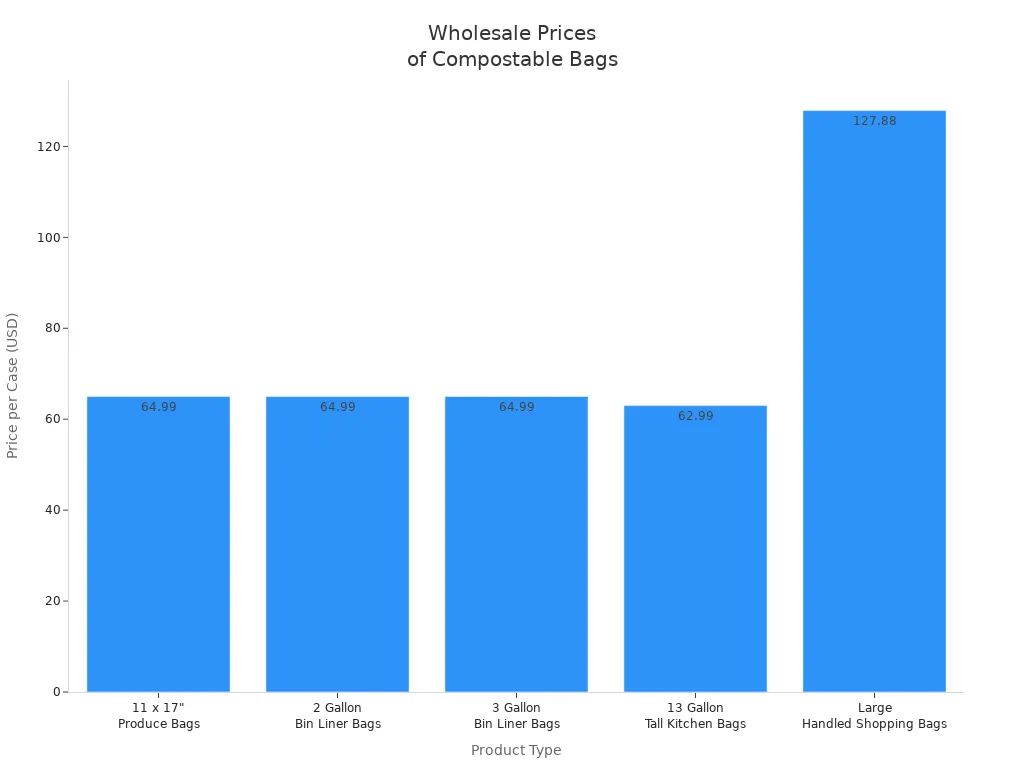
You can expect prices like:
Product Description | Price per Case |
|---|---|
11 x 17″ BioBag Compostable Produce Bags | $64.99 |
2 Gallon Compostable BioBag Compost Bin Liner Bags | $64.99 |
3 Gallon Compostable BioBag Compost Bin Liner Bags | $64.99 |
13 Gallon Compostable BioBag Tall Kitchen Bags | $62.99 |
Large BioBag Compostable Handled Shopping Bags | $127.88 |
Minimum order quantities (MOQ) also vary by bag type and supplier. For example:
Bag Type | MOQ (Approx.) |
|---|---|
Compostable T-shirt Bags | 10,000 – 30,000 pcs |
Compostable Garbage Bags | 5,000 – 10,000 rolls |
Compostable Mailer Bags | 5,000 – 8,000 pcs |
Compostable Ziplock Bags | 10,000 pcs |
Some suppliers offer custom compostable produce bags with a MOQ set at 500 kg. BN PACK provides flexible order options, so you can choose the right quantity for your needs.
Supplier Reliability
Choosing a reliable supplier is key when you buy compost bags wholesale. You want a partner who delivers consistent quality, meets deadlines, and supports your sustainability goals. Here are some criteria to help you evaluate suppliers:
Criteria | Description |
|---|---|
Certifications | Look for BPI, TÜV AUSTRIA Ok Compost, DIN CERTCO, ISO9001, and BRC certifications. |
Material Composition | Check the materials used for strength, flexibility, and compostability. |
Quality Control | Make sure the supplier uses strict testing to ensure product quality and reliability. |
Tip: ISO9001 certification shows that a supplier has strong quality management systems. BRC certification means the supplier meets global safety and quality standards. These certifications give you confidence that your supplier can handle large orders and meet international requirements.
BN PACK stands out as a trusted supplier. The company operates a 12,000㎡ ISO9001 & BRC-certified factory and serves customers in over 100 countries. You benefit from advanced production, strict quality control, and a commitment to sustainability.
Implementing Compostable Bags
Sourcing and Storage
You need to source compostable bags from a trusted supplier like BN PACK to ensure quality and compliance. Once you receive your bags, proper storage is essential to maintain their integrity and shelf life.
Store bags at temperatures between 50°F and 75°F to prevent heat damage.
Keep humidity low to avoid early degradation.
Ensure good air circulation to prevent moisture buildup.
Use pallets for storage and avoid excessive stacking to protect the bags.
Implement pest control measures.
Keep bags away from direct sunlight and heat sources.
Always check expiration dates on packaging.
Following these steps helps you keep your compostable bags strong and ready for use.
Staff Training
Your staff plays a key role in successful implementation. Training programs help them understand the value and handling of compostable packaging. A Corporate Sustainable Packaging Training Course, for example, focuses on eco-friendly solutions and reducing environmental impact. It usually lasts 12 to 24 hours and can be delivered virtually or on-site in multiple languages.
Training Program | Description | Duration | Delivery Type | Languages Available |
|---|---|---|---|---|
Corporate Sustainable Packaging Training Course | Eco-friendly packaging, waste reduction, sustainability | 12-24 hrs | Virtual/On-site/Off-site | 10+ (English, Español, etc.) |
You can also provide staff with an overview of compostable products, BPI certification details, and the market opportunities created by sustainable packaging.
Customer Communication
You build trust and loyalty by informing customers about your compostable bags.
Use clear labeling to highlight features like “100% compostable” and provide disposal instructions.
Share your sustainability story on packaging.
Create educational campaigns and content about environmental benefits.
Add QR codes that link to more resources.
Use in-store displays and signage to inform shoppers.
Foster a sense of shared purpose and encourage participation in sustainability programs.
Promote your efforts on social media and invite customers to share their experiences.
These strategies help customers understand your commitment and encourage them to support your eco-friendly initiatives.
Monitoring Impact
You should track key metrics to measure the success of your compostable bag program.
Monitor the volume of waste diverted from landfills.
Track your recycling rate to see how much waste is composted or recycled.
Measure the percentage of recycled content in your packaging.
Assess the biodegradation rate of your bags.
Calculate water and energy use per unit during production.
Track your carbon footprint and greenhouse gas emissions.
Metric | Description |
|---|---|
Volume of Waste Diverted | Total weight or percentage of food waste redirected from landfills. |
Recycling Rate | Percentage of total waste that is recycled or composted. |
Percentage of Recycled Content | Share of recycled materials in packaging. |
Biodegradation Rate | Speed at which compostable materials break down. |
Water and Energy Use per Unit | Resource consumption during packaging production. |
Carbon Footprint / GHG Emissions | Environmental impact measured through Life Cycle Assessment (LCA). |
Tracking these metrics helps you improve your sustainability efforts and demonstrate real progress to your customers.
Choosing compostable bags wholesale helps you boost sustainability, meet regulations, and build a strong brand. Many businesses have seen real results:
Case Study | Description | Impact |
|---|---|---|
Multinational Supermarket | Switched to compostable trays for fresh food | Cut plastic use by 900 tons each year |
Jane Dough | Uses compostable packaging for baked goods | Reduces plastic waste and supports green goals |
You can follow their lead. Partner with BN PACK for reliable, eco-friendly packaging. Start by reviewing your current packaging and exploring compostable options.