
Our modern world is grappling with the profound and lasting impact of conventional, petroleum-based plastics. From overflowing landfills to polluted oceans, the environmental cost is undeniable, and a global search is underway for smarter, more sustainable alternatives. At the heart of this green revolution in materials science and packaging is a single, promising, and often misunderstood term: bioplastics.
But what exactly are bioplastics? Is this innovative material truly the silver bullet for our plastic problem? The term itself is a broad umbrella, covering a diverse family of materials that range from plastics made from plants to plastics that can biodegrade back into the earth. The answer isn’t a simple yes or no, but a fascinating exploration of science, sustainability, and the future of how we make and use everyday things.
This authoritative guide will demystify the world of bioplastics. We will explore their precise definition, uncover their surprising history, break down the main types you’ll encounter (like PLA and PHA), and detail their manufacturing process. Finally, we will provide a balanced look at their advantages, the real-world challenges they face, and how they promise to change our future for the better.
Define Bioplastic: A Tale of Two Concepts
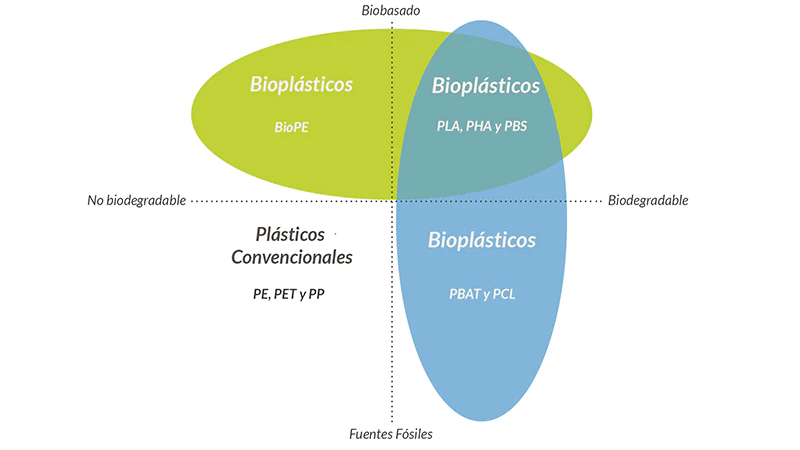
To begin, let’s define bioplastic. The term can be confusing because it is a broad umbrella that covers two distinct, and not always overlapping, categories of materials. A plastic is generally considered a bioplastic if it is either bio-based, biodegradable, or both. Understanding this distinction is the most critical first step to understanding the entire landscape.
1. Bio-based Plastics (A Focus on Source)
A plastic is considered “bio-based” if it is made in whole or in part from renewable biological resources, such as corn starch, sugarcane, potatoes, or algae. The primary advantage of these materials is that they reduce our dependence on finite fossil fuels like petroleum. Their claim to sustainability is rooted in their origin.
Critically, “bio-based” does not automatically mean “biodegradable.” There are many bio-based plastics, often called “drop-ins,” that are chemically identical to their petroleum-based counterparts. A prime example is bio-PET, used in some beverage bottles, which is made from sugarcane but is not biodegradable and must be recycled alongside traditional PET.
2. Biodegradable Plastics (A Focus on End-of-Life)
A plastic is considered “biodegradable” if it can be broken down by microorganisms (like bacteria or fungi) into water, carbon dioxide, and natural biomass under specific conditions. Their claim to sustainability is rooted in their ability to return to the earth after use.
Importantly, a biodegradable plastic is not necessarily bio-based. There are some fossil-fuel-based polymers (like PBAT) that are engineered to be fully biodegradable.
The category of what are bioplastics becomes most powerful and intuitive where these two concepts overlap. Materials like PLA (Polylactic Acid), which are both derived from plant resources and are biodegradable under industrial composting conditions, represent the ideal form of a bioplastic and are at the forefront of the sustainable packaging revolution.
When was Bioplastic Invented? A Brief History
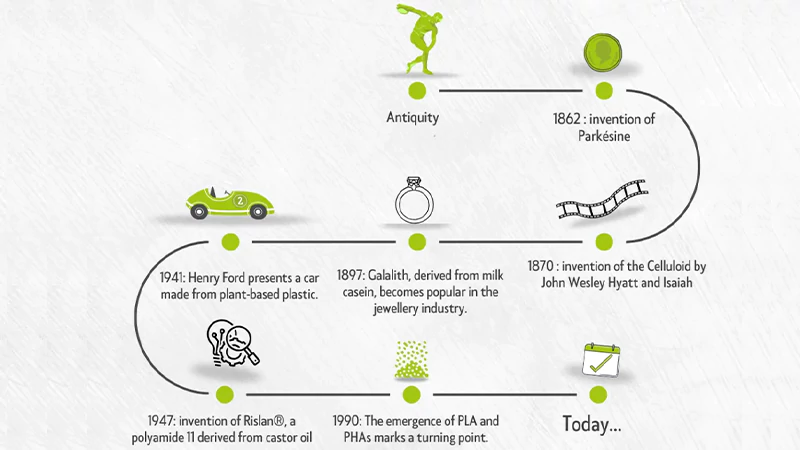
While the large-scale production of bioplastics is a 21st-century phenomenon, the answer to the question “when was bioplastic invented?” takes us back much further than most people realize. The idea of creating plastic-like materials from organic sources is over 150 years old.
The story begins in the 19th century. In 1862, an English inventor named Alexander Parkes created one of the first man-made plastics, which he called Parkesine. It was an organic material derived from cellulose—a natural polymer found in plant cell walls—treated with nitric acid. This material, later commercialized as celluloid, was a foundational step in showing that natural polymers could be modified to create new materials.
Perhaps the most fascinating chapter in the early history of bioplastics came from an unexpected source: the automotive industry. In the 1940s, visionary industrialist Henry Ford, seeking to create a synergy between agriculture and his factories, famously developed a “soybean car.” He championed research into creating bioplastic panels for his vehicles made from agricultural products like soybeans, hemp, and flax. He even demonstrated the material’s strength by striking the trunk of a prototype with an axe.
However, these early innovations were soon overshadowed. Following World War II, the world entered an age of cheap, abundant petroleum, and the focus shifted entirely to fossil-fuel-based plastics. It wasn’t until the late 20th and early 21st centuries, driven by growing concerns about oil dependency and plastic pollution, that the modern bioplastics industry was truly born, leading to the commercial-scale production of materials like PLA that we see today.
Types of Bioplastics
The term “bioplastic” is not a single material but a diverse family, each with its own unique origin story, properties, and ideal applications. Understanding the main players in this family is key to choosing the right sustainable material for a specific product.
PLA Bioplastic
PLA is currently the most popular and widely used bioplastic in the world, especially in food packaging, disposable cutlery, and 3D printing.
- Source: PLA bioplastic is derived from the fermentation of renewable carbohydrate-rich resources, most commonly corn starch in the United States or sugarcane in other parts of the world. Microbes ferment the plant sugars to produce lactic acid, which is then converted into Polylactic Acid.
- Properties: In its most common form, PLA is a rigid, transparent, and glossy polymer that closely resembles traditional PET (the plastic used for water bottles). It has good strength and is excellent for showcasing the product inside.
- Key Point: The most critical thing to understand about PLA is its end-of-life. While it is fully biodegradable, it requires the specific high-heat and high-humidity conditions of an industrial composting facility to break down efficiently (typically within 90-180 days). It will not biodegrade in a backyard compost pile or in a marine environment in a practical timeframe.
PHA Bioplastic
PHAs are often considered the next frontier of bioplastics due to their remarkable properties and end-of-life potential.
- Source: A PHA bioplastic is a truly unique material because it is produced by microorganisms. Certain bacteria, when fed a source of carbon (like vegetable oils or even food waste), naturally produce these polymers as an energy reserve, much like humans store fat. The PHA is then harvested from the bacteria.
- Properties: The PHA family is incredibly versatile. Depending on the specific type, they can range from being rigid and brittle to soft and highly elastic, mimicking a wide range of conventional plastics.
- Key Point: The most significant advantage of PHAs is their superior biodegradability. Many types of PHA can biodegrade in a much wider range of environments, including soil, freshwater, and even marine ecosystems, making them a very promising solution for reducing plastic pollution.
Starch-Based Bioplastics
These are some of the most common and cost-effective types of bioplastics, often used for loose-fill packaging “peanuts” or blended with other polymers.
- Source: As the name suggests, these plastics are made directly from plant starches, such as those from potatoes, tapioca, or corn.
- Properties: In their pure form, starch-based plastics can be brittle and are sensitive to moisture. For this reason, they are often blended with other biodegradable polymers (like PBAT) or even traditional plastics to improve their strength, flexibility, and water resistance.
- Use Case: They are an excellent way to reduce the fossil-fuel content of a package and can be engineered to be fully compostable.
Bio-based “Drop-in” Plastics
This category represents a pragmatic bridge between the bio-economy and our existing infrastructure.
- Source: These plastics are made, in whole or in part, from renewable resources. For example, the ethylene used to make Polyethylene (PE) can be derived from sugarcane ethanol instead of from natural gas.
- Properties: The final chemical structure of a “drop-in” bioplastic is chemically identical to its fossil-fuel-based counterpart. Bio-PE is the same as regular PE; Bio-PET is the same as regular PET.
- Key Point: Because they are chemically identical, these plastics are not biodegradable. However, their major advantage is that they can be seamlessly “dropped in” to existing recycling streams. A bio-PET bottle can be recycled right alongside a petroleum-PET bottle. Their primary sustainability claim is the reduction of fossil fuel consumption at the source.
How Are Bioplastics Made? From Plant to Polymer
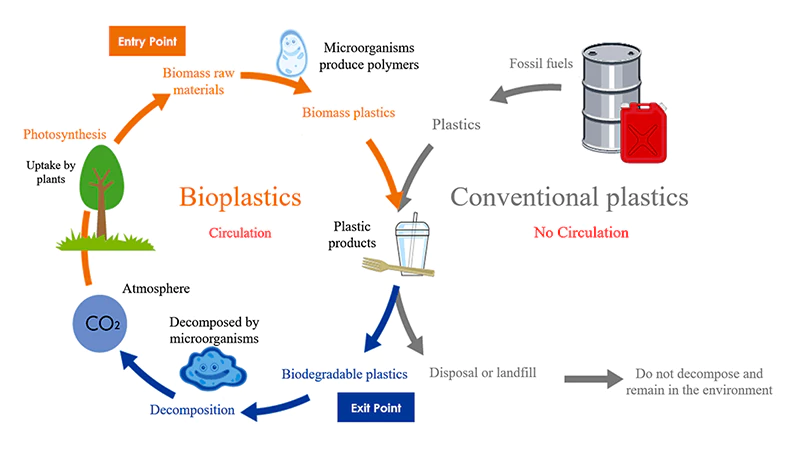
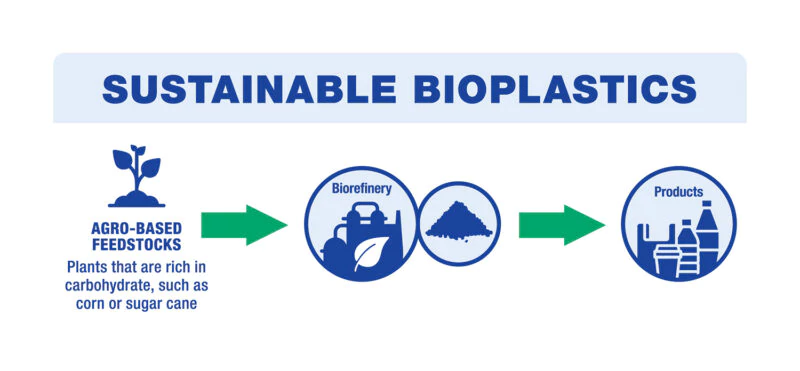
While the science can be complex, the fundamental process for creating many of the most common bioplastics, particularly a material like PLA, can be understood as a remarkable three-step journey that transforms a simple farm crop into a high-performance polymer.
Step 1: Sourcing and Extracting the Biomass
The process begins in the field. A carbohydrate-rich crop, such as industrial corn, sugarcane, or potatoes, is harvested. The raw plant matter is then taken to a mill where it is processed to extract its core component: sugar. For corn, this involves milling it to separate the starch, which is then converted into a simple sugar (dextrose). This sugar is the essential feedstock that will fuel the entire bioplastic production process.
Step 2: Fermentation and Conversion
This is where the “bio” technology truly comes into play. The extracted plant sugar is placed into large fermentation vats and introduced to specific microorganisms, such as bacteria or yeast. These microbes consume the sugar, and through the natural process of fermentation—similar to how beer or yogurt is made—they convert it and excrete a new chemical. In the case of PLA production, the microbes produce lactic acid. This lactic acid, which is the basic chemical building block (or “monomer”), is then purified.
Step 3: Polymerization
The final step is to create the plastic itself. “Polymerization” is the chemical process of linking a large number of small monomer molecules together to form a long, repeating chain, called a polymer. For PLA, the purified lactic acid monomers are chemically processed to link them end-to-end, forming the long polymer chains of Polylactic Acid. It is this long-chain structure that gives the material its strength, durability, and plastic-like properties, allowing it to be melted, extruded into a film, or molded into a rigid container.
Advantages of Bioplastics
The global shift towards bioplastics is driven by a powerful set of environmental and functional advantages over their traditional, fossil-fuel-based counterparts. These benefits address some of the most pressing challenges of the 21st century, from climate change to resource depletion.
Reduced Carbon Footprint
One of the most significant environmental benefits of bioplastics is their potential for a lower carbon footprint. The plant feedstocks used to create them, such as corn and sugarcane, absorb carbon dioxide (CO2) from the atmosphere as they grow through the process of photosynthesis. This initial absorption of CO2 helps to offset the CO2 that is emitted during the manufacturing and transportation of the bioplastic. In many cases, this results in a production process that is less carbon-intensive compared to the extraction and refining of petroleum for conventional plastics.
Dependence on Renewable Resources
Conventional plastics are derived from petroleum, a finite and non-renewable fossil fuel. The entire bioplastics industry is built upon a different foundation: renewable biomass. The plant resources used to make bioplastics can be grown and harvested annually, creating a more circular and sustainable model for material production. This shift away from fossil fuels is a critical step in building a more resilient and sustainable global economy.
Potential for Biodegradability and a Circular End-of-Life
Certain types of bioplastics, like PLA and PHA, offer a revolutionary end-of-life solution that conventional plastics cannot. Their ability to biodegrade under the right conditions means they can be broken down and returned to the earth as natural biomass. When managed through an industrial composting system, this creates a closed-loop, circular economy where a plant becomes a package, and that package is then turned into compost to help grow new plants. This offers a powerful alternative to the linear “take-make-dispose” model that has led to overflowing landfills and plastic pollution.
Versatility and Innovation
The field of bioplastics is a hotbed of innovation. As we’ve seen with the diverse family of materials from rigid PLA to flexible PHA, these polymers can be engineered to have a wide range of properties. They can be made transparent or opaque, stiff or elastic, and can be used in an ever-expanding array of applications. From food packaging and disposable cutlery to automotive parts, medical implants, and textiles, bioplastics are proving to be highly versatile materials that can meet the demands of modern industry.
Your Partner in Sustainable Packaging
Navigating the complex landscape of bioplastics—with its nuanced benefits, specific disposal requirements, and real-world challenges—requires more than just good intentions; it requires deep expertise. For a brand owner, making the right sustainable choice can feel overwhelming. This is where a knowledgeable and experienced packaging partner becomes essential.
At BN PACK, we are committed to being at the forefront of the sustainable packaging revolution. We understand both the immense potential and the critical challenges of bioplastics. We specialize in providing custom packaging solutions for brands based on a range of eco-friendly materials, including PLA.
Our team of experts will help you understand the properties of different materials, select the best option for your specific product and brand values, and guide you on how to clearly communicate the packaging’s environmental features and proper disposal methods to your customers. Let’s work together to build a greener future for your product, backed by science and responsibility.
How Will Bioplastics Change the Future for the Better
Bioplastics represent a critical and fundamental shift in our approach to materials science. They offer a tangible pathway to reduce our deep-seated dependence on fossil fuels and to move away from the linear “take-make-dispose” model that has defined manufacturing for the last century. They are a cornerstone in the development of a true circular economy, where the materials we use are designed to be returned to the earth or reused in a sustainable loop.
However, their ultimate success is not guaranteed by the technology alone. It is inextricably linked to our collective commitment to building the necessary infrastructure—widespread access to industrial composting facilities and clear, streamlined recycling systems. It requires the dedication of brands to choose these materials responsibly and to educate their consumers, and it requires the willingness of all of us to participate in creating a more sustainable system.
Bioplastics are not a simple, single-shot solution to our plastic problem, but they are a powerful and hopeful promise of a more regenerative future.