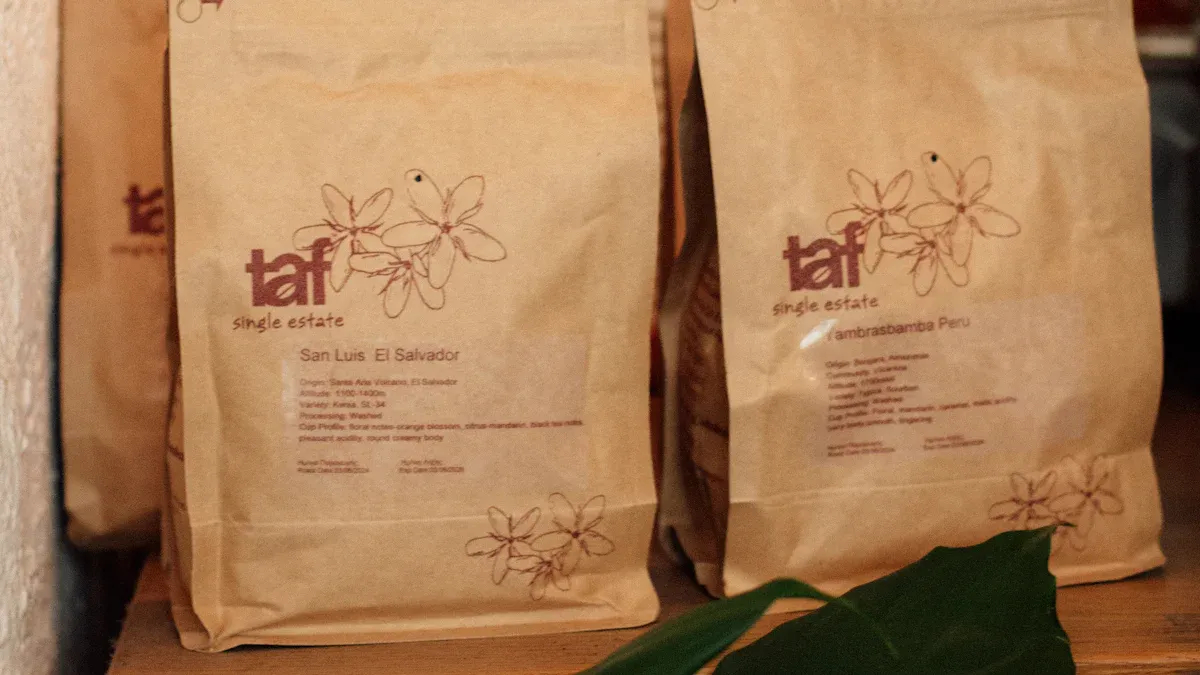
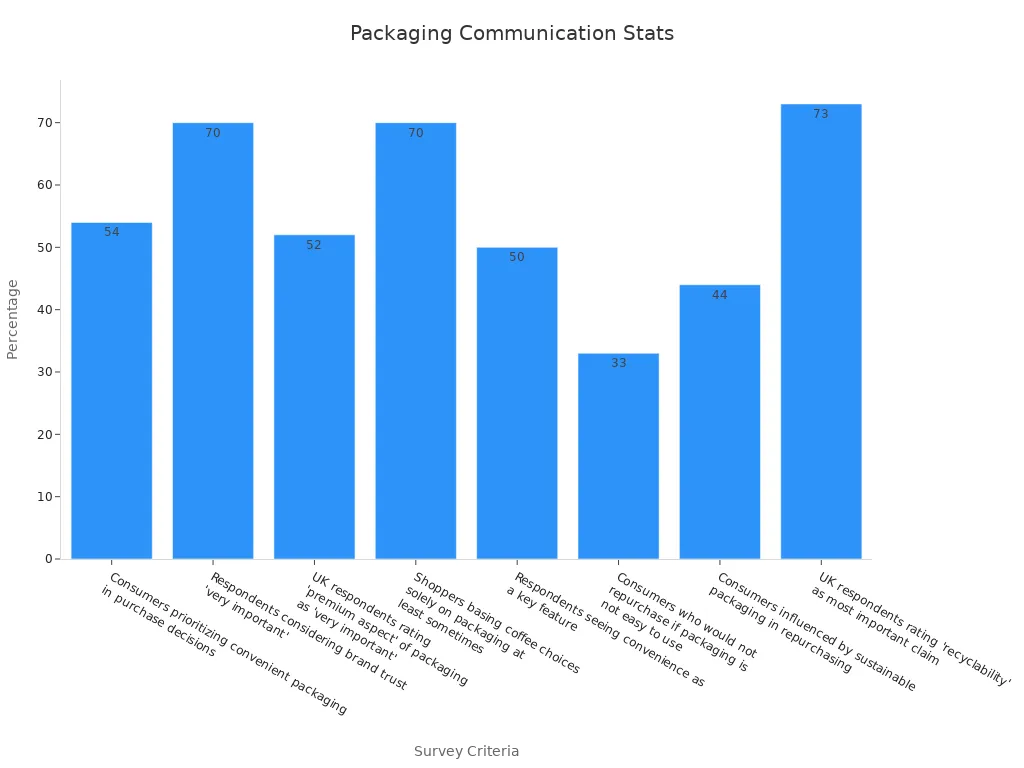
To get accurate, compliant, and effective packaging, you should provide your coffee packaging supplier with clear details about your product, branding, packaging types, and any legal or labeling requirements. Clear communication helps you avoid mistakes and ensures your packaging stands out on the shelf. Studies show that shoppers take only seven seconds to decide on a purchase, so packaging must quickly and clearly share key details. You can see from the chart below that clear information about convenience, sustainability, and brand trust strongly influences buying decisions. Working with an experienced supplier like BN Packaging helps you achieve quality, sustainability, and fast turnaround.
Product Info
Coffee Type
You should always tell your packaging supplier what type of coffee you offer. Coffee bean variety affects flavor, caffeine, and even how your packaging looks. Most coffee on the market comes from Arabica or Robusta beans. Arabica beans taste smooth and sweet, while Robusta beans have a stronger, more bitter flavor. Some brands use rare Liberica beans for a smoky taste. The table below shows key differences:
Coffee Bean Variety | Market Share (%) | Flavor Profile | Caffeine Content (mg/cup) | Key Characteristics |
|---|---|---|---|---|
Arabica | 60-80 | Smooth, sweet, bright | ~160 | Most popular, delicate, moderate |
Robusta | 30-40 | Bold, intense, bitter | ~220 | Hardier, higher caffeine, affordable |
Liberica | <2 | Smoky | N/A | Rare, unique flavor |
Tip: Let your supplier know if you offer regular, espresso, or flavored coffee. This helps them suggest the best packaging features.
Origin & Roast
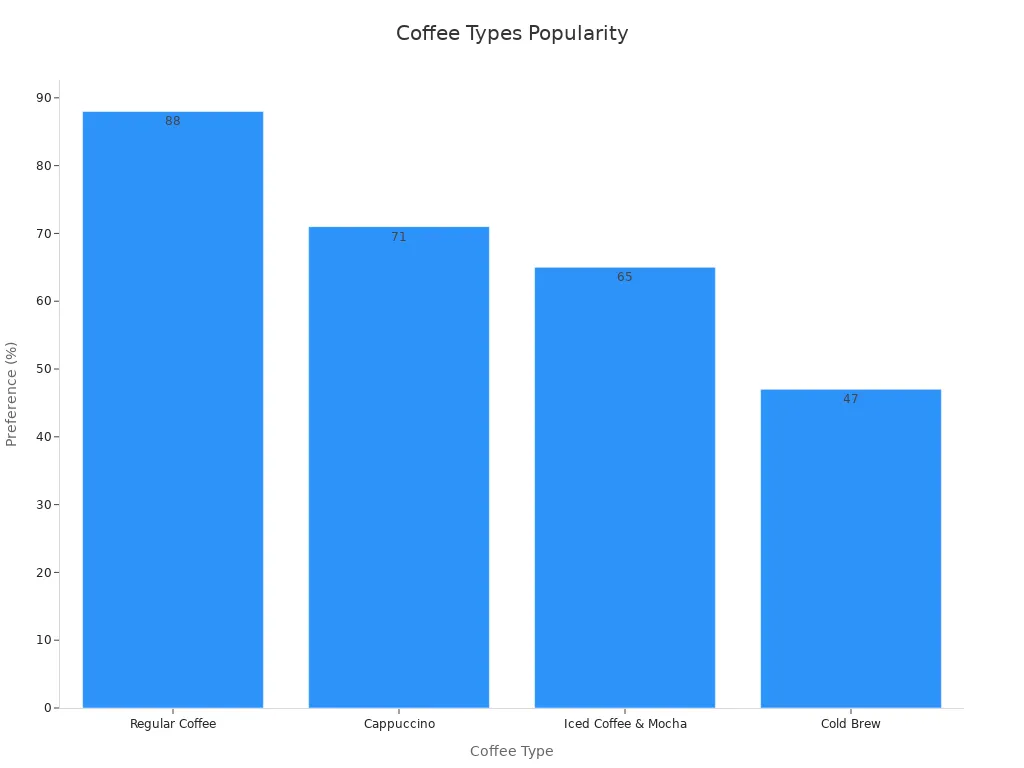
Coffee origin and roast level shape your product’s story and appeal. You should specify the country or region where your beans come from, such as Colombia, Ethiopia, or Vietnam. Roast level—light, medium, or dark—also matters. North America and Europe prefer medium roasts, while specialty blends and single-origin coffees are growing in popularity. Many brands highlight ethical sourcing and sustainability, which can attract more customers.
Medium roast blends lead in North America and Europe.
Latin America, especially Brazil and Colombia, supplies much of the world’s coffee.
Asia-Pacific markets, like China, show fast growth in specialty coffee.
Single-origin and ethically sourced coffees create niche markets.
Weight & Notes
Always provide the exact weight for each coffee bag, such as 250g, 500g, or 1kg. This ensures your packaging fits your product and meets legal standards. You should also share any special notes, like grind size, flavor notes (vanilla, hazelnut), or brewing tips. Clear information helps your supplier design packaging that protects freshness and highlights what makes your coffee unique.
Branding
Logo & Colors
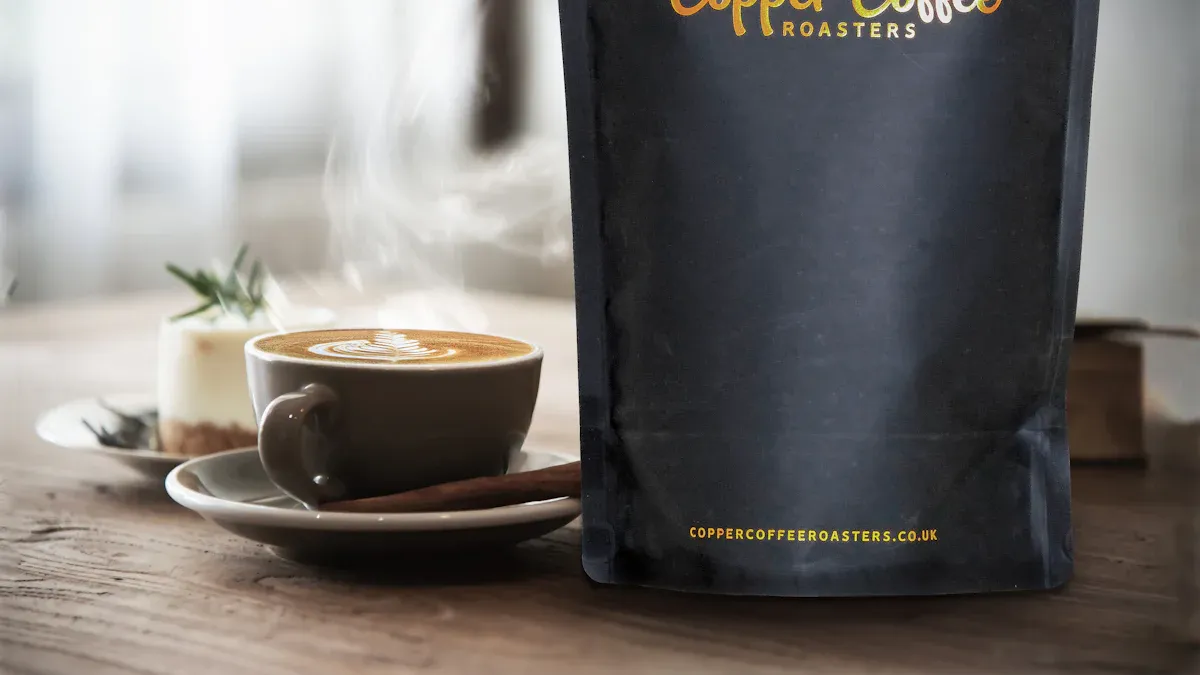
Your logo and color scheme set the first impression for your coffee brand. You should provide your supplier with high-resolution logo files and clear color codes (such as Pantone or CMYK values). Color psychology plays a big role in coffee packaging. For example, green often signals health and nature, while gold suggests elegance and premium quality. Both bold and minimalist color schemes can work, depending on your brand’s message.
Green evokes freshness and sustainability.
Gold and metallics add a sense of luxury.
Vibrant colors attract attention on crowded shelves.
Minimalist designs can signal sophistication.
A 2015 study found that packaging with motion or action-oriented graphics, including dynamic logos, performs better in consumer selection. Consistent use of your logo and colors helps shoppers recognize your brand quickly and builds trust over time.
Fonts & Product Name
Typography does more than display your product name—it shapes how customers feel about your coffee. You should specify the exact fonts you want on your packaging and ensure they match your brand’s personality. For example, bold fonts can suggest energy, while elegant scripts may hint at a refined taste.
A scientific study showed that brands using fonts appropriate to their product category were chosen twice as often as those with mismatched fonts. When your font style matches your product name, customers recognize your brand faster and feel more positive about it. Brands like Fuel America use bold fonts and symbols to promise energy, while others use custom lettering to stand out.
Make sure your font is easy to read on both packaging and digital platforms. Creative, consistent typography boosts brand recognition and consumer trust.
Company Details
You should always include clear company information on your packaging. This means your logo, website, and location. These details help customers know who you are and where your coffee comes from.
State what your company does, such as direct-trade sourcing or eco-friendly practices.
Share what your company stands for, like social impact or sustainability.
Add essential coffee details—origin, tasting notes, roast level, and roast date—to educate and build trust.
Many leading brands include QR codes that link to social media or sourcing stories. This approach increases transparency and connects with values-driven buyers. Visual storytelling through logo, typography, and color choices shapes your brand’s personality and helps your coffee stand out in a crowded market.
Packaging Specs
Bag Type & Size
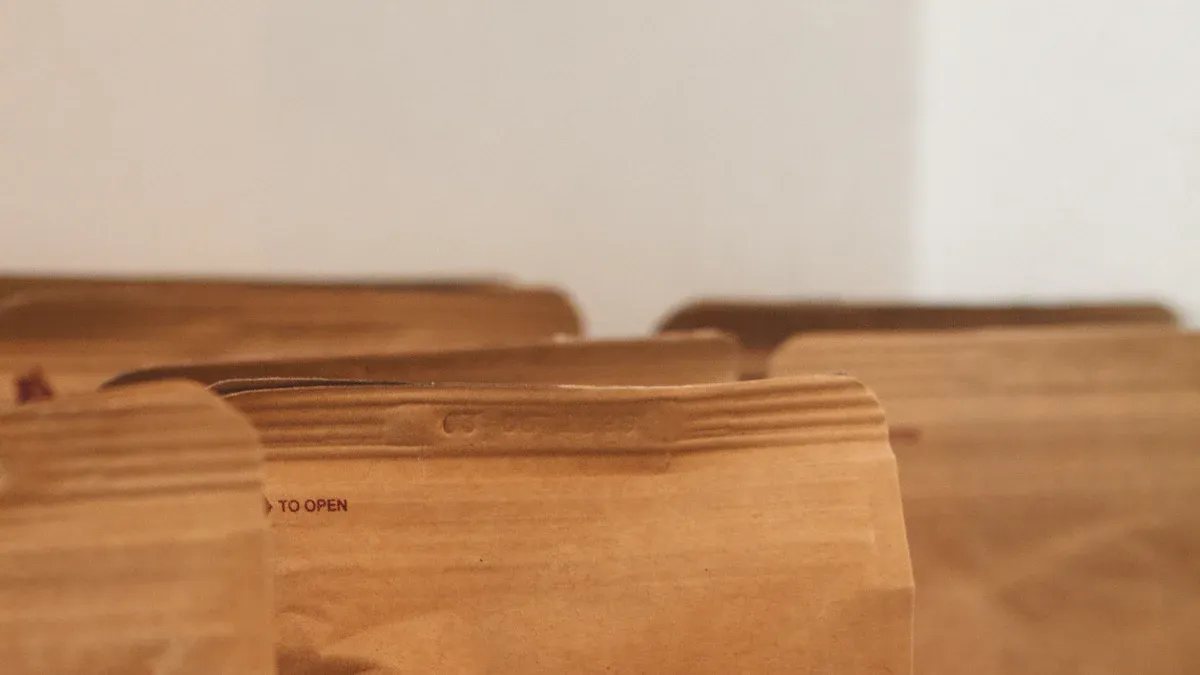
Choosing the right bag type and size is essential for protecting your coffee and making your brand stand out. You have many options, each with unique benefits. Stand-up pouches, flat bottom bags, side gusset bags, spouted pouches, fin/lap seal bags, three side seal pouches, roll film, and child-resistant zipper bags all serve different needs. Custom shapes can help your product catch the eye on crowded shelves.
Stand-up pouches work well for retail because they stand upright and display your branding clearly. Flat bottom bags offer stability and a premium look, with five printable surfaces for your logo and product details. Side gusset bags provide flexibility and hold larger amounts, making them ideal for bulk sales. Custom shapes and closures, such as resealable zippers or spouts, add convenience and help your coffee stay fresh.
The table below shows how different bag types and sizes fit various market needs:
Bag Type | Key Features & Benefits | Typical Use Cases | Size/Capacity Range | Market Segment |
|---|---|---|---|---|
Stand-up Pouches | Upright display, resealable, strong barrier | Retail, freshness preservation | Small to Medium | Retail consumers |
Flat Bottom Bags | Stable base, premium look, large branding area | Premium coffee, retail | Small to Medium | Premium products |
Side Gusset Bags | Expandable, cost-effective, traditional | Bulk, retail | Medium to Large | Bulk packaging |
Quad Seal Bags | Durable, efficient storage, premium appearance | Specialty coffee | Medium to Large | Specialty coffee |
Pillow Bags | Simple, affordable, basic protection | Cost-sensitive segments | Small to Medium | Basic packaging |
Vacuum Bags | Excellent freshness, vacuum-sealed | Freshness-critical products | Small to Medium | Specialty coffee |
Resealable Bags | Consumer convenience, freshness retention | Retail, everyday use | Small to Medium | Retail consumers |
Tip: Tell your coffee packaging supplier your target market and sales channels. This helps them recommend the best bag type and size for your needs.
Materials & Features
The choice of materials and features affects both the quality of your coffee and your brand’s environmental impact. BN Packaging offers a wide range of materials, including plastic, foil, paper, and innovative hybrids. You can also choose eco-friendly options like biodegradable, compostable, and recyclable films.
Eco-friendly packaging is in high demand. Many consumers prefer brands that use sustainable materials. Biodegradable and compostable bags break down naturally, reducing landfill waste. Recyclable materials support the circular economy by turning old packaging into new products. Hybrid materials combine the best qualities of plastic, paper, and foil, offering both protection and sustainability.
Here is a table showing the effectiveness and features of different materials:
Material Type | Effectiveness & Features | Typical Use Cases |
|---|---|---|
Plastic | Superior barrier, flexible, cost-effective, multi-layer films | General coffee packaging, moisture/oxygen protection |
Foil | Excellent barrier against light, air, moisture; preserves freshness | Premium coffee, humid/high temp regions |
Paper | Eco-friendly, biodegradable coatings, growing demand | Sustainable packaging, green consumers |
Hybrid/Innovative | Combines benefits; compostable films emerging | Eco-friendly, regulatory compliance |
Special features can further enhance your packaging. Valves allow gases to escape without letting air in, keeping coffee fresh. Resealable zippers make it easy for customers to open and close the bag. Metallic foils add a premium look. Tamper-evident seals protect your product and reassure buyers.
Feature | Benefit |
|---|---|
Degassing Valve | Maintains freshness, prevents bag swelling |
Resealable Zipper | Easy to open/close, preserves aroma |
Metallic Foil | Premium appearance, extra barrier |
Tamper-Evident Seal | Product safety, consumer trust |
Child-Resistant Zipper | Safety for households with children |
Many brands now use post-consumer recycled (PCR) materials and bio-based films. These choices lower your carbon footprint and appeal to eco-conscious shoppers.
Artwork & Proofs
Clear and accurate artwork ensures your packaging looks professional and matches your brand. You should provide your supplier with high-resolution artwork files, such as AI, PSD, or PDF formats. Include your branding guidelines, color codes, and font choices. This helps the design team create packaging that reflects your brand identity.
Request digital proofs or 3D previews before production. These tools let you see how your packaging will look and catch any errors early. BN Packaging offers 3D previews and physical samples, so you can approve the design with confidence.
Always double-check your artwork and details before final approval. This step saves time and prevents costly mistakes.
A well-prepared artwork file speeds up the process and ensures your packaging stands out on the shelf. If you need help, BN Packaging’s design team can guide you through every step, from concept to final proof.
Legal & Labeling
Ingredients & Allergens
You must list all ingredients and potential allergens on your coffee packaging. This step protects your customers and keeps your brand compliant with food safety laws. Food labels help people with allergies make safe choices. Accurate allergen declarations on packaging reduce accidental exposures and support consumer safety.
Listing every ingredient and allergen helps allergic individuals avoid health risks.
Food labels act as the main tool for safe decision-making by allergic consumers.
Many countries, including the U.S., U.K., and EU, require you to highlight major allergens, often using bold text. You should only use “may contain” statements after a proper risk assessment. Failing to declare allergens can lead to recalls, fines, and legal action. Industry studies show that mistakes in allergen labeling can damage your reputation and result in lost sales. Laws like Natasha’s Law in the U.K. now require full ingredient and allergen labeling for foods prepacked for direct sale.
Always double-check your ingredient and allergen lists before sending your packaging to print.
Net Weight & Codes
Clear net weight information builds trust with your customers. You should display the net quantity on the main panel of your packaging, using both customary (oz, lb) and metric (g, kg) units. Research shows that consumers prefer simple, clear labels. Net weight serves as a key cue for product authenticity and quality.
Accurate net weight labeling increases brand trust and customer loyalty.
Inaccurate or missing net weight can lead to consumer mistrust and negative reviews.
FDA guidelines require net quantity to be clear and easy to read, usually on the lower third of the main panel.
You should also include batch codes or best-by dates. These codes help with traceability and quality control.
Certifications & Recycling
Certifications on your packaging show your commitment to safety and sustainability. Programs like OEKO-TEX Standard confirm your packaging is free from harmful substances. Cradle to Cradle Certified® evaluates your packaging for material health and circularity. These certifications improve recyclability and consumer safety.
Certification | Environmental Impact | Consumer Safety / Business Benefits |
|---|---|---|
APR Certification | Ensures packaging is recyclable, reduces emissions | Builds trust, supports compliance, circular economy |
RecyClass Recyclability | Optimizes packaging for recycling, reduces waste | Enhances credibility, meets legislative requirements |
Green Seal Sustainable Packaging | Minimizes resource use, promotes circular economy | Strengthens sustainability performance, builds trust |
BPI (Biodegradable Products Inst.) | Supports compostability, reduces plastic waste | Enables compostability claims, meets sustainability targets |
Cradle to Cradle Certified® | Designs for reuse, supports closed-loop systems | Differentiates products, attracts premium markets |
OK Compost (TÜV Austria) | Reduces landfill waste, promotes nutrient recycling | Strengthens eco-conscious brand image |
OEKO-TEX Standard | Certifies non-hazardous end-products | Verifies product safety, builds consumer trust |
Displaying these certifications on your packaging helps customers make informed, eco-friendly choices and supports your brand’s reputation.
Working with Your Coffee Packaging Supplier
Deadlines & Quantities
Clear communication with your coffee packaging supplier starts with setting precise deadlines and order quantities. When you share your production schedule and expected volumes, you help your supplier plan resources and avoid delays. This approach supports timely deliveries and keeps your inventory at the right level.
Meeting your deadlines ensures you receive products when you need them, preventing stockouts.
Accurate quantity information helps your supplier allocate resources efficiently, reducing waste and costs.
Well-defined plans allow for quick decision-making and better coordination between teams.
Tip: Use order tracking tools and set internal deadlines to keep your project on schedule. BN Packaging’s digital workflow lets you approve designs and monitor orders 24/7, making the process smooth and transparent.
Distribution & Storage
Proper distribution and storage protect your coffee’s quality from production to delivery. You should discuss logistics options with your coffee packaging supplier to find the best fit for your needs.
Air freight offers fast shipping for time-sensitive or small orders, keeping coffee fresh.
Ground freight works well for regional deliveries and balances speed with cost.
Ocean freight suits large shipments but may require temperature control to maintain quality.
You also need to consider storage conditions. Regulated storage spaces with temperature control preserve freshness and safety. Good inventory management, such as tracking stock levels and using FIFO (First-In, First-Out) systems, helps prevent spoilage and waste.
Note: Clean, organized warehouses and traceability systems support quality assurance and make recalls easier if needed.
Compliance & Safety
You must follow all legal and safety standards when working with your coffee packaging supplier. This includes food safety regulations, labeling laws, and data protection rules if you handle customer information.
Certifications like ISO9001, QS, and BRC show your supplier meets high quality and safety standards.
Regular quality checks of packaging materials prevent defects that could harm your product.
Vendor risk management and traceability systems help you track compliance and respond quickly to any issues.
Always train your staff on proper handling and storage. Automation tools can help you monitor compliance and keep your business audit-ready.
Giving your coffee packaging supplier complete and accurate information helps you create packaging that stands out and builds trust. Research shows that clear packaging details improve customer satisfaction and support brand growth. Use a checklist to make sure your packaging stays effective, compliant, and on-brand. BN Packaging offers expert guidance, eco-friendly materials, and fast service. These choices help you meet consumer expectations and grow your business in a competitive market.
FAQ
What file formats should I send for my packaging artwork?
You should send high-resolution files in AI, PSD, or PDF format. These formats keep your design sharp and clear. Always include your color codes and font details for the best results.
How do I choose the right packaging material for my coffee?
Think about your coffee’s shelf life and your brand’s values. If you want eco-friendly options, choose biodegradable or recyclable materials. For maximum freshness, select materials with strong barriers against air and moisture.
Can I order small quantities for a new product launch?
Yes, you can. BN Packaging offers low minimum order quantities starting at 500 units. This option works well for startups, seasonal blends, or market testing.
What special features help keep coffee fresh?
Degassing valves let gases escape without letting air in. Resealable zippers help keep coffee fresh after opening. Tamper-evident seals add safety and build trust with your customers.
How long does it take to receive my custom coffee packaging?
Production usually takes 5-7 days after you approve your design. Shipping time depends on your location and shipping method. You can track your order online for updates.