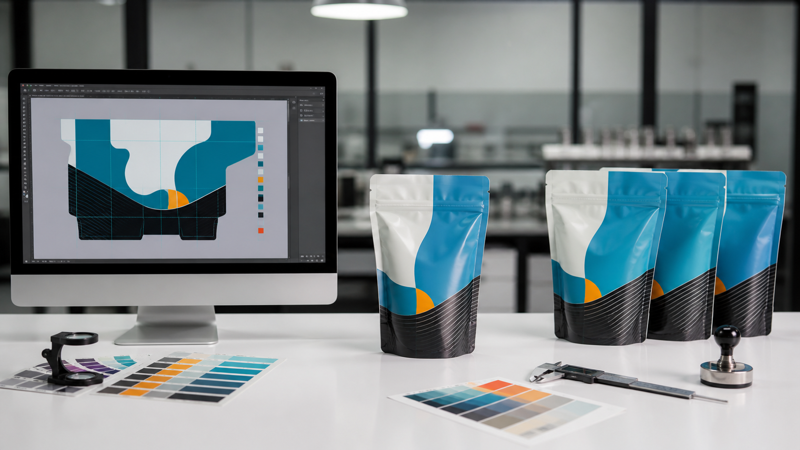
Packaging approval becomes risky when every preview is called a “sample.” A PDF proof, a digitally printed mock-up, and a pouch taken from a production run answer different questions. One may confirm copy and layout, another may demonstrate size and appearance, while only a production-representative sample can show the combined behavior of the final printing method, laminate, seals, zipper, and pouch-making process.
Brands should define what each approval stage is expected to prove. A clear sequence prevents a layout approval from being mistaken for a color guarantee and stops a beautiful prototype from being treated as evidence of production performance. Before ordering samples, confirm the exact structure, pouch format, printing process, and intended use through the supplier’s how to customize packaging workflow.
The Three Approval Tools
A digital proof is usually a PDF or online proof generated from the production artwork. It shows the dieline, graphics, copy, colors, and technical separations on screen. It is fast and inexpensive, making it the primary tool for checking content and prepress setup. It does not reproduce physical film, ink density, transparency, metallic effects, kraft shade, surface texture, lamination, or seal appearance.
A printed sample is a physical prototype produced before the main run, often with digital printing or a sample-making process. It can show actual dimensions, artwork scale, general color direction, pouch format, zipper position, clear windows, and how the design wraps around folds. The material may be the intended structure, a similar stock, or a simplified substitute. The printing technology may also differ from the final flexographic or gravure process.
A production sample is made using the approved commercial process, tooling, structure, and converting route. It may be a preproduction trial, a first-off sample from the main run, or an approved reference retained from production. It provides the strongest evidence of achievable color, registration, material appearance, lamination, seals, and workmanship. It also requires the greatest commitment because plates, cylinders, film, inks, and machine time may already be involved.
What a Digital Proof Can Approve
Use the digital proof to approve text, spelling, dimensions, SKU identity, barcode data, mandatory information, graphic position, panel orientation, and the relationship between artwork and dieline. Check bleed, safe zones, seals, gussets, zipper, tear notch, hang hole, valve, spout, window, date-code area, and other functional clearances.
Review separations as well as the composite image. Confirm CMYK versus spot colors, white-ink objects, varnish plates, overprints, knockouts, and technical layers. A composite can look correct while the underlying white plate is missing or an unintended spot color creates an extra printing station. Ask prepress for a separation preview when the design uses clear or metallic film.
Do not approve physical color from an ordinary monitor. Display calibration, ambient light, PDF rendering, and the difference between emitted screen light and reflected printed light all affect appearance. A digital proof may simulate color, but it should state whether it is content-only or part of a color-managed contract workflow. Even a calibrated contract proof normally represents a defined reference condition, not every substrate effect.
Use structured comments and one decision owner. Mark each change clearly, return a complete consolidated revision, and confirm the new proof rather than assuming an instruction was implemented. The approved file should have a unique version number and date linked to the purchase order.
What a Printed Sample Can Approve
A printed prototype is valuable for three-dimensional design review. Fill it with the real product or a weight-and-volume equivalent. Check whether the pouch stands correctly, whether graphics remain visible after the gusset opens, and whether the package fits shelves, cartons, displays, and filling equipment. Open and reclose the zipper, use the tear notch, and inspect the placement of a valve or spout.
The sample can also show whether type is legible at final size, whether the barcode sits on a sufficiently flat panel, and whether transparent areas reveal the product as intended. For custom coffee bags, test the filled appearance, degassing-valve location, headspace, top-seal allowance, and the way coffee color affects any clear window.
Before approving appearance, document how the sample was made. Ask whether it uses the final substrate, adhesive, sealant, thickness, printing method, white-ink opacity, varnish, zipper, and pouch-making equipment. A digital print can be an excellent visual prototype but may differ in gamut, gloss, dot structure, ink laydown, and registration from conventional production. A hand-made pouch may not predict automatic seals or fold tolerances.
Treat deviations as known limitations, not surprises. Write a sample scope such as “approved for dimensions and artwork placement; color and surface finish are directional only.” If the sample uses substitute material, do not use it to approve barrier, stiffness, seal window, product compatibility, or shelf life.
What a Production Sample Can Approve
A production sample should represent the final bill of materials and process: named film grades, thicknesses, inks, adhesive, coatings, zipper or valve, printing method, lamination, curing, slitting, and pouch making. Compare it with the signed artwork, color target, specification, and workmanship criteria.
Inspect color under standardized lighting and measure critical brand colors if numerical tolerances were agreed. Review registration, small text, reverses, gradients, white backing, clear windows, matte or gloss effects, scuff resistance, blocking, odor, curl, and visual defects. Measure pouch dimensions, seal widths, feature positions, and film thickness according to the sampling plan.
Functional approval requires more than a visual check. Test seal strength and integrity, zipper operation, tear behavior, valve or spout performance, drop resistance, and compatibility with the filling process. If the package protects a sensitive product, begin the planned barrier, migration, shelf-life, or distribution validation rather than inferring performance from appearance.
Clarify when production samples are reviewed. A preproduction trial can allow correction before the full quantity is run, but it adds setup cost and lead time. A first-off sample may permit press-side adjustment within a limited window. A shipment sample documents the completed lot but may arrive too late to prevent production. The purchase agreement should identify the hold point and who has authority to release manufacturing.
The Role of Free and Stock Samples
Stock or previously produced samples are useful at the beginning of a project. They help compare pouch formats, materials, zipper styles, valves, finishes, and general workmanship without making custom tooling. The guide to free packaging samples explains how these samples support early selection.
They do not approve a new SKU. A stock pouch may use different dimensions, film, artwork coverage, or production date. Use it to narrow choices and communicate preferences, then request project-specific evidence for the final specification.
A Practical Approval Sequence
Start with a blank structural sample if size, fill volume, or machine fit is uncertain. Once the structure is frozen, approve the production dieline and submit final artwork. Review the digital proof for content and separations. When appearance or placement risk justifies it, order a printed prototype and record its limitations. Approve tooling only after artwork is controlled.
For important launches, define a production reference or first-article approval. The retained sample should be signed or otherwise uniquely identified, protected from light and contamination, and connected to the final specification. Future lots can then be compared against a meaningful physical standard.
If a question remains unresolved, contact BN PACK or the selected converter with a precise gap list: what must be approved, which process will produce the evidence, and what tolerance will decide acceptance. “Please send a sample” is too broad to manage risk.
Approval Checklist
- Digital proof: approve copy, SKU data, barcode content, layout, orientation, dieline fit, and production separations.
- Printed sample: approve physical scale, general appearance, feature placement, filled presentation, and handling only within its documented scope.
- Production sample: approve final color, material appearance, registration, construction, workmanship, and specified functional tests.
- Record the exact material and printing process used for every physical sample.
- State what is directional, what is contractual, and what still requires validation.
- Identify the approved file version, sample ID, date, specification, and decision owner.
- Define the manufacturing hold point before the order is released.
- Retain approved references and change-control records for repeat orders.
The correct sample is the one that answers the current decision. Digital proofs control information, printed prototypes reveal three-dimensional design, and production samples demonstrate the commercial process. Used in sequence, they reduce approval ambiguity while keeping cost and lead time proportional to risk.