
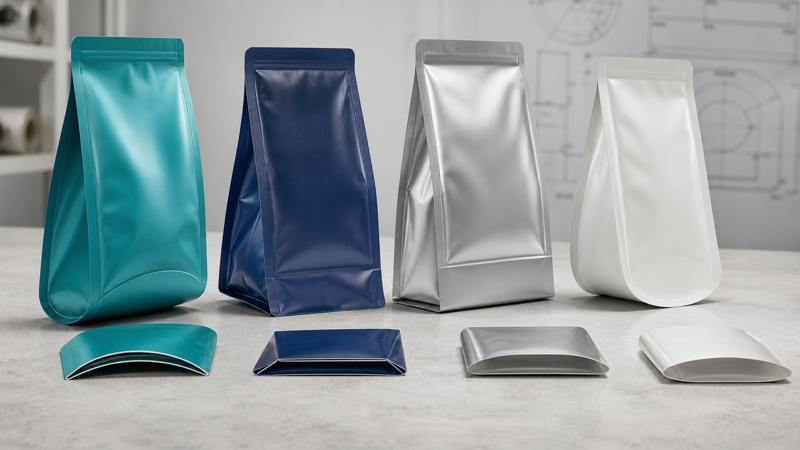
The bottom gusset is what allows a flexible pouch to expand, hold volume, and stand on a shelf. Its shape affects more than appearance. It changes load distribution, usable capacity, bottom stability, seal geometry, filling behavior, artwork placement, and the way the pouch fits into cartons. Choosing the wrong gusset can produce a bag that rocks, leans, wrinkles at the corners, or uses more material than necessary.
Names are not perfectly standardized across converters. “Doyen,” “round bottom,” and “plow bottom” may describe slightly different seal patterns depending on the machine and supplier. A brand should therefore approve a dimensioned drawing and physical sample rather than relying on a name alone. The comparison below explains the common principles used when specifying stand-up pouches.
How a Bottom Gusset Works
A stand-up pouch begins as flat flexible material. The bottom web is folded inward between the front and back panels, then sealed in a pattern that lets the fold open when product is filled. As the gusset expands, part of the pouch footprint moves outward and becomes the base. The final shape depends on gusset depth, pouch width, seal geometry, film stiffness, fill volume, and product distribution.
The nominal gusset dimension does not equal usable internal depth. Seals consume material, and the fold does not open into a perfect rectangle. Powder settles differently from snacks, beans, liquids, or irregular pieces. Capacity should be verified with the actual product, not calculated from outside dimensions alone.
A well-designed base spreads load without pulling excessively on the bottom corners. It should stand reliably after filling, remain compatible with the sealant and process temperature, and survive drop and compression forces. The design must also leave sufficient clearance for zippers, valves, handles, and the top seal.
Quick Comparison of Common Gusset Styles
| Gusset style | Typical strength | Common advantage | Main design concern | Often considered for |
|---|---|---|---|---|
| Doyen | Light to medium loads | Stable curved base with efficient shelf presentation | Bottom corner stress and limited heavy-load capacity | Snacks, coffee, powders, confectionery |
| K-seal | Medium to heavier loads | Reinforced seal pattern distributes weight toward the sides | More complex seal area and artwork clearance | Pet food, larger dry-food packs, dense products |
| Plow bottom | Medium loads, structure-dependent | Efficient forming and good internal volume | Terminology and machine geometry vary by supplier | Dry goods, powders, general stand-up formats |
| Round bottom | Light to medium loads | Smooth rounded footprint and clean appearance | May overlap with “Doyen” naming; verify drawing | Lightweight retail products and compact sizes |
This table is a starting point, not a load rating. Material structure, pouch dimensions, seal width, and product shape can make one supplier’s light-duty format outperform another supplier’s nominally stronger style.
Doyen Bottom
The Doyen-style gusset uses a curved seal pattern that allows the folded bottom to open into a rounded supporting base. The pouch tends to rest on the opened gusset rather than on sharp sealed corners. This design is widely associated with classic stand-up pouches because it offers a clean front panel and good stability in small and medium sizes.
Doyen bottoms can use material efficiently and present well for coffee, snacks, powders, nuts, dried fruit, and confectionery. The curved base gives the package a familiar retail silhouette. For lighter fills, it can provide enough support without the more complex reinforcement used in heavy-duty gussets.
The main limitation appears as fill weight, pouch width, or drop stress increases. Load can concentrate near the curved seal transitions and bottom corners. A stiff or brittle laminate may crease, while a soft structure may spread or sag. Larger formats require careful validation of film toughness, sealant, bottom width, and the relationship between fill level and footprint.
K-Seal Bottom
A K-seal bottom uses diagonal and vertical seal areas that resemble the arms of the letter K when viewed in the flat pouch. The geometry directs load toward the side seals and reinforces the lower corners. It is commonly considered when a larger or denser product needs more bottom support than a basic curved gusset provides.
The reinforced pattern can improve stability for pet food, grains, bulk powders, and other heavier fills. It may help the pouch hold a squarer footprint and resist stress during lifting, case packing, and drops. The actual benefit depends on correct seal width, material toughness, and the way the product settles.
K-seals occupy visible and functional space. Artwork should not rely on exact alignment around the diagonal seals, and small copy should remain clear of the transitions. The additional seal geometry can also affect capacity, converting speed, and cost. A K-seal is not automatically necessary for every large-looking pouch; product weight and mechanical tests should justify it.
Plow Bottom
“Plow bottom” generally refers to a gusset formed by guiding or plowing the bottom material into a folded configuration before sealing. Depending on the equipment, the seal pattern and the way the base opens may differ from a Doyen or K-seal. Some suppliers use the term for a style that offers efficient volume and a relatively flat standing surface.
The comparison of plow-bottom pouches vs Doypack provides additional context, but the final decision should be tied to the converter’s exact construction. If two quotes use different names, compare their drawings rather than assuming that the formats are equivalent.
Round Bottom
A round-bottom gusset creates a curved lower profile as the pouch opens. In some supply chains, “round bottom” is used almost interchangeably with a Doyen-style construction; in others, it identifies a specific tooling pattern. The smooth footprint can support compact retail packs and produce an attractive transition from front panel to base.
Round bottoms are often used for lighter products where shelf presentation matters more than maximum load. Their curved seal can reduce harsh visual corners, but it must still be evaluated for bottom drop impact and seal stress. A round appearance does not guarantee that the pouch will stand well when underfilled or filled with a product that settles unevenly.
How Flat-Bottom Pouches Differ
Flat-bottom pouches use a distinct base panel and side gussets to create a box-like package. They are not simply stand-up pouches with a wider bottom gusset. Their five printable panels, rectangular footprint, and strong shelf stability can suit premium coffee, pet food, and larger dry products.
The format usually requires more material and more complex converting than a standard stand-up pouch. It can improve carton efficiency and presentation, but cost, filling compatibility, and minimum order may differ. Compare the complete package system rather than choosing it only because its base looks flatter.
Match the Gusset to Product Behavior
Start with fill weight, bulk density, particle shape, oil content, flow, and headspace. Fine powder may settle into a dense bottom load, while lightweight snacks occupy volume with little weight. Irregular products can press into corners. Liquids create dynamic loads during drops and transport. Each behavior challenges the gusset differently.
Pouch proportions matter too. A tall narrow pouch has a higher center of gravity than a short wide pouch. Underfilling may prevent the gusset from opening fully; overfilling may pull seals inward and reduce top-seal clearance. Test the minimum and maximum normal fill, not only the nominal target.
The broader family of gusset bags includes side-gusset formats that may suit products whose weight or filling method does not fit a classic stand-up base.
Validate Before Production
Obtain unprinted samples in the proposed dimensions and structure. Fill them on the intended equipment or reproduce the process closely. Inspect gusset opening, bottom symmetry, rocking, leaning, front-panel distortion, top-seal space, zipper access, and case fit.
Perform drop, compression, vibration, and temperature conditioning based on distribution risk. Test samples at the heaviest credible fill and at the weakest orientation, including bottom and corner impacts. Record failure location rather than only pass or fail. A seal rupture, film puncture, or gusset fold crack requires a different correction.
Selection Checklist
- Obtain a dimensioned seal drawing; never approve by gusset name alone.
- Confirm finished size, gusset depth, seal width, standing footprint, and usable fill height.
- Test the real product at minimum, nominal, and maximum fill weights.
- Keep essential artwork away from folds and diagonal bottom-seal transitions.
- Evaluate stability, drop strength, compression, case packing, and filling compatibility.
- Compare material use and converting cost with the functional benefit.
- Retain an approved filled sample and final specification for repeat orders.
The best bottom gusset is the one that supports the actual product throughout filling, display, and distribution. Doyen and round styles often serve compact retail packs, K-seals can add reinforcement for heavier loads, and plow-bottom constructions can offer efficient volume. Because supplier terminology varies, drawings, filled samples, and performance tests should make the final decision.