
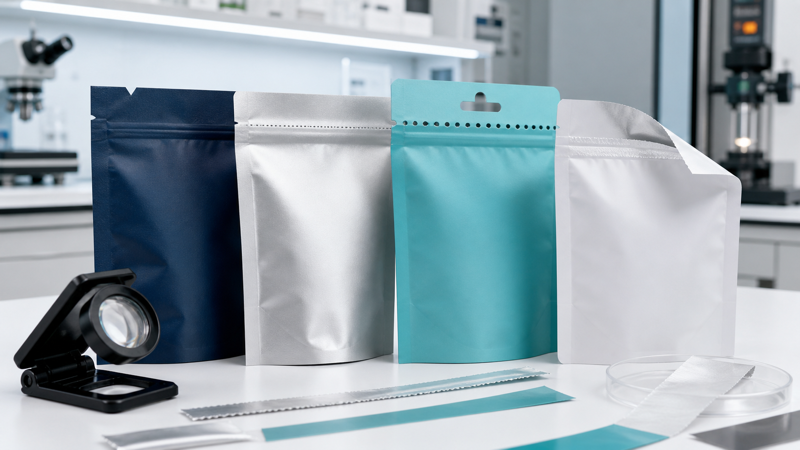
An easy-open feature seems successful only when consumers use the package. A pouch can protect the product perfectly and still disappoint if the top stretches, tears unpredictably, requires scissors, spills contents, or damages the reclosable zipper below. Tear notches, laser scores, microperforations, peelable seals, and shaped opening aids each influence how a tear begins and where it travels.
The correct feature depends on material structure, pouch format, product, consumer, opening direction, barrier requirement, and filling process. Ease of opening must be balanced with seal integrity, tamper evidence, child safety, drop resistance, and shelf life. The design should produce a controlled first opening without creating a weak point during distribution.
Begin With the Intended Opening Sequence
Describe exactly what the consumer should do. For a resealable stand-up pouch, the user may tear away a sealed header and then open the zipper. A single-use sachet may tear across one corner and pour through the opening. A medical, industrial, or regulated product may require a peel action, scissors, or child-resistant sequence rather than an unrestricted tear.
Decide which hand positions are expected, whether the consumer will wear gloves, and how much force is acceptable. Consider older adults, children where appropriate, and users with limited strength or dexterity. The tear path should keep fingers away from product and provide a wide enough opening for pouring, scooping, or direct consumption.
Place the feature in relation to headspace. If product fills the pouch up to the tear line, opening can cut through contents or cause spills. Fine powders may puff outward, while liquids need a controlled pour point. Test the lowest and highest normal fill levels.
Tear Notches
A tear notch is a small cut or shaped indentation in the pouch edge that concentrates stress and initiates tearing. V-notches, U-notches, and other profiles can be cut mechanically during pouch making. They are familiar, economical, and effective with many laminates when aligned to a suitable tear direction.
The notch starts the tear but does not fully control its route. Film orientation, layer balance, thickness, stiffness, printing, adhesive, and consumer pull angle determine whether the tear travels straight. Oriented films may tear more easily in one direction; tough sealant layers can stretch or produce a ragged edge. A notch that works on one structure may fail after a material change.
Position is critical. The notch must sit above the zipper or other feature that should remain after opening, with enough clearance for converting tolerances. If placed too close to the top seal, users may not get a reliable grip. If it cuts into the primary seal or falls below it, package integrity can be compromised.
The guide to tear notch packaging provides additional background, but approval should be based on filled pouches. Check both sides because asymmetric cutting or seal geometry can make one opening direction easier than the other.
Laser Scoring
Laser scoring removes or modifies a controlled portion of the material so the package tears along a planned path. The score can be continuous or patterned, straight or shaped, and placed in a specific layer or through part of a laminate. It is useful when a simple notch does not provide enough directional control.
A well-designed score can create a clean opening across a pouch, form a tear-away strip, or enable a shaped pour spout. It may be registered to printed artwork, allowing the opening path to follow the package design. On film roll packaging, scoring can be integrated with web processing, but registration, unwind, repeat, and filling equipment must remain aligned.
The main risk is excessive depth. A score that weakens barrier or sealant layers too much can crack during flexing, leak, or reduce shelf life. A score that is too shallow may not open consistently. Foil and high-barrier coatings require special care because microscopic damage can increase oxygen or moisture transmission without an obvious hole.
Score performance depends on film absorption, layer position, pigmentation, metallization, thickness tolerance, and laser settings. When the laminate changes, the score recipe should be reviewed. Validate barrier after scoring and after distribution conditioning for sensitive products.
Microperforations and Perforated Tear Lines
A perforated tear line uses a series of small cuts or weakened points to guide separation. It can create a removable header, opening strip, or ventilation feature. Mechanical or laser methods may be used, but opening perforations should not be confused with breathable-package perforations designed for gas exchange.
Perforations can be easy to understand visually, yet every hole or cut reduces local strength. If the line is exposed to tension during filling, hanging, or transport, it may begin to tear prematurely. Place it away from load-bearing zones and test the complete package under drops, vibration, and case compression.
For a resealable pouch, the removed strip should not leave sharp fragments or a rough edge that interferes with the zipper. Confirm that the consumer can grasp the strip and that the perforation ends cleanly rather than propagating into the body panel.
Peelable Seals
A peelable seal opens by separating two sealed surfaces under controlled force rather than tearing the web. It can provide a smooth opening for lidding, medical packaging, or pouches designed around a peel interface. The seal must be strong enough to survive distribution yet easy enough to open without sudden product release.
Peel behavior is influenced by sealant chemistry, temperature, pressure, dwell time, contamination, peel angle, and package age. A wide production window is more valuable than one perfect laboratory setting. Test opening force across the whole seal and after storage, because some materials strengthen or weaken over time.
Peelable does not automatically mean hermetic, tamper-evident, or child-resistant. Define each requirement separately. If the seal protects food, medical, or sensitive product, validate integrity before and after the intended environmental and distribution exposures.
Pouch Format Changes the Design
Three-side seal pouches often use a side notch to create a straight tear across the top. The remaining sealed edges can form a convenient pour opening or a full-width access area. The notch should not reduce the side-seal strength below the product and distribution requirement.
Stand-up pouches with zippers need a removable header above the closure. Flat-bottom and side-gusset bags may have multiple layers near the top corners, which can change tear force. Spouted pouches usually open through a cap or fitment and may not need a tear feature unless they include a secondary compartment or tamper strip.
Small sachets need special attention because there is little room between product, seal, notch, and required copy. Moving a notch by a few millimeters can change both usability and seal integrity. Build the opening feature into the dieline before artwork is finalized.
Material Structure and Tear Direction
Every layer contributes differently. Polyester can provide stiffness and print protection but may resist tearing. Oriented polypropylene has directional properties. Nylon adds puncture toughness and can make a structure harder to tear. Polyethylene sealant stretches and may leave a tail if the tear is not guided. Paper tears readily but can delaminate from film if the laminate is poorly balanced.
Do not solve difficult opening by simply weakening the whole structure. Use a targeted initiation and guidance system while preserving body strength and barrier. If a tougher film is needed for distribution, laser scoring or a specialized easy-tear layer may provide controlled opening without sacrificing the rest of the pouch.
Validate With Real Consumers and Real Product
Laboratory tensile data helps compare samples, but consumer behavior is variable. Test filled packages with users who represent the target market. Observe where they grip, which direction they pull, whether they see the opening cue, and what happens immediately after the tear.
Measure initiation force, propagation force, tear deviation, opening width, debris, spills, and zipper damage. Condition samples at low and high temperatures and humidities when relevant. Film stiffness and seal behavior can change significantly outside the packaging laboratory.
Include production tolerances. Sample across lanes, rolls, and machine positions. A feature that works only when perfectly centered is not robust. Retain failed examples and map the tear path to the notch, score, print, folds, and material orientation.
Easy-Open Checklist
- Define the full opening sequence and the opening width the product requires.
- Place the feature with sufficient clearance from seals, zippers, gussets, and filled product.
- Match notch and score direction to the actual laminate’s tear behavior.
- Protect barrier layers from excessive laser depth or unintended perforation.
- Test filled packages after aging, temperature, humidity, and distribution conditioning.
- Evaluate users’ grip, force, tear path, spills, sharp edges, and reclosure access.
- Revalidate whenever structure, thickness, orientation, supplier, or scoring settings change.
Easy opening is a controlled failure designed into an otherwise durable package. A notch provides a starting point, a laser score can guide the path, a perforation can create a removable section, and a peelable seal offers a different opening mechanism. The right solution opens reliably for the intended consumer while remaining strong and protective until that moment.