
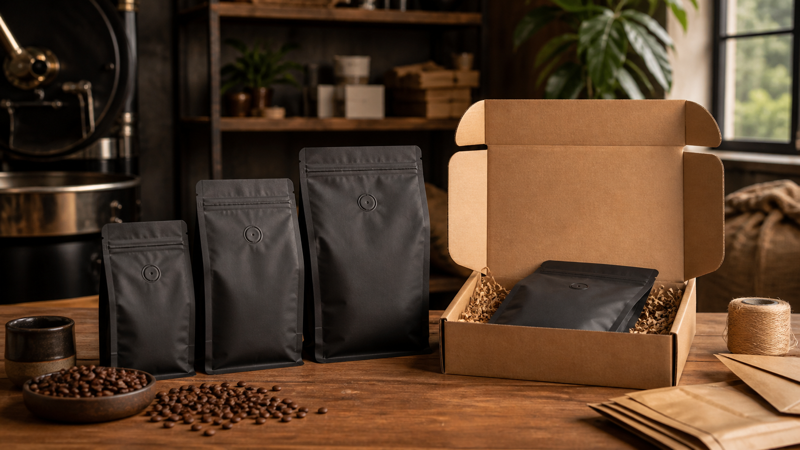
Coffee subscription packaging has to perform as a retail bag, shipping component, and recurring brand experience at the same time. The pouch must protect aroma, manage coffee degassing, fit the selected dose, survive parcel distribution, and arrive in a mailer that feels intentional rather than oversized. Because the shipment repeats every week or month, small inefficiencies in bag size, carton volume, postage, damage rate, or packing labor quickly become significant.
The best system begins with the subscription offer: coffee format, net weight, number of bags, roast-to-ship timing, delivery frequency, destination, and consumer use. Packaging should be designed around that complete journey rather than choosing an attractive bag first and trying to find a mailer afterward.
Connect Subscription Format to Package Size
Subscription size should match brewing behavior and delivery interval. A single consumer who brews one cup daily needs a different quantity from a household using espresso several times a day. If too much coffee arrives, the product ages after opening; if too little arrives, the customer may cancel because the schedule is inconvenient.
Whole-bean density varies with roast level and bean size. Dark roasts often occupy more volume at the same net weight than denser light roasts. Ground coffee settles differently and may trap air during filling. Never finalize dimensions from weight alone. Measure representative coffees, fill candidate bags, allow them to settle, and record maximum filled dimensions.
Common subscription formats can be framed as follows:
| Subscription format | Packaging approach | Shipping advantage | Main watchpoint |
|---|---|---|---|
| Single small bag | Compact pouch sized to one short consumption cycle | Simple parcel and low shipment weight | Postage may be high relative to product value |
| Two-bag rotation | Two identical or coordinated pouches | Supports variety while sharing one mailer | Bags and valves must nest without concentrated pressure |
| Multi-sample discovery box | Several mini coffee bags | Strong tasting and gifting experience | More filling, labeling, sorting, and SKU-control labor |
| Large household bag | One higher-capacity resealable pouch | Fewer components and efficient packing | Coffee may remain open longer; zipper and barrier become more important |
The table is a commercial starting point. Final net weights should reflect the brand’s market, brew methods, shipping rates, and product freshness strategy.
Select the Pouch Format
Custom coffee bags can be produced as flat-bottom, stand-up, or side-gusset formats. A flat-bottom pouch creates a structured premium presentation and can pack efficiently when its filled dimensions match the mailer. A stand-up pouch offers familiar retail display and may be economical across several sizes. A side-gusset bag can accommodate larger volumes but may form a rounder or brick-like shape after filling.
For a subscription, the best bag is often the one that nests consistently. A beautiful wide pouch can force the parcel into a higher dimensional-weight tier. An overly tall narrow pouch may bend inside the box or create unused space. Compare filled, settled packages in actual mailers and record the complete external dimensions.
Zippers support repeated use but add header height and cost. For a bag consumed quickly, a well-designed fold-and-clip closure may be acceptable; for larger household subscriptions, a zipper can protect aroma and simplify storage. Keep an intact top seal above the zipper for first-opening integrity.
Decide Whether the Coffee Needs a Valve
Fresh roasted coffee releases carbon dioxide. If it is packed soon after roasting, gas can inflate a sealed bag and stress seals or change parcel dimensions. A one-way degassing valve allows pressure to escape while limiting inward oxygen flow when the valve, laminate, and installation are correctly specified.
Valve need depends on roast profile, coffee form, resting time before packing, fill weight, headspace, and shipping speed. Whole beans commonly release more gas over time than pre-degassed or older coffee. Ground coffee releases gas faster because more surface area is exposed, but it is also more vulnerable to oxygen and aroma loss.
Place the valve above the settled product level and away from folds, zipper flanges, side seals, and high-pressure carton contact. In a two-bag mailer, do not stack valves directly against each other. A shallow protective recess, alternated orientation, or small divider can prevent compression.
The recurring nature of the program makes valve consistency important. Track bag inflation, valve contamination, seal integrity, and customer complaints by roast date and shipment route rather than treating each incident as isolated.
Match Barrier to the Delivery Cycle
Subscription coffee may reach the consumer quickly, but the package must protect it through production, fulfillment, shipping, waiting at the doorstep, and use after opening. Choose oxygen, moisture, aroma, and light barrier for the complete period—not only transit days.
Foil and metallized structures provide strong barrier, while transparent or paper-look options may offer different appearance and recyclability tradeoffs. A clear window can reveal beans but also introduces light and gas-transfer considerations. Validate shelf life with the final laminate, seals, zipper, and valve.
If the subscription ships internationally or to hot climates, include the longer and more variable route. Heat accelerates quality change and can affect seals or valve adhesives. Moisture exposure can weaken some paper surfaces and corrugated mailers.
Design the Mailer Around Filled Bags
Measure each bag after normal filling and settling. Record maximum width, height, and thickness, including the valve and zipper. Arrange the intended number of bags in several orientations. Alternating tops and bottoms can reduce bulging, but it should not put a valve under a concentrated load.
The mailer should limit movement without crushing the pouches. Empty volume allows packages to accelerate during drops; excessive compression can burst seals or damage beans. Use correctly sized corrugated, inserts, sleeves, or paper cushioning according to the tested hazard. Avoid rough surfaces rubbing directly against printed pouches during long vibration.
Dimensional weight can dominate parcel cost. A few millimeters added to each bag may force a larger carton across thousands of shipments. Before approving a pouch dieline, model carrier thresholds and test whether a different bag proportion or two-layer arrangement reduces shipping volume.
For coffee bags for businesses, subscription fulfillment may share inventory with wholesale or office programs. A common pouch structure can simplify purchasing, but the retail mailer dimensions still need a dedicated validation.
Protect Coffee During Parcel Distribution
Test the complete parcel through drops, vibration, compression, and temperature conditioning. Include the heaviest subscription combination and the loosest pack-out. Inspect side seals, bottom gussets, top seals, valves, abrasion, bean breakage, and parcel appearance.
Coffee bags rarely produce liquid leaks, but pinholes or weak seals can allow oxygen and aroma transfer. After testing, examine package inflation, vacuum where used, and barrier-related product quality. A parcel can look undamaged while the coffee package has developed a fine puncture.
Pilot shipments across nearby, national, and long-distance routes reveal handling and delivery-time variation. Ask recipients to photograph the unopened parcel and record freshness, inflation, damage, and unboxing impressions.
Build an Efficient Fulfillment Workflow
Recurring orders multiply picking errors. Use clear SKU codes, roast dates, lot traceability, and scan verification. Separate similar artworks through color blocks, labels, or machine-readable identifiers that do not rely on subtle flavor names.
Design the pouch and mailer for fast packing. The bag should enter without folding, and inserts should lock into place without excessive tape. Measure packs per labor hour and record rework. Premium unboxing should come from organized presentation and useful information, not unnecessary layers.
The rise of coffee subscriptions reflects the value of a direct recurring relationship. Packaging should reinforce that relationship with consistency, freshness, and easy disposal. Consider a simple brew card, roast information, and recycling instructions when they provide clear customer value.
Subscription Packaging Checklist
- Define consumption rate, delivery interval, coffee form, roast-to-pack timing, and net weight.
- Test light and dark roasts in candidate bags to capture bulk-density variation.
- Choose pouch format, zipper, barrier, and valve as one system.
- Measure settled filled dimensions and arrange the exact subscription combination.
- Keep valves and seals clear of carton pressure points.
- Model dimensional weight and carrier thresholds before freezing the pouch size.
- Test the complete mailer through drops, vibration, compression, and climate exposure.
- Track fulfillment accuracy, damage, inflation, freshness, and customer feedback by shipment.
Coffee subscription packaging succeeds when freshness, parcel efficiency, and customer experience are designed together. The correct bag holds the real coffee without excess volume, the valve manages gas without becoming a shipping weak point, and the mailer protects the product at the lowest practical size. Repeated delivery then becomes an advantage: every shipment provides data that can improve the next one.