
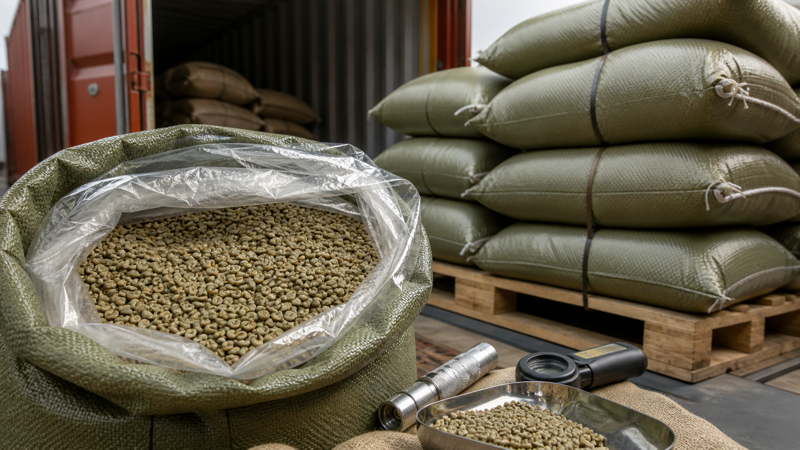
Green coffee beans may spend weeks or months moving from origin to roaster through warehouses, trucks, ports, and ocean containers. During that journey, the beans face changing temperature, relative humidity, condensation risk, odors, insects, abrasion, and rough handling. Export packaging must protect quality without trapping unstable product conditions inside the bag.
This application differs from retail packaging for roasted coffee. Green beans are commonly shipped in large sacks, bulk bags, or cartons with protective liners, while roasted coffee relies heavily on oxygen and aroma barrier in smaller consumer packs. The correct export system connects bean condition, liner performance, outer handling strength, closure, container preparation, and traceability.
Understand Moisture Risk
Green coffee is hygroscopic: it exchanges moisture with the surrounding air. If exposed to high humidity, beans can absorb moisture, increasing the risk of mold, off-flavors, staining, and physical change. In dry conditions, they may lose moisture and mass, become more brittle, or change roasting behavior.
Packaging does not correct beans that enter the bag outside the acceptable condition. Measure moisture content and, where used in the quality program, water activity before packing. Sampling should represent the lot, not only the top of one sack. Beans should be stable in temperature and free from active condensation.
Temperature cycles create a particular shipping hazard. Warm humid air can enter during loading, then cool against container walls and condense. Water may drip onto outer sacks or collect on floors. A high-barrier liner can protect beans from external moisture, but poor container preparation or wet packaging can still create local damage.
Hermetic Packaging Principles
Hermetic packaging limits gas and moisture exchange between the beans and the external environment. A properly sealed high-barrier liner can reduce humidity fluctuations, insect activity, and odor pickup. The protection depends on film integrity, closure, seam quality, and handling—not the word “hermetic” alone.
Green coffee bags may use multilayer liners inside woven polypropylene or jute sacks, standalone heavy-duty bags, or other export configurations. The outer layer carries mechanical loads and accepts markings; the inner liner provides barrier and containment. Evaluate the complete combination.
Hermetic does not mean vacuum. Air may remain in the headspace and between beans. Some systems remove excess air before sealing to improve density and reduce movement, while others use standard closure. If vacuum is applied, sharp bean edges and handling pressure can stress the liner. Validate the chosen evacuation level.
Select the Liner Structure
The liner needs water-vapor barrier, puncture resistance, sealability, and sufficient toughness for filling and transport. A very high barrier film can fail if it is too thin or brittle for the application. Conversely, a tough liner with weak seams or poor closure will not remain hermetic.
Film should tolerate contact with rough beans, loading chutes, stitching areas, pallet edges, and repeated movement inside the outer sack. Examine flex cracking, pinholes, seal creep, and abrasion after shipping simulation. Clear liners support visual inspection, while opaque or metallized layers may provide additional light or gas protection where required.
Food-contact status and odor neutrality are essential. Green beans readily absorb foreign odors. Review resin, additives, inks, adhesives, and storage conditions. Do not store empty liners near chemicals, fuels, spices, or strongly scented materials.
Outer Sacks and Mechanical Protection
Jute sacks provide traditional appearance, breathability, handling familiarity, and market identification, but they do not provide a strong moisture barrier by themselves. Woven polypropylene sacks offer toughness and moisture resistance at the outer level, while cartons or bulk systems can support specific logistics programs.
The outer package must protect the liner from hooks, dragging, conveyor abrasion, and stacking. If the outer sack is stitched after the liner is sealed, needles must not puncture the inner barrier. Use a closure sequence and liner length that keep stitching clear.
Side-gusset bags and other gusseted forms can improve fill opening and create a regular shape, but large export loads need validated seam strength and handling support. Lifting should be carried by the outer package, not a thin barrier liner.
Bag Size and Fill Weight
Traditional coffee export sacks often follow regional and commercial conventions, but a project should select fill weight according to handling, pallet, container, buyer, and quality needs. Smaller bags can improve lot separation and manual handling while increasing material and closure labor. Larger bags reduce unit packaging but increase drop energy and make partial-lot inspection more difficult.
Measure bean bulk density across representative lots. Variety, screen size, processing method, moisture, and defects influence volume. Leave enough liner length for a reliable seal without excessive empty material folded into the sack.
Filled dimensions matter for pallet patterns and container utilization. A tightly optimized theoretical arrangement may fail when sacks settle and bulge. Build test pallets, apply expected stacking, and measure after conditioning and vibration.
Closure and Seal Integrity
Heat sealing can provide a consistent hermetic closure when temperature, pressure, dwell time, cleanliness, and liner material are controlled. Beans, dust, fibers, or folds in the seal create channels. Keep the seal area clean and supported during sealing.
Mechanical ties or clips may be used in some systems, but their hermetic performance should be demonstrated. A folded liner inside a stitched outer sack is not automatically airtight. Define the closure method in the specification and train operators to recognize incomplete seals.
Use visual inspection plus an appropriate leak or seal test. For large bags, sampling and practical methods may differ from small pouches, but the goal remains the same: verify continuous closure without pinholes or channels. Retain records by lot and packing date.
Vacuum and Air Management
Vacuum seal bags for food illustrate the principle of removing air before closure, but green coffee export bags require a heavier-duty application-specific design. Vacuum can reduce package volume and restrict bean movement, yet it also pulls the liner tightly around hard edges and reveals weak seals.
Full vacuum may not be necessary. Controlled air removal can improve packing without excessive stress. Monitor the bag after sealing; loss of the compact shape may indicate leakage, but stable appearance alone does not prove barrier performance.
If gas flushing or oxygen management is considered for specialty programs, define the quality objective and validate it. Moisture control and physical integrity usually remain the primary packaging priorities during export.
Container and Pallet Preparation
Inspect containers for holes, water, rust, odors, residues, and damaged floors before loading. The container should be dry and suitable for food cargo. Liners, desiccants, moisture-control materials, or thermal protection may be used according to route risk, but they should not contact or damage the coffee bags.
Keep sacks away from wet walls and floors using clean pallets or protective layers. Prevent sharp pallet boards, nails, and straps from puncturing the package. Stabilize the load without crushing seams.
Route, season, port dwell, and container color can affect internal temperature. Use data loggers in representative shipments to understand temperature and humidity profiles. This evidence supports decisions on liner barrier and container moisture control better than assumptions.
Traceability and Inspection
Identify origin, producer or lot, crop, process, net weight, packing date, and any certification or buyer information required. Labels and printing should remain legible after handling. The liner and outer sack should be linked to the same lot to avoid mix-ups during rebagging or inspection.
At arrival, inspect outer condition before opening. Record wet marks, odor, tears, insect evidence, pallet shift, and container conditions. Sample beans according to the quality plan and compare moisture, water activity where used, sensory quality, and physical defects with origin data.
The guide to store green coffee beans long term can support warehouse planning after arrival. Export packaging should remain sealed until controlled receiving and storage are ready.
Export Packaging Checklist
- Verify representative bean moisture, water activity where used, temperature, and cleanliness before packing.
- Select a food-contact, odor-neutral liner with validated moisture barrier and puncture resistance.
- Pair the barrier liner with an outer sack or container that carries handling loads.
- Keep beans, dust, stitching, and folds out of the closure area.
- Validate sealing, leak resistance, abrasion, drops, compression, and vibration.
- Size bags using real bulk density, handling limits, pallet patterns, and buyer requirements.
- Inspect containers for moisture, odors, damage, and sharp surfaces before loading.
- Track temperature and humidity on representative export routes.
- Maintain lot identity from packing through receiving inspection.
Green coffee export protection depends on controlling moisture exchange and preserving liner integrity throughout rough logistics. Stable beans, a genuinely sealed barrier liner, a strong outer handling layer, and a dry container work as one system. When those elements are validated together, the package helps preserve the quality created at origin until the beans reach the roaster.