
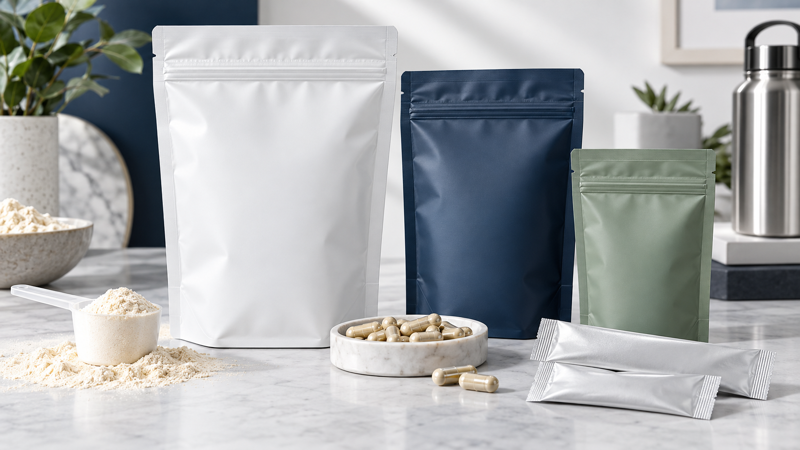
Supplement pouch packaging must protect the product while helping consumers use it correctly. It also has to carry dense regulatory and commercial information, provide visible evidence of first opening, support lot traceability, and fit the way the supplement is measured. These demands vary sharply between powders, capsules, tablets, gummies, and single-dose products.
A successful design begins with dosage form and use pattern. The pouch format, closure, barrier, tamper evidence, and artwork should then be developed together. Adding each feature late in the project usually creates crowded labels, awkward opening, or a package that is difficult to fill consistently.
Match the Package to the Dosage Form
Different supplement forms produce different mechanical and chemical risks. Powders create dust and can contaminate zippers or seals. Tablets and capsules may chip under compression and can be sensitive to moisture. Gummies may stick together or carry oils and flavors that require compatibility testing. Single-dose products prioritize accurate portioning and easy opening.
| Dosage form | Common pouch approach | Dosing need | Packaging watchpoint |
|---|---|---|---|
| Powder | Resealable stand-up pouch | Scoop access and serving accuracy | Dust in zipper and top seal |
| Capsules or tablets | Small to medium resealable pouch | Count-based daily use | Moisture control and child access |
| Gummies | Barrier pouch with reliable reclosure | Pieces per serving | Sticking, aroma, and closure contamination |
| Single-dose powder | Flat three-side-seal sachet | Premeasured serving | Tear behavior and seal integrity |
| Multi-SKU daily pack | Connected or grouped sachets | Dose sequence | Mix-ups and variable-data control |
This comparison is a starting point. Product stability, market rules, consumer population, and distribution climate should determine the final specification.
Build Tamper Evidence Into the Opening Sequence
Tamper evidence should make interference visible before consumption. For a zipper pouch, an intact heat seal above the zipper is a common solution. The consumer removes the header at a tear notch, then accesses the reclosable profile. The top seal needs enough strength to survive distribution but should open cleanly with normal effort.
Do not place a tear notch so low that it damages the zipper or removes required information. Leave enough grip area above the tear line, and test opening with users who have different hand strength. Matte finishes, stiff laminates, and narrow headers can make a theoretically easy tear frustrating.
A tear notch alone is not tamper evidence if the pouch is already open below it. The intact seal, closure geometry, and instructions must create a clear first-opening condition. Perforations, laser scores, membrane seals, or fitment bands may be appropriate for other pouch types, but each needs production and distribution validation.
Tamper-evident and child-resistant functions are not identical. A visible first-opening feature does not necessarily delay child access, while a child-resistant closure still needs a clear indication that the package was initially sealed.
Decide When Child Resistance Is Needed
The need for child resistance depends on the product, active ingredients, dose, sales market, and applicable regulations. It should be determined with qualified regulatory guidance rather than assumed from package appearance.
Child-resistant zipper bags use closure mechanisms intended to be difficult for young children while remaining usable by adults when properly designed and certified. The full package—not just an individual zipper component—must be evaluated for the intended application.
Usability matters. If adults cannot reclose the pouch correctly, the child-resistant function may not be maintained after first use. Test opening and reclosing with the target population, including older adults where relevant. Instructions should be concise, visible, and placed where they are not removed with the tamper-evident header.
Avoid graphics that suggest child resistance without supporting evidence. Work with the packaging supplier and compliance specialists to confirm testing, certification scope, production controls, and any required statements.
Design for Accurate Dosing
Powder pouches must accommodate the selected scoop and allow the consumer to level and remove it without coating the closure. Define scoop bowl dimensions, handle length, serving mass, and expected number of servings before finalizing the pouch opening.
Bulk density changes the relationship between serving volume and mass. Verify the scoop with production formulas and acceptable density variation. If consumers are instructed to use a rounded or heaped scoop, dosing may be inconsistent; clearer volumetric or weight guidance may be needed.
Consider where the scoop will sit. A loose scoop can settle to the bottom during transport, forcing the user to reach through product. A clip, holder, or alternative dosing format may improve the experience but adds components and assembly steps.
For capsules, tablets, and gummies, the opening should allow controlled removal without spilling many pieces. A very wide mouth helps filling but may make consumer dosing clumsy. Prototype both tasks and look for a balanced width.
Single-dose three-side seal pouches remove the need for a scoop and can support travel or daily routines. They require precise filling, dependable seals, and a tear path that opens without scattering powder. They also use more individual package units, so material, packing labor, and carton design must be considered.
Reserve Label Space Before Artwork Begins
Supplement labels often need product identity, net quantity, serving information, ingredients, directions, warnings, storage conditions, responsible-party details, lot code, expiration or best-before information, and market-specific statements. Requirements vary, so the final copy should be reviewed for each sales region.
Create an information hierarchy before styling. Mandatory content needs adequate contrast, type size, and an uninterrupted reading area. Brand storytelling and product imagery should fit around that framework rather than forcing required text onto gussets, seals, or heavily curved surfaces.
Supplement pouches offer broad printable panels, but not every visible area is equally usable. Zipper flanges, bottom gussets, side seals, tear zones, hang holes, and rounded corners can distort or hide information. Fill the pouch before judging layout because a flat dieline does not show final curvature.
Keep variable coding in a dedicated light, matte-compatible zone. Confirm that the coding technology adheres to the finished surface and remains readable after rubbing, heat, and humidity exposure. Lot and date codes should not land across folds or dark graphics.
Use QR Codes Without Sacrificing Essentials
A QR code can connect consumers to certificates, testing summaries, directions, subscriptions, or multilingual information. It should supplement rather than replace information that must remain on the package.
Test the code on the final printed, filled pouch. Curvature, glare, metallic films, low contrast, small quiet zones, and print gain can reduce scan reliability. Position it on a relatively flat panel away from the gusset and zipper. Verify multiple phone models under ordinary retail and home lighting.
Select Barrier for Product Stability
Barrier requirements depend on the active ingredients, flavor system, moisture sensitivity, oxidation risk, light sensitivity, and expected shelf life. Powders may cake, capsules may soften, tablets may degrade, and aromatic products may lose flavor if the structure is inadequate.
Request relevant oxygen and moisture transmission data, but remember that flat-film values do not capture seals, zippers, folds, or punctures. Stability testing should use the finished package produced on the intended equipment.
Vitamin pouches may need protection tailored to sensitive nutrients and the chosen dosage form. Foil, metallized, or clear high-barrier structures each offer different performance, appearance, and recycling tradeoffs. Select through stability evidence rather than visual preference.
Desiccants or oxygen absorbers may support protection where compatible and appropriate, but they must be sized for the expected load and safely integrated. They cannot compensate for a leaking seal or a pouch that is repeatedly left open.
Validate Filling and Seal Integrity
Run trials at realistic production speed. Check pouch opening, dosing accuracy, dust generation, product breakage, zipper contamination, seal cleanliness, and code placement. Establish validated seal settings rather than a single nominal temperature.
Use appropriate leak, seal-strength, and distribution tests. Inspect packages after vibration, drops, compression, and climate conditioning. Reclose the pouch repeatedly and confirm that the closure still functions after product contacts it.
Quality records should link packaging material lots, product lots, filler settings, seal checks, codes, and finished-case identification. Traceability is particularly important when several formulations use similar graphics.
Supplement Pouch Checklist
- Define dosage form, serving method, consumer group, and use period.
- Separate tamper evidence from any child-resistant requirement.
- Test scoop access or piece dispensing with the filled pouch.
- Reserve compliant label and coding areas on the dieline.
- Validate QR codes on printed, filled packages.
- Choose barrier from product stability and target climate.
- Keep product and dust away from zipper and heat-seal zones.
- Test the complete package through production, distribution, and repeated use.
Supplement pouch design is strongest when safety, dosing, information, and protection follow one deliberate opening experience. The consumer should see that the pack is intact, understand how to access and reclose it, measure the right amount, and find essential information without searching. Designing these functions together reduces late artwork compromises and creates a package that performs beyond the shelf.