
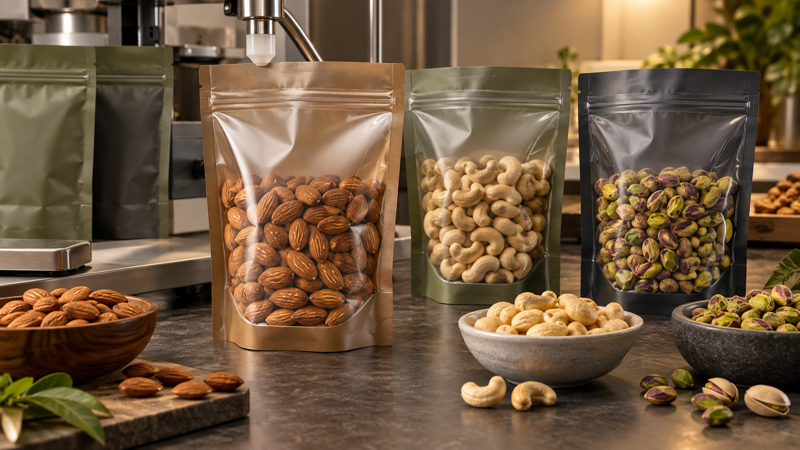
Nuts appear dry and durable, but their natural oils make them highly vulnerable to oxidation. Once oxygen, heat, or light begins degrading those oils, fresh flavor can give way to stale, paint-like, or bitter notes. Moisture changes can also soften roasted nuts, while sharp shells and irregular pieces may puncture a weak package. Good nut packaging must manage all of these risks without making the pouch difficult to fill, open, or reclose.
Nitrogen flushing is often part of the solution, but it cannot compensate for poor barrier film or leaking seals. The most reliable package combines suitable materials, controlled headspace, clean sealing, and a closure matched to the consumer’s use period.
Begin With the Nut and Its Processing History
Raw almonds, roasted cashews, salted peanuts, and in-shell pistachios do not need identical protection. Oil composition affects oxidation sensitivity. Roasting can accelerate later oxidation, while salt, seasonings, and surface oil may influence moisture behavior and film compatibility. In-shell products create more empty space and sharper contact points than dense kernels.
Create a product profile before selecting the pouch. Record form, piece dimensions, bulk density, oil level, seasoning, target moisture or water activity, fill temperature, intended shelf life, and distribution climate. Include the expected time between roasting and packaging because warm or recently processed nuts may introduce heat or additional oxygen into the pack.
Representative production lots should be tested. A packaging sample filled with small, uniform kernels may not reveal puncture risks created by the largest pieces or shell fragments.
Control Oxygen as a Complete System
Oxidation depends on the oxygen already present in the product, the gas trapped in headspace, and oxygen entering later through the film, seals, zipper, or damage. Removing headspace oxygen improves the starting condition, but shelf life still depends on preventing rapid re-entry.
Barrier specifications should include oxygen transmission under relevant conditions. Foil, metallized films, and clear high-barrier laminates offer different combinations of protection, flexibility, appearance, and cost. Mylar bags for food can be configured with protective multilayer structures, but the name alone does not define performance. Ask for the actual layer construction and test data.
Light may accelerate oxidation and fade seasonings. An opaque structure offers strong protection, while a window helps consumers inspect the product. If visibility is commercially important, keep the window appropriately sized and validate the complete pouch rather than assuming the remaining opaque area will carry the shelf life.
Use Nitrogen Flushing Deliberately
Nitrogen displaces oxygen in the package headspace and can create a cushion around fragile products. The objective is not a visibly inflated bag; it is a controlled residual-oxygen level and enough protective gas volume for the product and distribution system.
Set the process around pouch volume, fill weight, product displacement, gas flow, nozzle position, and the delay before sealing. Excessive flow wastes gas and may blow seasoning or lightweight pieces into the seal. Insufficient flow or a long delay allows air to return before the jaws close.
Measure residual oxygen in production-equivalent packs immediately after sealing and again after a defined period. A low initial reading followed by a rapid increase may indicate film, seal, or puncture problems. Sampling should cover start-up, normal running, changeovers, and different package sizes.
Very low headspace can make displacement difficult, while excessive headspace uses more material and carton volume. Determine the minimum practical space that supports gas exchange, seal clearance, and product protection.
Select Film for Puncture and Flex Resistance
Whole nuts and shells can create concentrated pressure points during vibration and compression. A laminate with excellent laboratory barrier may still fail if it develops pinholes in the supply chain. Tough outer and sealant layers help protect the barrier component.
Pistachio bags need special attention when shells have split edges. Fill samples with the most irregular pieces, then subject them to vibration, drops, and carton compression. Inspect high-contact areas, gusset folds, and corners for abrasion or tiny punctures.
Cashew bags may face less shell puncture risk but still need oxygen control and gentle handling to limit breakage. Film stiffness, drop height, pouch size, and nitrogen cushion can all affect the final appearance.
Avoid selecting thickness as the only measure of durability. Layer type, orientation, bonding, flex resistance, and package geometry often matter as much as total gauge. Test the final laminate in the final format.
Protect the Heat Seal
Nut fragments, salt, seasoning dust, and surface oil can contaminate the sealing zone. Material trapped between sealant layers creates channels and weak areas. A pouch may look closed while oxygen enters through a fine leak.
Control the filler cut-off, product drop, settling time, and fill height. Keep enough clearance below the zipper and top seal so nuts do not bounce into the jaws. If seasoning dust is present, use appropriate extraction or seal-zone cleaning that does not spread contamination.
The inner sealant must be compatible with oils and support a broad operating window. Establish validated temperature, pressure, and dwell-time settings at normal line speed. Check peel strength and use a suitable leak method. Inspect failures to distinguish contamination, wrinkles, inadequate heat, and punctures.
Choose a Closure for the Consumption Pattern
A single-serve nut pack may need only a tear notch and clean opening. A family-size pouch may remain in use for weeks and benefits from reliable reclosure. The zipper should be easy to align and should remain functional after crumbs, salt, or oil reach the profile.
Test repeated opening and closing with actual product. Ask users to operate the filled package, not an empty pouch. The opening should allow a hand or scoop to enter without scraping the zipper, and the pouch should remain stable as the product level drops.
An intact top seal above the zipper provides first-opening evidence. Leave enough header for gripping and tearing, and position the tear notch so the user does not cut into the zipper. Storage guidance should remind consumers to remove crumbs from the track and close it across the full width.
Match Pouch Format to Channel
Nut packaging can use stand-up, flat-bottom, pillow, or side-gusset formats depending on weight, equipment, and sales channel. Stand-up pouches provide broad graphics and reclosure. Flat-bottom bags support premium shelf presentation and efficient use of front and side panels. Pillow packs formed from rollstock can suit high-speed production and small portions.
Format influences gas use and shipping efficiency. A wide pouch may provide a large presentation face but require more headspace and a larger carton. A narrow package may fit retail shelves well yet be difficult to fill with irregular pieces. Evaluate the settled filled shape rather than the empty dimensions.
For e-commerce, place production-equivalent packs in the intended mailer and test drops, vibration, and compression. The outer package should limit movement without crushing the gas cushion or forcing sharp pieces against the film.
Validate Shelf Life and Production
Shelf-life testing should measure more than visible rancidity. Track sensory freshness, peroxide or other relevant oxidation indicators, moisture, texture, seasoning quality, residual oxygen, seal integrity, and package appearance. Use normal and challenging storage conditions that reflect target markets.
Test after distribution simulation because flexing and puncture can change barrier performance. Include repeated-opening studies for resealable packs. Each opening introduces air, and consumer reclosure may be inconsistent, so the open-life claim should be realistic.
Production controls should cover incoming film identity, seal settings, gas pressure and flow, residual oxygen, fill weight, leak checks, coding, and carton configuration. Trend results by product and packaging lot to detect changes before complaints rise.
Nut Packaging Checklist
- Characterize oil sensitivity, product form, seasoning, bulk density, and sharp points.
- Select oxygen, moisture, light, and aroma barrier for the target shelf life.
- Set nitrogen flow, headspace, nozzle position, and seal timing together.
- Monitor residual oxygen immediately and after a defined holding period.
- Test puncture and flex resistance with the most challenging pieces.
- Keep fragments, dust, salt, and oil away from the heat-seal zone.
- Match zipper and opening size to serving pattern and pack life.
- Validate filled packages through storage and distribution testing.
Nut packaging performs best when nitrogen flushing, barrier film, seals, and closure reinforce one another. A low-oxygen headspace protects the product at packing, a durable laminate slows oxygen entry, clean seals preserve integrity, and a usable zipper limits exposure after opening. Together, these controls protect freshness without sacrificing shelf impact or convenience.