
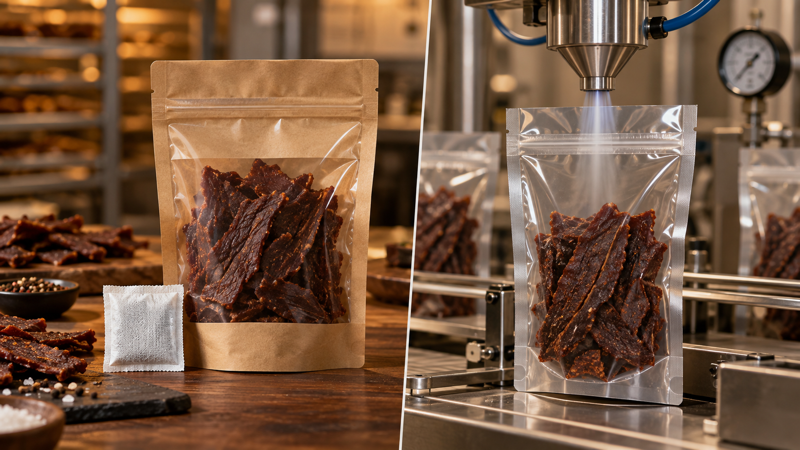
Oxygen control is central to jerky packaging because it affects flavor, color, fat oxidation, and the growth of some spoilage organisms. Two common approaches are placing an oxygen absorber inside the sealed package and displacing air with nitrogen before sealing. Both can reduce oxygen, but they work differently and create different requirements for product formulation, headspace, equipment, inspection, and consumer experience.
There is no universal winner. The best system depends on the jerky’s water activity, fat content, preservatives, package size, desired shelf life, line speed, distribution conditions, and safety plan. Neither method replaces validated processing, hygienic handling, adequate barrier, or sound seals.
Start With Product Safety and Water Activity
Jerky is often treated as a shelf-stable food, but recipes and processes vary. Meat type, thickness, drying profile, water activity, pH, cure, preservatives, surface treatments, and post-process handling all influence stability. Packaging selection must follow a validated product and food-safety program.
Water activity is especially important because it describes how available moisture is for chemical reactions and microbial growth. A package can control oxygen effectively while the product still has an unsuitable moisture profile. Conversely, a very dry jerky may remain microbiologically stable but develop oxidative rancidity or an overly hard texture.
Set critical product limits before comparing oxygen-control methods. Work with qualified food-safety and regulatory specialists for the intended market. Packaging tests should use production-equivalent jerky, not a visually similar sample.
Compare the Two Approaches
| Decision factor | Oxygen absorber | Nitrogen flushing |
|---|---|---|
| Basic mechanism | Chemically removes oxygen after sealing | Displaces air before the pouch is sealed |
| Headspace behavior | May reduce oxygen to a low level over time if correctly sized | Creates a low-oxygen starting headspace and may add cushioning |
| Main equipment need | Controlled insertion and verification | Gas supply, nozzles, flow control, and residual-oxygen testing |
| Consumer experience | Visible sachet or device must be managed safely | No loose component inside the food package |
| Primary process risk | Missing, damaged, exhausted, or incorrectly sized absorber | Poor purge, air re-entry, gas waste, or delay before sealing |
| Shared requirement | High-barrier pouch and reliable seals | High-barrier pouch and reliable seals |
The table describes operating differences, not a shelf-life guarantee. Either method may fail if the pouch leaks, the product is contaminated, or the process is not controlled.
How Oxygen Absorbers Work in Jerky Packs
An oxygen absorber reacts with oxygen inside the sealed pouch. If it has sufficient capacity and the package has adequate barrier, it can remove residual oxygen around the product and oxygen introduced during filling. This can be useful for compact packages where gas flushing is difficult or for operations without flushing equipment.
Capacity must cover the oxygen in headspace, oxygen trapped within or around the jerky, and oxygen expected to enter through the package during shelf life. The calculation also needs a safety margin. Choosing a sachet by pack weight alone is unreliable because two pouches with the same jerky weight may have very different headspace.
Absorbers begin reacting after exposure to air. Production teams must control the time between opening the bulk absorber package, inserting units, and sealing finished pouches. Unused absorbers need appropriate resealing and storage. Line stoppages require a defined response so partially exposed units are not used beyond their validated handling time.
Insertion systems should detect missing or multiple absorbers. The sachet must not enter the heat seal, stick to oily product, or be confused with food. Packaging and labeling should clearly communicate that the absorber is not edible where required and appropriate.
How Nitrogen Flushing Works
Nitrogen flushing pushes oxygen-containing air out of the pouch immediately before sealing. Performance depends on gas flow, nozzle location, pouch geometry, fill level, product arrangement, and the time between purge and jaw closure.
A controlled gas cushion can reduce compression and improve presentation, but an excessively inflated pack wastes carton space and may be vulnerable to pressure changes. Very little headspace reduces gas consumption yet can make complete displacement more difficult around irregular jerky pieces.
Measure residual oxygen in production packs rather than relying only on gas-flow settings. Samples should represent start-up, steady production, changeovers, and different pouch sizes. Recheck after a holding period; rising oxygen can indicate leaks, poor barrier, or gas trapped in the product.
Nitrogen systems require investment in gas supply, controls, safety procedures, and testing. They can integrate well with faster lines, but poor synchronization wastes gas and delivers inconsistent results.
Barrier Film Is Essential for Both
Jerky bags need barrier appropriate to the product’s oxygen and moisture sensitivity. Foil and metallized laminates are common options, while clear high-barrier films support product visibility. The actual oxygen and water-vapor transmission values, sealability, puncture resistance, and flex durability matter more than the material’s appearance.
Mylar bags for food can use multilayer structures that combine printability, strength, barrier, and sealing. Confirm the exact construction because a generic material label does not specify performance.
Jerky edges can be firm or sharp, especially after drying. Vibration may rub the product against the laminate and create pinholes. Test the most rigid pieces in the final pouch and carton. A tiny puncture can overwhelm both an absorber and a nitrogen-flushed headspace.
Manage Moisture and Texture
Oxygen control and moisture control are related but not interchangeable. An oxygen absorber does not automatically prevent the jerky from drying out or becoming too moist. Nitrogen does not stop water vapor from moving through an inadequate film.
Select moisture barrier around the product’s target texture and expected climate. Flexible jerky may become tough if moisture escapes, while a product that gains moisture can become tacky or less stable. Package size and repeated opening also influence texture after purchase.
Some absorber technologies have moisture requirements for activation. Confirm compatibility with the jerky’s water activity and formulation. Do not assume that a component used in another food will behave identically.
Compare Vacuum Packaging as a Third Option
Vacuum seal bags for food remove air by drawing the film closely around the product. Vacuum can reduce oxygen and package volume, but the tight fit may emphasize irregular pieces, squeeze marinades or oils toward seals, and create puncture stress.
Vacuum appearance may suit traditional jerky, while nitrogen-flushed pillow or stand-up pouches can create a fuller retail presentation. An oxygen absorber can also be used in a non-vacuum pack where validated. The correct choice depends on equipment, product shape, brand presentation, and performance evidence.
Combining methods is possible, but complexity should have a defined benefit. Adding an absorber to a poorly controlled nitrogen process does not eliminate the need to diagnose leaks or excess oxygen.
Protect the Seal Area
Jerky crumbs, seasoning, fat, and marinade residues can interfere with heat sealing. Control product drop and fill height so pieces stay below the seal. Keep oily surfaces away from the pouch mouth, and provide enough dwell time for the product to settle before sealing.
Choose a sealant compatible with the product and process. Establish a validated window for temperature, pressure, and dwell time at operating speed. Inspect for wrinkles, contamination, channels, and punctures near the seal.
Seal-strength and leak testing should accompany residual-oxygen checks. If oxygen rises, both the package and measurement process need investigation. Document material lots, equipment settings, and product conditions so failures can be traced.
Evaluate Cost Beyond the Component Price
Absorber cost includes the unit, insertion equipment or labor, detection, exposure control, storage, and rejects. Nitrogen cost includes gas, supply equipment, maintenance, controls, testing, and any reduction in line speed. Barrier film and quality testing are required in both cases.
Also consider product loss, customer complaints, carton volume, and operational complexity. A lower-cost method that produces inconsistent oxygen levels may be more expensive overall than a controlled system with higher direct cost.
Run a Shelf-Life Validation
The process described in how to package beef jerky should end with testing of the actual commercial package. Produce samples using normal line conditions and foreseeable worst cases. Store them under target and challenging environments.
Track residual oxygen, seal integrity, package appearance, water activity, texture, color, odor, flavor, oxidation indicators, and relevant microbiological criteria. Include distribution simulation before storage and repeated-opening studies for resealable packs.
Decision Checklist
- Confirm the jerky process, water activity, formulation, and safety limits.
- Calculate headspace and oxygen load for the real package.
- Size absorbers or set nitrogen flow from measured conditions.
- Use suitable high-barrier, puncture-resistant film.
- Protect the seal from crumbs, oil, and product edges.
- Verify absorber insertion or measure residual oxygen during production.
- Compare total operating cost, not only gas or sachet price.
- Validate safety, sensory quality, and shelf life in finished packs.
Oxygen absorbers are often attractive for simple or compact operations, while nitrogen flushing can support fast production and a package without a loose component. The right choice is the one the brand can control, verify, and validate consistently. Strong barrier and seal integrity remain essential whichever method is selected.