
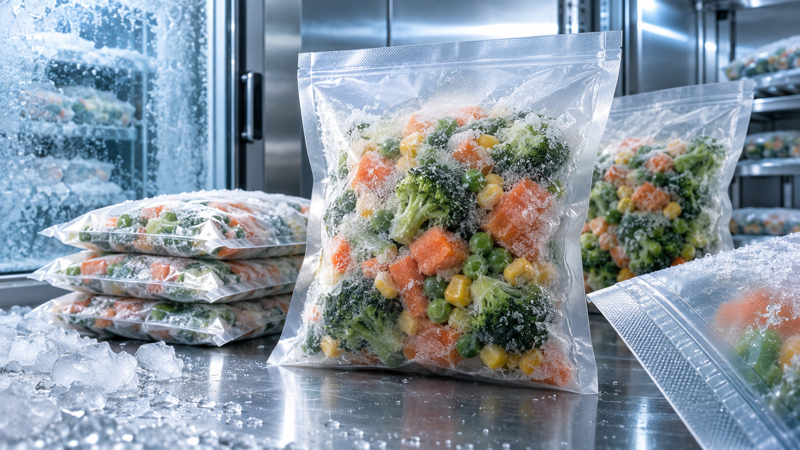
A frozen food pouch may leave the packing line with strong seals and still fail later in a freezer, distribution case, or consumer’s hands. Low temperatures can make some materials less flexible, while ice crystals and frozen product edges create concentrated impact points. Moisture, oil, frost, or food particles in the seal area add another source of weakness. The result can be split seals, brittle cracks, punctures, or slow leaks that were not visible at room temperature.
Preventing these failures requires more than increasing film thickness. Resin selection, laminate design, sealant behavior, pouch geometry, filling conditions, freezing process, carton protection, and cold-condition testing all influence performance.
Identify the Actual Failure Mode
“The seal opened in the freezer” can describe several different defects. A true seal failure occurs when the bonded sealant layers separate or contain a channel. A film fracture beside the seal may look similar but comes from brittleness, flexing, or stress concentration. A puncture caused by frozen product is not a sealing problem, even if it appears near the pouch edge.
Collect failed packages without warming or altering them unnecessarily. Record product lot, packaging lot, sealing settings, freezer temperature, time after packing, carton position, and route. Inspect the failure under magnification and compare it with retained samples.
Separate seal peel, cohesive film tear, delamination, puncture, flex crack, and cut damage. Correct diagnosis prevents teams from raising sealing temperature when the real issue is a brittle outer layer or sharp frozen product.
Choose Materials That Remain Tough in the Cold
Polymers change behavior as temperature falls. A structure that is flexible at room temperature may become stiff and less resistant to impact in frozen distribution. The degree of change depends on resin type, formulation, orientation, thickness, and laminate construction.
Polyethylene is widely used as a sealant and toughness layer in frozen applications. The discussion of PE for frozen food packaging is useful because different PE families and blends provide different sealing, stiffness, puncture, and low-temperature characteristics. A generic “PE film” specification is not enough.
Outer layers must also tolerate flexing and abrasion. If high barrier is needed, confirm that the complete laminate can survive repeated bending and impacts without cracks or delamination. Adhesives should be properly selected and cured for the product and cold-chain conditions.
Ask for low-temperature dart, impact, puncture, tear, and seal data where relevant, then verify with the finished pouch. Flat-film data cannot reproduce every fold, seal transition, corner, or product contact point.
Build a Reliable Heat-Seal Window
The sealing process must create adequate fusion without damaging the laminate. Temperature, pressure, dwell time, jaw alignment, line speed, seal width, and cooling all matter. A single nominal temperature is not a process window.
Run a designed trial across realistic settings and measure seal strength after production, after conditioning, and at frozen temperature. Some seals change as they cool or as the laminate relaxes. Hot-tack performance is important when filled pouches are handled before the seal has fully set.
Excessive heat can thin or distort the sealant, wrinkle the pouch, damage printing, or create a brittle edge. Insufficient energy can leave partial fusion. Uneven pressure or contaminated jaws produce localized weak areas.
Seal design should avoid abrupt stress concentration. Rounded pouch corners and smooth transitions may perform better than sharp geometry. Keep tear notches and hang holes far enough from load-bearing seals.
Keep Product and Frost Out of the Seal
Frozen vegetables, fruit pieces, sauces, meat juices, crumbs, and oil can contaminate the pouch mouth during filling. Even a small fragment can create a channel. If a chilled or frozen product produces condensation, surface moisture can further interfere with sealing.
Control fill height, product drop, pouch opening, and timing. Guide pieces below the seal zone and allow splashes or particles to settle. Clean or protect the sealing surface with validated methods. High-speed production should be assessed under normal worst-case filling, not only during a slow trial.
For liquids or sauces, check whether product is squeezed upward when the jaws close. For particulate foods, verify that the largest pieces cannot bridge the seal. Consider a wider seal only after controlling contamination; width alone cannot close a channel around trapped food.
The production environment matters. Frost on film, wet equipment, or rapid movement between temperature zones can introduce moisture. Define material storage and acclimation procedures so rollstock or premade pouches reach the line in a controlled condition.
Protect Against Frozen-Product Puncture
Food becomes harder after freezing. Bone edges, shrimp shells, cut vegetables, pasta corners, ice-coated fruit, and irregular blocks may press against the pouch during drops. Free liquid can freeze into sharp shapes if the product settles against a gusset or seal.
Frozen food packaging bags should be tested with the most challenging product orientation and fill weight. Simulate the actual freezing method because rapid individual quick freezing produces a different package load from freezing a filled pouch into one solid block.
Increase toughness through appropriate layer choice and geometry rather than thickness alone. Ensure the pouch is large enough for the product to settle without stretching seals, but not so large that pieces accelerate inside it during handling.
Cartons, liners, and dividers can reduce concentrated compression. Avoid forcing pouches against corrugated edges or staples. Pallet patterns should protect lower cases from excessive load during cold storage.
Account for Vacuum and Headspace
Vacuum seal bags for food reduce oxygen and package volume, but close film contact can increase puncture stress around sharp frozen pieces. Vacuum level should protect the product without drawing the laminate too tightly over edges.
Non-vacuum pouches need controlled headspace. Too much air creates movement and makes cartons inefficient; too little space can place the seal under tension as product shifts or freezes. For products that expand during freezing, allow appropriate volume and validate the filled shape.
Gas flushing may be useful for selected foods, but the gas composition and package pressure must fit product safety, quality, and distribution. It does not replace cold-chain control.
Design Rollstock for the Machine
Food packaging roll film used on form-fill-seal equipment must run consistently through forming collars, guides, jaws, and registration systems. Coefficient of friction, stiffness, curl, thickness tolerance, and seal initiation affect both output and package integrity.
Vertical systems can trap product in cross seals if timing and drop distance are poorly matched. Horizontal systems may face contamination along long seals or stress at fin-seal folds. Test the intended laminate at production speed and with normal product variation.
Monitor seal-jaw temperature across the full width. A displayed set point does not guarantee uniform surface temperature. Worn jaw coatings, misalignment, product buildup, and uneven pressure can create recurring lanes of weak seals.
Test at the Temperature of Use
Room-temperature seal tests are not enough. Condition packages at the lowest expected product and distribution temperature, then test impact, drop, flex, puncture, seal strength, and leak integrity while cold. Include temperature cycling if the supply chain includes loading docks, retail cabinets, or consumer transport.
Test the complete case and pallet configuration. Drops of individual pouches reveal local toughness, while case compression and vibration show how packages interact. Examine gusset folds, seal ends, corners, and high-contact product points.
After testing, allow a controlled thaw only when part of the inspection plan. Some leaks become more visible as ice melts, but the original fracture location should be documented first.
Establish Production Quality Controls
Verify incoming material identity, thickness, bond quality, appearance, and sealability. At start-up and defined intervals, check seal strength, visual quality, leak performance, fill weight, and contamination. Retain samples in frozen storage for comparison.
Trend failures by machine lane, jaw position, shift, product type, and packaging lot. A cluster on one side of the seal often points to equipment alignment rather than film quality. Traceability helps separate a material change from a process drift.
Frozen Pouch Checklist
- Identify whether failures are seal peel, fracture, puncture, or delamination.
- Select films and adhesives for the lowest expected temperature.
- Establish a validated sealing window at actual line speed.
- Keep food, oil, moisture, and frost out of the seal zone.
- Test the hardest and sharpest frozen product configuration.
- Balance headspace, vacuum, product expansion, and carton efficiency.
- Perform leak, impact, puncture, and seal tests while packages are cold.
- Monitor results by machine position, material lot, and route.
Reliable frozen food packaging comes from designing for the cold state rather than approving only warm pouches. A tough laminate, compatible sealant, clean seal area, controlled freezing process, and protective carton must work together. When testing reproduces the real product and cold chain, low-temperature failures become measurable engineering problems instead of unexpected field complaints.