
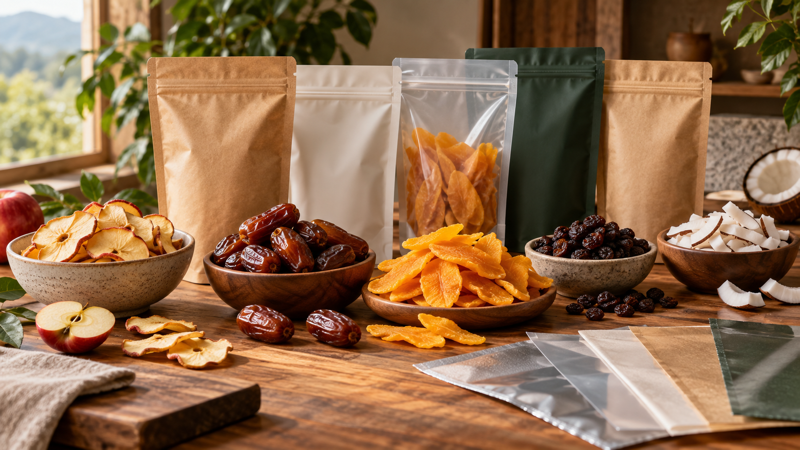
Dried fruit is not one uniform packaging category. Crisp apple chips, soft dates, chewy mango, oily coconut, and sugar-coated cranberries respond differently to humidity, oxygen, light, heat, and physical handling. A barrier that preserves one fruit may make another too dry, while a package sized for dense raisins may crush a fragile freeze-dried product.
Choosing moisture barrier by fruit type begins with the texture the brand wants to preserve. The packaging system should maintain that texture through filling, distribution, sealed storage, and repeated consumer opening while also protecting flavor, color, and food safety.
Define the Product’s Moisture Behavior
Moisture content and water activity are related but not interchangeable. Moisture content describes how much water is present, while water activity indicates how available that water is for reactions and microbial growth. Sugar, acids, fiber, and other components influence the relationship.
Measure both values for production-equivalent fruit and establish acceptable limits for texture and stability. Determine whether the product becomes sticky as it gains moisture or hard as it loses moisture. Some soft fruits need protection from drying as much as from moisture gain.
The direction of moisture movement depends on the product and surrounding relative humidity. A crisp fruit in a humid climate tends to absorb water and lose crunch. A moist, chewy fruit in very dry conditions may release water and toughen. Packaging must slow the harmful direction for the intended market.
Group Fruits by Texture and Composition
Low-moisture crispy fruits, including many freeze-dried products and fruit chips, generally need strong moisture barrier. Small moisture gain can cause a rapid loss of crispness even when the food remains otherwise acceptable. These products may also be fragile and require cushioning headspace.
Soft, high-sugar fruits such as dates, raisins, figs, and some mango products need moisture control that preserves chewiness without encouraging surface stickiness. Sugar may migrate or crystallize over time, and pieces can block together under heat and compression.
Oily products such as coconut or fruit-and-nut blends add oxidation risk. They may require stronger oxygen and light protection as well as compatibility testing with sealants and adhesives. Added flavors, oils, or acids can change the material requirement.
Sugar-coated or infused fruits may shed particles into the seal and zipper. Their packaging should be designed around both moisture behavior and contamination control.
Translate Texture Into Barrier Requirements
Water-vapor transmission rate helps compare films, but the number must be read with its test temperature, humidity gradient, units, and material thickness. Conditions that look similar on a data sheet may not represent tropical distribution or a hot warehouse.
For a crisp product, define how much moisture can enter before sensory texture fails. Combine that limit with package surface area, expected storage conditions, initial product moisture, and shelf life to screen structures. Then confirm the result with real-time testing.
For chewy fruits, the package may need to limit both gain and loss. A very strong barrier often supports stability, but initial conditioning and headspace are critical because the film will retain the product’s starting environment. Packaging cannot correct fruit that enters the pouch too wet, too dry, or too warm.
Dried fruit bags can use foil, metallized, coated, or clear high-barrier laminates. Choose the construction from measured needs rather than appearance alone. Windows support product visibility but may reduce overall barrier and expose color to light.
Add Oxygen and Light Protection Where Needed
Dried fruits can darken, fade, lose flavor, or develop oxidized notes. The risk varies with fruit variety, residual enzymes, oil content, antioxidants, sulfur treatment, and storage temperature. Brightly colored products may need better light protection even when moisture is the main texture concern.
Opaque foil or metallized layers offer strong light protection. Clear structures can be appropriate when the product is reasonably stable and visibility is valuable, but shelf-life testing should include retail lighting. A small window may provide a useful compromise.
Nitrogen flushing can reduce initial oxygen and protect fragile pieces by adding a cushion. It works only when the film and seals prevent rapid oxygen entry. For dense, soft fruits, excessive gas and headspace may add cost without improving the consumer experience.
Select a Pouch Format for the Fruit
Stand-up pouches suit many retail dried fruits because they provide shelf presence, a zipper option, and broad graphics. The bottom gusset must open consistently during filling, and the package should remain stable as product is removed.
Kraft stand-up pouches can support a natural brand position, but the paper appearance does not determine moisture barrier. The inner layers and any barrier coating must be specified for the product. Exposed paper edges and windows should also be considered in storage and distribution.
Flat pouches work well for small portions, samples, and mailers. Side-gusset or larger stand-up formats may suit family and foodservice sizes. Fragile fruit chips need enough area to avoid crushing, while compact raisins or dates can use volume more efficiently.
Test dimensions with representative pieces. The same net weight can produce very different volume depending on cut size, porosity, coatings, and settling. An oversized pouch increases material and shipping volume; an undersized one creates seal contamination and compression.
Design the Zipper for Repeated Use
Large dried-fruit packs are often opened many times. Each opening introduces ambient air, so a good zipper helps limit exposure between servings. It does not restore the original sealed barrier, and open-life testing is still necessary.
Choose a profile that closes through the expected level of sugar, crumbs, and sticky residue. Keep the fill line below the zipper, and provide enough room for consumers to remove fruit without scraping the closure. Test opening and reclosing after vibration has moved particles around the pouch.
An intact heat seal above the zipper provides first-opening evidence. Place the tear notch where the consumer can remove the header without cutting the zipper. Storage instructions should be visible after opening.
Prevent Seal Contamination and Puncture
Fruit fragments, sugar, syrup, oil, and powder can form channels in the top seal. Control dosing, fill height, product drop, and settling time. Clean the seal zone with validated methods and inspect it before sealing at production speed.
The sealant should be compatible with the fruit’s oils, acids, and coatings. Establish a process window for temperature, pressure, and dwell time. Test seal strength and leak integrity after conditioning because residues can affect performance over time.
Hard banana chips, stems, and sharp freeze-dried pieces may puncture the laminate. Soft fruits can form dense blocks that stress gussets during drops. Distribution tests should use the most challenging fruit shape and the final carton.
Consider Desiccants Carefully
A desiccant can support very moisture-sensitive crisp products, but it must be sized for the initial headspace, package transmission, shelf life, and repeated opening. It cannot overcome a weak film or leaking seal.
Too much drying may negatively affect certain fruits, and a loose sachet can be mistaken for food. Confirm food-contact suitability, placement, labeling, and consumer safety. Shelf-life testing should compare the chosen component in the complete package.
Validate by Fruit Type, Not Only Package Size
The overview of types of dried fruit packaging becomes more practical when each fruit family has its own specification. Produce samples on the intended line and store them under normal and challenging conditions.
Track water activity, moisture, texture, stickiness, color, flavor, aroma, oxidation markers where relevant, seal integrity, zipper function, and package appearance. Include repeated-opening studies and distribution simulation before or during storage.
If several fruits share one laminate, validate the most moisture-sensitive, oxidation-sensitive, oily, sharp, and bulky products. A common structure simplifies purchasing only when it protects every SKU without excessive cost or material.
Dried Fruit Packaging Checklist
- Define desired texture and acceptable moisture or water-activity limits.
- Group fruits by crispness, sugar, oil, shape, and oxygen sensitivity.
- Compare barrier data under conditions relevant to the target climate.
- Add light and oxygen protection where color or flavor requires it.
- Size pouches with actual product volume and settling behavior.
- Keep sugar, crumbs, oils, and syrup away from seals and zippers.
- Test puncture, crushing, reclosure, and carton performance.
- Validate shelf life separately for meaningful fruit families.
The right dried-fruit package preserves the intended eating experience, whether that means a crisp snap, a soft chew, or clean separation between pieces. Fruit type determines the moisture risk; moisture risk guides the barrier; and the pouch format, closure, and filling process protect that barrier in real use. Product-specific testing turns these choices into a reliable shelf-life system.