

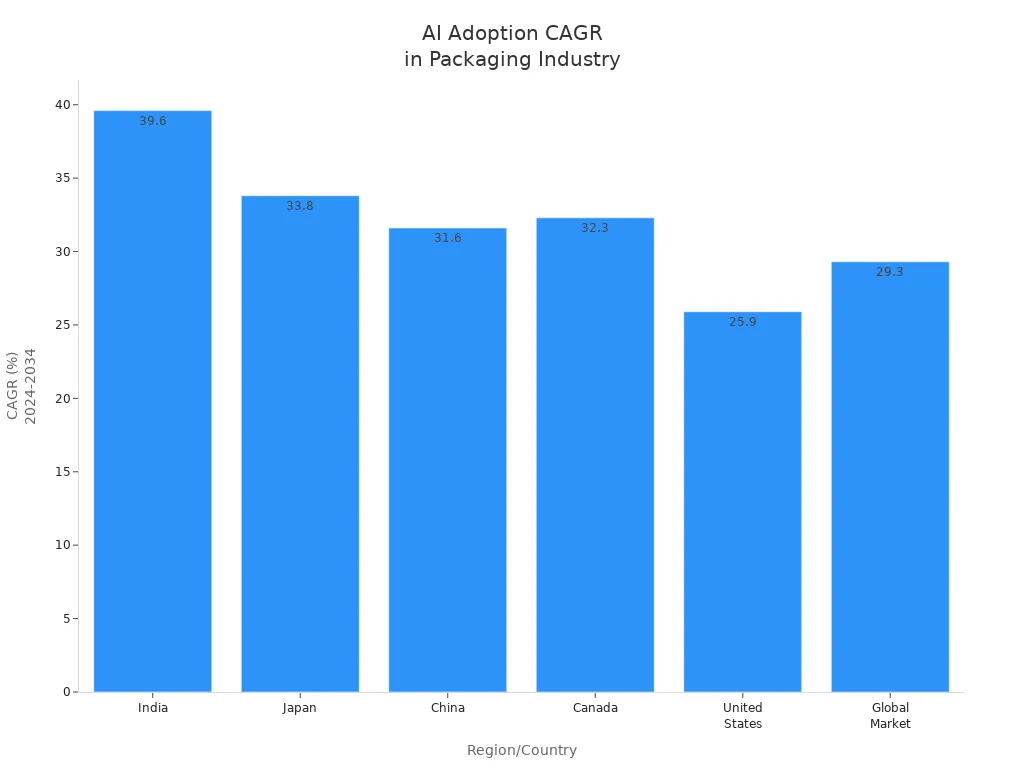
AI packaging design drives rapid change in the packaging industry, fueling remarkable growth worldwide. Companies now rely on AI for advanced packaging design, improving quality control and sustainability. BN PACK leads with flexible packaging solutions that reflect this innovation. Recent data shows the global AI packaging market will grow at a CAGR of 29.3% from $1,790.8 million in 2024 to $23,415.2 million by 2034.
Region/Country | CAGR (2024-2034) | Market Value 2024 (USD million) | Market Value 2034 (USD million) |
|---|---|---|---|
Global Market | 29.3% | 1,790.8 | 23,415.2 |
India | 39.6% | N/A | N/A |
Japan | 33.8% | N/A | N/A |
China | 31.6% | N/A | N/A |
Canada | 32.3% | N/A | N/A |
United States | 25.9% | N/A | N/A |
AI Packaging Design Innovation
Generative Design
Generative AI is changing how companies approach packaging design. Designers use advanced algorithms to create packaging that looks appealing and functions well. These algorithms analyze large datasets of past packaging designs and consumer feedback. They help select the best colors, shapes, and materials for each product. Generative AI can blend successful design concepts to produce new packaging solutions that stand out on store shelves.
Many brands now use generative AI to optimize packaging for durability and sustainability. The technology helps reduce excess material while keeping products safe. Real-time monitoring during production improves energy efficiency and cuts down waste. AI also predicts and prevents quality issues, which means fewer rejected products and less material waste. Companies like PepsiCo and L’Oréal use AI to create personalized packaging designs for special promotions and limited editions. Interactive features, such as augmented reality labels, add value and engage customers.
Generative AI creates a cycle of continuous improvement. It learns from past data and consumer reactions, making each new packaging design better than the last.
Rapid Prototyping
AI-driven rapid prototyping speeds up the packaging design process. Designers can quickly create digital prototypes and test different ideas before making physical samples. This approach saves time and money. Before AI, teams spent weeks or months building and testing physical prototypes. Now, AI automates many design tasks, allowing brands to launch new packaging solutions faster.
Rapid prototyping lets designers explore multiple concepts with less risk. Teams can visualize and interact with prototypes that closely match the final product. Early feedback helps refine designs quickly. Testing prototypes for usability and strength prevents costly mistakes later. AI-powered tools generate many design variations in a short time, making it easier to adapt to market trends.
Cost Saving Aspect | Description | Quantified Savings/Impact |
|---|---|---|
Material Waste Reduction | Redesigning a part to avoid excess material | Over 40% cost savings |
Machining Time Reduction | Splitting designs into simpler components | Significant reduction in machining time |
Per Part Machining Cost Avoidance | Eliminating special tools and extra steps | About $250 saved per part |
Early Design Flaw Detection | Identifying costly issues early | Prevented expensive production mistakes |
Production Cost Reduction | Iterative prototyping and design optimization | 15% reduction reported |
Testing Time Reduction | Less need for physical testing of faulty parts | Faster time to market and cost savings |
AI in packaging helps companies reduce costs and launch products quickly. Early detection of design flaws and optimized material use lead to significant savings.
Customization with BN PACK Coffee Bags
BN PACK uses AI to deliver advanced customization for coffee bag packaging solutions. Their AI-driven design software optimizes pouch dimensions, reducing material usage by 15–20%. This process supports sustainability and lowers costs. BN PACK’s platform combines artificial intelligence with expert designers to provide pre-press support, material guidance, and real-time updates.
The customization process starts with online communication. Clients share their requirements, such as size, material, style, branding, and special features. BN PACK’s design team uses the latest software to create packaging concepts that match each brand’s identity. Clients receive 3D visualizations to review and request changes before production. Physical samples allow clients to check material quality and design before full-scale manufacturing.
Personalization trends in coffee packaging are growing. Consumers can add names or messages to custom coffee bags, making them ideal for gifts. Limited edition packaging and subscription boxes tailored to individual preferences are also popular. AI packaging design supports these trends by enabling brands to create unique, emotionally engaging packaging for every customer.
Personalization Trend | Description |
|---|---|
Custom Coffee Bags | Add names, messages, or select designs for emotional connection and gift appeal |
Limited Edition Packaging | Seasonal or artist collaboration designs for uniqueness and exclusivity |
Subscription Packaging | Tailored packaging based on consumer preferences like blend or roast profile |
BN PACK’s approach to customization demonstrates how advancements in AI packaging design drive packaging innovation. Their flexible packaging solutions help brands stand out while supporting sustainability and efficiency.
Sustainable Materials and Future Trends
Eco-Friendly Solutions
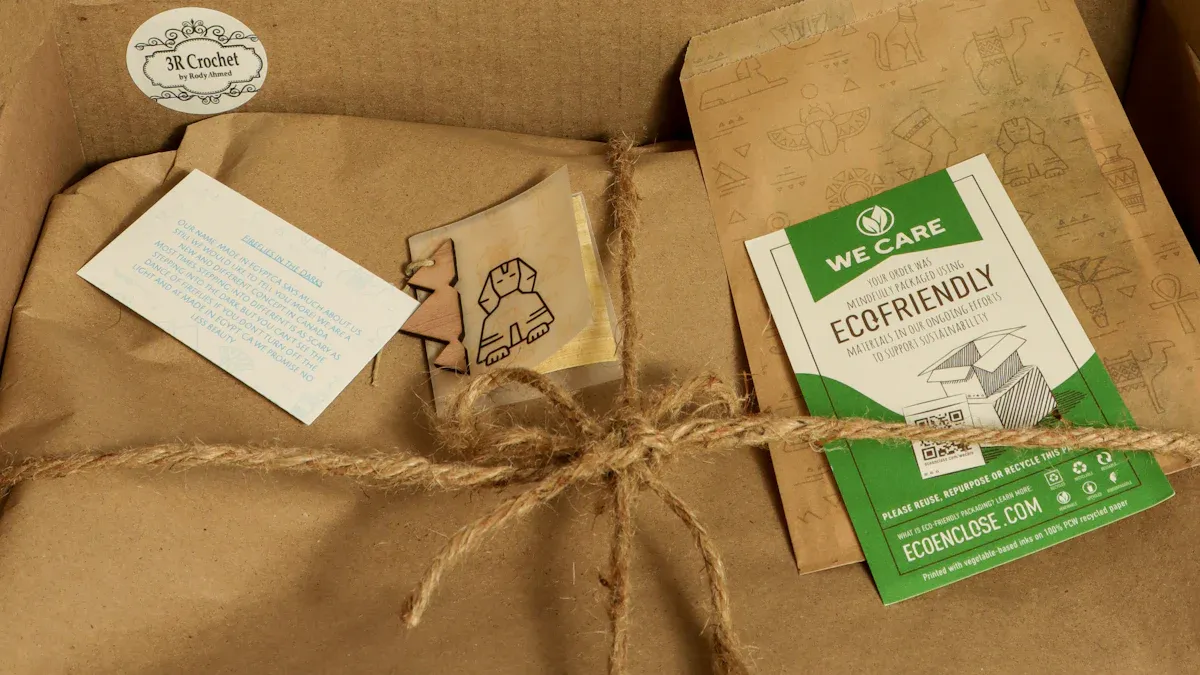
AI is transforming how companies address sustainability demands in packaging. Machine learning and deep learning help businesses select eco-friendly materials that meet both regulatory and consumer expectations. Companies use AI to analyze the entire lifecycle of packaging, from raw material extraction to disposal. This process helps reduce carbon footprints and supports circular economy goals. Recent advancements include the use of biodegradable, edible, and plant-based packaging such as mushroom mycelium, seaweed, and cornstarch. AI-driven systems also enable real-time quality detection and shelf-life prediction, which reduces food waste and improves sustainability.
Amazon uses AI to optimize packaging materials, reducing shipment damage by 24% and cutting shipping costs by 5%.
AI algorithms recommend the best packaging type to minimize weight and waste.
AI-powered vision systems achieve 100% accuracy in package inspection, eliminating customer complaints and reducing plastic waste.
Material Optimization
AI agents play a key role in optimizing packaging design. They reduce material use, enhance recyclability, and control costs. Specialized AI tools evaluate environmental impact, recyclability, and cost-effectiveness, promoting plastic alternatives and supporting sustainable material selection. Companies use digital twin simulations to model packaging systems virtually, which reduces prototyping waste. AI also forecasts packaging waste, preventing overproduction and lowering environmental impact.
Advancement Area | Description |
|---|---|
AI-driven material development | Accelerates testing of biodegradable and plant-based packaging through simulation and data analysis |
Lifecycle analysis and compostability | AI forecasts compostability and lifecycle impacts for faster innovation |
Optimized packaging design | Minimizes material use while maintaining product integrity |
Quality control in manufacturing | Real-time defect detection reduces production errors and waste |
Smart recycling systems | AI-powered sorting improves material recovery and reduces contamination |
BN PACK’s Coffee Bag Sustainability
BN PACK demonstrates a strong commitment to sustainability through its coffee bag solutions. The company uses recyclable, compostable, and bio-based materials to support circular economy principles. Plastic-free degassing valve technology prevents over 1,800 metric tons of plastic waste each year in the U.S. alone. Lightweight and mono-material packaging designs simplify recycling and reduce raw material consumption. These innovations help BN PACK meet global sustainability demands while maintaining product freshness and quality. The company’s efforts also encourage consumer engagement in recycling and reuse programs, further supporting future trends in eco-friendly packaging.
Automation in the Future of Packaging
Manufacturing Efficiency
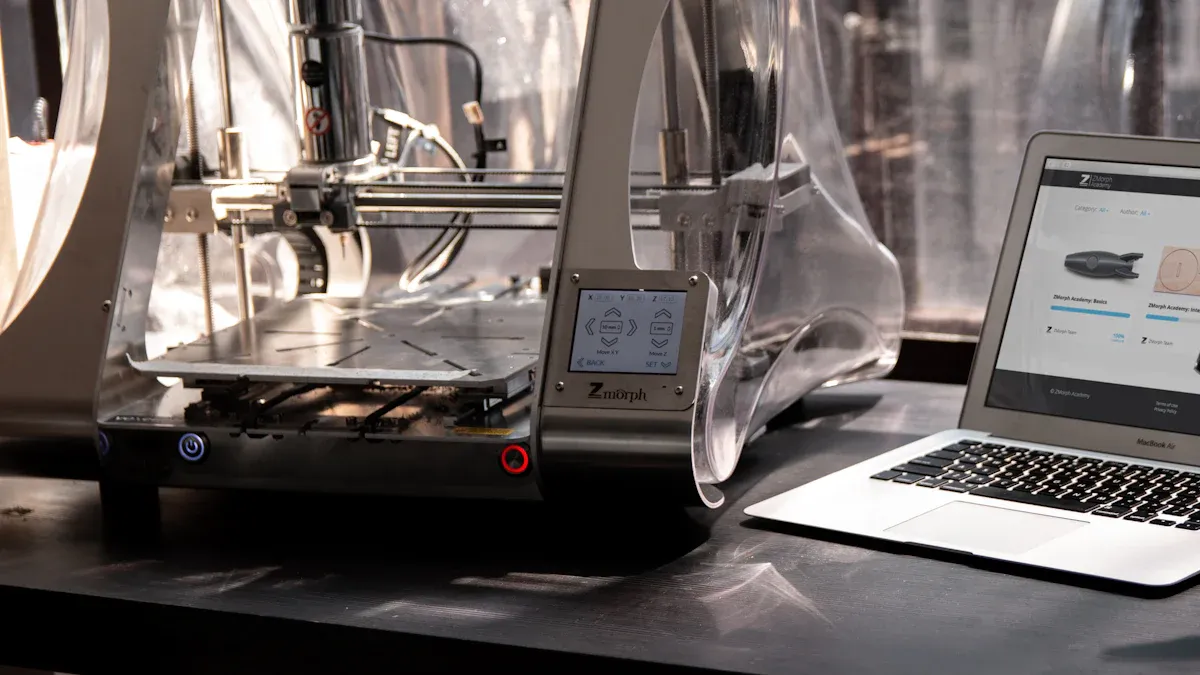
Automation in manufacturing processes has transformed the packaging industry. Over half of packaging companies now invest in automation to address workforce shortages and improve operational speed. Smart conveyor systems optimize product flow, while advanced software speeds up packaging design and prototyping. These systems streamline repetitive tasks, such as prepress processes and job handovers, which reduces human error and increases productivity. Companies can scale operations without adding more labor, helping smaller businesses grow. Cloud-based automation standardizes workflows across multiple sites, improving resource utilization and job balancing. Automation also balances time, cost, and quality, making these priorities easier to achieve. AI and IoT advancements continue to lower costs and make automation accessible to more businesses.
Market research shows that 42% of industry experts believe automation will have the biggest impact on packaging by 2025.
Quality Control
AI-driven automation brings enhanced quality control to packaging production. AI automates defect detection with high precision, identifying misprints, dents, tears, and seal integrity issues. Real-time monitoring and anomaly detection enable prompt identification of defects, reducing manual inspection time. Adaptive AI algorithms improve accuracy over time and reduce false positives. AI-powered vision systems and sensors continuously inspect packaging materials and processes, minimizing human error and increasing consistency. Predictive maintenance supported by AI minimizes downtime and ensures equipment reliability. Integration of AI leads to improved product reliability, operational efficiency, cost savings, and compliance with regulatory standards. AI-driven robotics increase speed and precision in packaging tasks. AI analytics provide data-driven insights for better decision-making, enhancing overall quality control with AI.
AI-controlled vision systems detect tiny imperfections invisible to humans.
Real-time anomaly detection and feedback loops enable automatic adjustments on the packaging line.
AI optimizes material use and reduces waste, supporting sustainability.
Predictive Maintenance
Predictive maintenance applications in packaging manufacturing use AI to monitor equipment health and predict failures. As of 2023, 71% of packaging and processing companies have implemented some form of predictive maintenance. IoT sensors track temperature, vibration, and pressure in real time. Machine learning algorithms analyze both historical and real-time sensor data, detecting anomalies and predicting equipment failures. These systems recommend maintenance actions to prevent unplanned downtime. Benefits include less downtime, improved productivity, lower maintenance costs, reduced spare parts inventory, and increased run times. Combining AI with expert human insights maximizes predictive maintenance effectiveness. AI-driven inventory management and real-time inventory tracking further support operational efficiency by ensuring equipment and materials are always available when needed.
Predictive Maintenance Benefits | Description |
|---|---|
Less Unplanned Downtime | Early detection prevents breakdowns |
Improved Productivity | Machines run longer and more reliably |
Lower Maintenance Costs | Fewer emergency repairs and spare parts |
Increased Run Times | Equipment operates at peak performance |
AI advancements in predictive maintenance help packaging companies maintain high precision and adaptability, even in harsh operational conditions.
Enhanced Customer Experience
Personalization
AI transforms how brands connect with customers through packaging. Companies now use AI to analyze consumer preferences and create packaging that feels unique to each buyer. For example, AI can customize visuals and text on packaging, making every product feel personal. Brands like Diageo use generative AI to print personalized labels within minutes, giving each customer a one-of-a-kind experience. AI-driven customer support tools, such as chatbots, also gather customer insights and customization data, helping brands improve satisfaction and loyalty.
AI customizes packaging visuals and messages for each customer.
Smart packaging uses QR codes and sensors to create interactive unboxing experiences.
Packaging can change color with temperature or release scents, all enabled by AI.
AI-powered chatbots provide personalized support and collect valuable feedback.
These advances allow brands to respond quickly to changing consumer preferences and deliver memorable experiences.
Smart Packaging
Smart packaging powered by AI brings new possibilities to the industry. Companies now use RFID and NFC tags to track packages in real time and ensure product safety. Printed sensors monitor quality and environmental conditions, while active packaging extends shelf life with oxygen absorbers and antimicrobial agents. Nanomaterials improve insulation and prevent contamination. QR codes and AI-powered augmented reality features let consumers access detailed product information or enjoy interactive experiences.
RFID and NFC tags transmit real-time data about location and quality.
Printed sensors track freshness and environmental changes.
Active packaging interacts to keep products safe and fresh.
QR codes unlock AI-powered AR experiences for consumers.
These technologies enhance safety, efficiency, and engagement, making packaging smarter and more responsive.
Data Insights for BN PACK Coffee Bags
BN PACK uses AI to gather and analyze data from its coffee bag packaging. This process helps the company understand consumer preferences and improve product design. AI tracks how customers interact with packaging, such as scanning QR codes or using smart features. The company uses this information to refine packaging, ensuring it meets both functional and branding needs. By leveraging customer insights and customization, BN PACK creates packaging that stands out and supports brand loyalty.
AI-driven data insights help BN PACK deliver packaging solutions that match market trends and consumer needs, setting new standards for quality and innovation.
Industry Challenges and Adoption
Integration Barriers
Many packaging companies face challenges when adopting ai technologies. Integration barriers often slow progress, especially for smaller organizations. Several common obstacles include:
Security and compliance concerns, especially in Europe, make companies cautious about new technology.
Integration difficulties with legacy systems are widespread in the United States, where many manufacturers still rely on outdated equipment.
Lack of internal expertise and uncertainty about where to start can prevent smaller businesses from moving forward with ai integration.
Uneven adoption rates favor larger, digitally mature companies, leaving others behind.
Companies must align ai solutions with their readiness and specific industry needs.
Data quality and fragmentation also create problems. Nearly half of manufacturers report fragmented data as a major obstacle. Skill gaps remain significant, with over half of workers needing upskilling to handle ai technologies. Unclear return on investment and immediate costs deter many companies from pursuing ai integration.
Companies that address these barriers early can gain a competitive edge in the evolving packaging industry.
Data Security
Data security stands as a top priority for packaging companies using ai. These companies handle sensitive information about production processes and product formulations. To protect this data, they implement strong cybersecurity measures such as firewalls, encryption, and access controls. Employee training on data privacy and security best practices helps ensure comprehensive protection. Transparency with customers about data collection and usage builds trust and encourages safe data sharing. Companies also monitor ai models for accuracy to prevent data errors and maintain reliability.
Workforce Adaptation
The shift to ai in packaging manufacturing requires workforce adaptation. Companies use machine learning-driven automation for tasks like material handling, assembly, and labeling. These changes improve efficiency and quality control. To keep up, companies invest in upskilling and reskilling employees. They foster a culture of continuous learning and offer flexible work arrangements. Governments support adaptation through training programs and apprenticeships. Educational institutions update curricula to include ai and automation topics, giving students hands-on experience. Essential skills for future jobs include empathy and communication, which remain important even as ai becomes more common.
A resilient workforce, equipped with new skills, will help companies thrive as ai integration continues to shape the packaging industry.
Artificial Intelligence and the Future of the Packaging Industry
Market Growth
Artificial intelligence continues to reshape the packaging industry. The global market for AI in packaging reached about USD 2.98 billion in 2024. Analysts expect this figure to grow to nearly USD 8.67 billion by 2034. This steady increase represents a compound annual growth rate of 11.26% over the next decade. Machine learning stands out as the fastest-growing technology segment, while smart warehousing leads as the largest application area. North America remains the dominant regional market, but Asia Pacific shows the fastest growth.
Industry experts predict several future trends for AI in packaging design:
AI integrates across the entire packaging process, from design to printing and inspection, improving efficiency and quality control.
Generative AI tools, such as ChatGPT and Adobe Firefly, enable faster and more diverse design options.
Prototypes like ‘Reprint a Pack’ and ‘Remote Press Approval’ speed up workflows and improve accuracy.
Automation, AI, and machine learning will have the biggest impact on packaging by 2025, according to 73% of survey respondents.
AI augments human capabilities by automating repetitive tasks, while human oversight ensures quality.
“AI-powered advancements drive market growth by optimizing design, reducing waste, and improving supply chain efficiency. Companies like Tetra Pak and Amcor lead the way with predictive maintenance and smart packaging solutions.”
A balanced approach combining AI innovation with human expertise remains essential. Companies use AI to predict effective box structures, simulate durability, and forecast machinery failures. AI-driven inventory management improves real-time tracking and demand prediction. These advancements help brands respond quickly to market changes and consumer needs.
Technology Segment | Growth Rate | Application Area | Regional Leader |
|---|---|---|---|
Machine Learning | Fastest | Smart Warehousing | North America |
Computer Vision | High | Quality Control | Asia Pacific |
Predictive Analytics | Steady | Supply Chain Optimization | Europe |
AI-powered advancements continue to drive innovation, sustainability, and efficiency in the packaging industry.
Human-AI Collaboration
Human-AI collaboration transforms roles and responsibilities in packaging design teams. AI systems analyze customer behavior and preferences, providing designers with deep insights. Designers use these insights to make informed decisions and optimize packaging through iterative techniques like AI-led A/B testing. This process accelerates creative cycles and reduces manual effort on routine tasks.
Human designers retain control over creative direction, cultural nuances, and regulatory compliance. They prepare final artwork and ensure brand storytelling remains strong. AI supports sustainability by generating eco-friendly packaging alternatives. Tools such as Amazon’s PackOpt help reduce material waste and promote green manufacturing.
Industry experts emphasize that AI augments human creativity rather than replacing it. AI automates repetitive tasks, allowing designers to focus on innovation and strategic decisions. Human oversight remains essential to vet AI outputs and maintain quality. Packaging teams adapt workflows and upskill to work effectively with AI technologies.
AI transforms subjective design decisions into data-driven processes.
Machine learning enables iterative improvements and optimizes packaging formats.
AI-powered tools create interactive customer engagement experiences, such as Snapple’s AI-generated facts accessed via QR codes.
Predictive analytics help brands understand consumer preferences and improve marketing consistency.
AI contributes to sustainability by generating eco-friendly packaging alternatives.
“The impact of AI on packaging design grows stronger as teams combine data-driven insights with human expertise. This synergy leads to faster, smarter, and more sustainable design outcomes.”
AI-powered advancements in defect detection, demand forecasting, and recycling efficiency support future innovation. Convolutional Neural Networks automate fault identification, while Recursive Neural Networks predict product demand. AI-powered smart bins and robotic sorting increase recycling rates, supporting sustainability goals.
A balanced approach ensures that artificial intelligence enhances creativity, quality, and efficiency. The packaging industry benefits from this collaboration, driving new standards in design and manufacturing.
AI packaging design continues to transform the future of packaging by improving quality control, boosting efficiency, and supporting sustainability. Companies now use computer vision and predictive maintenance to reduce defects and downtime. Platforms like Deepnest help brands track waste and improve recycling. As more businesses adopt AI, they see faster design cycles and less material waste. BN PACK leads this shift by combining advanced technology with expert knowledge, setting new standards for smart, sustainable packaging.