
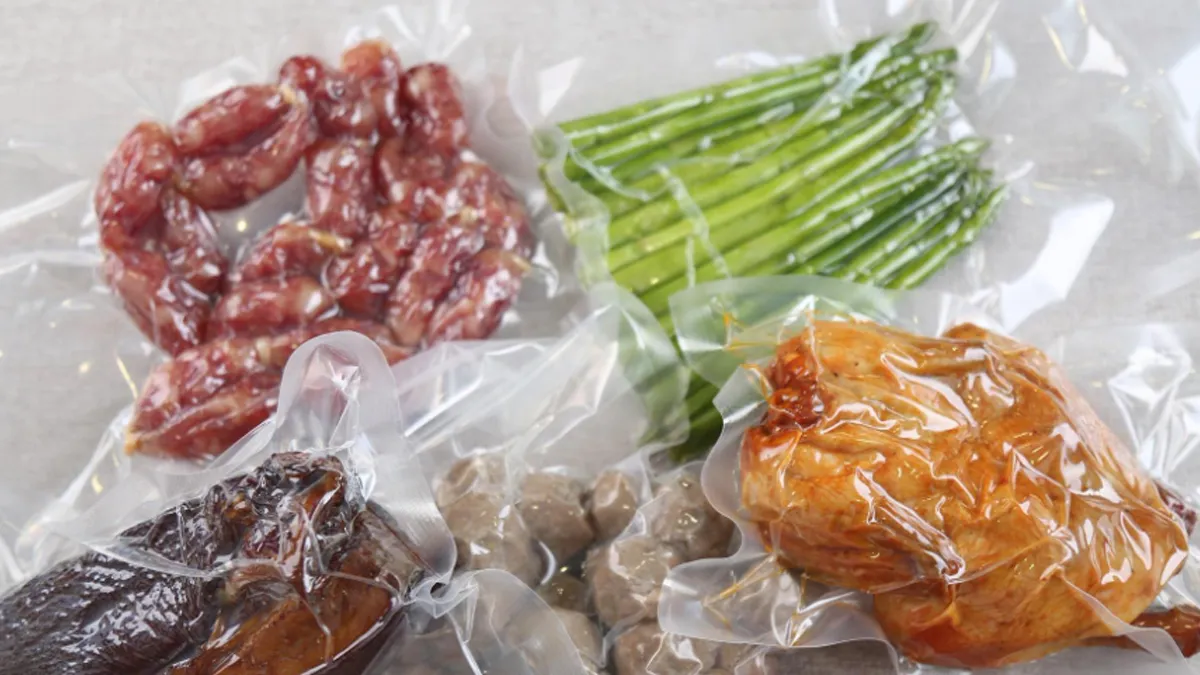
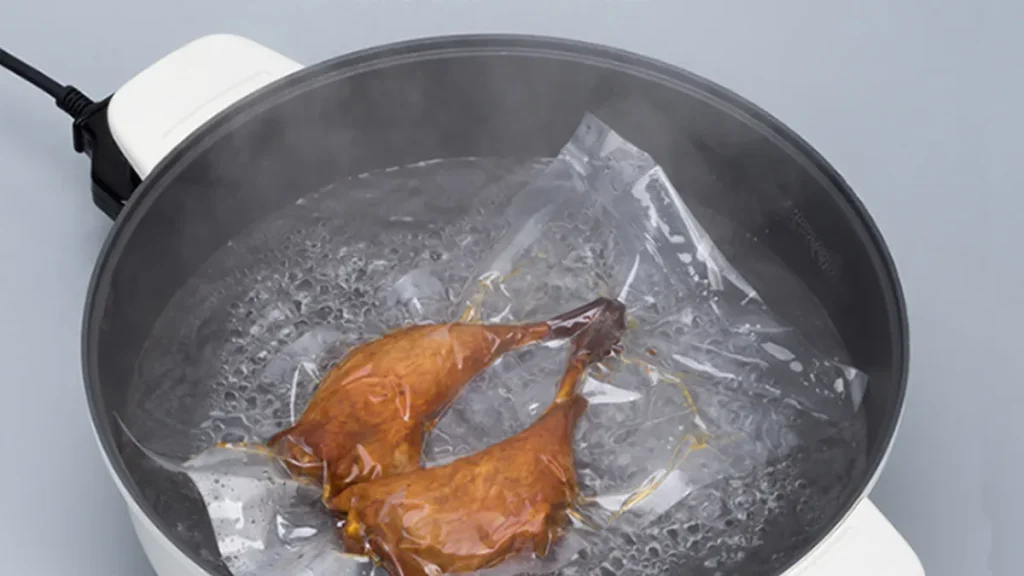
Some vacuum seal bags can be used in boiling water, but only when the exact product is specified for that use. A bag designed for chilled storage, freezing, or lower-temperature sous vide cooking is not automatically suitable for boiling.
For packaging buyers, the essential question is more specific than “Is this bag heat-resistant?”
Ask: “Is this finished pouch suitable for our food at this water temperature, for this length of time, using our sealing process?”
That information helps a supplier propose a relevant construction and identify what needs testing before production.
Vacuum Packaging and Boil-in-Bag Packaging Are Different Claims
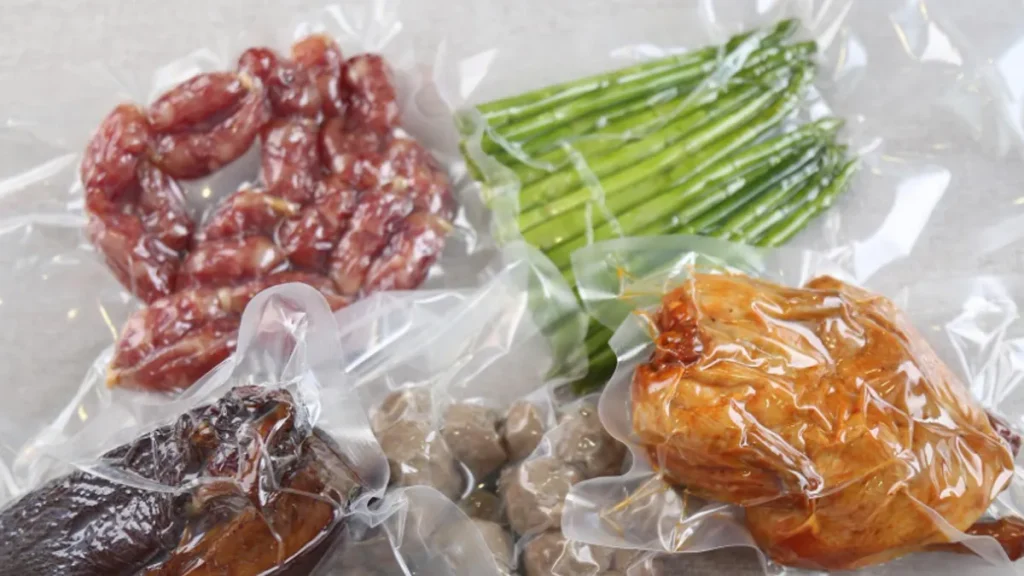
Vacuum packaging describes the removal of air before sealing. It does not, by itself, describe the package’s heating capability.
USDA defines boil-in-bag packaging as a heat-resistant container designed to hold food while the bag and contents are brought to boiling temperature. These are separate definitions because they describe different functions.
A vacuum pouch may therefore be suitable for storage without being suitable for cooking. Conversely, a cooking pouch still needs to work with the intended vacuum and sealing equipment.
Boiling, Simmering, and Sous Vide: What Changes for the Bag?
| Process | What it means for packaging selection |
|---|---|
| Boiling-water heating | Confirm suitability for boiling water and the intended exposure time. Water boils at approximately 100°C / 212°F at sea level. |
| Simmering | Follow the product’s stated limits. “Below boiling” is not a complete temperature-and-time specification. |
| Sous vide | Specify the controlled water-bath temperature and duration. Do not infer boiling suitability from a lower-temperature rating. |
| Hot filling | Assess contact with hot contents and subsequent cooling; do not substitute a hot-fill specification for an immersion-cooking specification. |
| Retort processing | Treat this as a separate processing application requiring an appropriate package and validated process. |
For example, a long water-bath exposure at a lower temperature and a shorter exposure in boiling water are different conditions. Approval for one should not be extended to the other without supporting evidence.
What Real Product Specifications Show
Published manufacturer instructions demonstrate why “vacuum bag” is not a universal cooking specification.
| Published example | What the source states | What a buyer should take from it |
|---|---|---|
| FoodSaver U.S. bag FAQ | Bags should be placed in simmering, rather than boiling, water | Do not treat a household vacuum bag as automatically boilable |
| FoodSaver VS9000 New Zealand manual | Water reheating is described at a low simmer below 75°C | Consult the instructions relevant to the exact product and market |
| Vollrath model 23854 boil-in vacuum bags | Maximum cooking temperature is listed as 212°F / 100°C | A specific boil-in product has a stated temperature limit; the intended duration still needs confirmation |
These are product-specific examples, not ratings for all bags from those brands or for BN PACK products. Where general guidance and product instructions differ, obtain clarification for the bag you intend to use.
Why Material Names and Thickness Are Not Enough
A description such as “nylon/PE vacuum pouch” is a starting point for discussion. It does not identify every detail of the finished package.
Performance depends on the complete construction and its intended conditions, including:
- The particular material grades and layer arrangement.
- Total thickness and individual layer thicknesses.
- The food-contact surface.
- Bonds between layers, where applicable.
- Seal design and sealing conditions.
- Contact with the actual food.
- Heating temperature, duration, and handling.
A thicker bag may address a particular handling requirement, but thickness alone does not establish cooking suitability.
Likewise, a resin’s melting-point information is not a substitute for evaluating the finished pouch. The specification needs to cover more than whether the plastic visibly melts.
What Does Food-Contact Compliance Establish?
Food-contact suitability must relate to the intended application.
The FDA explains that its assessment of food-contact substances considers their intended use, migration into food, and the safety of the resulting exposure. That makes the proposed contact conditions relevant—not merely whether a supplier describes the material as “food grade.”
Ask for documentation applicable to the proposed construction, food type, heating conditions, and sales market. Avoid relying on a generic “FDA-approved” statement without understanding what it covers.
What to Include in a Boilable Vacuum Bag Inquiry
A useful inquiry allows the supplier to assess your actual application.
| Information | What to provide |
|---|---|
| Food product | Product type, including relevant fat, acidity, salt, or sharp pieces |
| Intended process | Cooking, reheating, sous vide, or another specified use |
| Water temperature | The operating temperature and any relevant process variation |
| Heating duration | Expected exposure and the longest intended cycle |
| Starting condition | Frozen, chilled, or another defined condition |
| Fill amount | Target weight or volume and approximate product dimensions |
| Equipment | Chamber or external vacuum sealer, sealing arrangement, and settings if known |
| Distribution | Storage, freezing, transport, and end-user reheating conditions |
| Sales market | Destination and applicable documentation requirements |
If consumers will heat the food in the pouch, include the proposed instructions in the development brief. A package approved for one controlled factory process should not be assumed suitable for every home reheating method.
Check the Seal as Carefully as the Film
A suitable material can still produce an unsuitable finished pack if the seal is incomplete or contaminated.
FoodSaver identifies wrinkles, moisture, grease, crumbs, and powders in the sealing area as possible reasons for sealing problems. This is a useful practical reminder to test with the actual product rather than empty bags alone.
Before approving a cooking pouch, assess:
- Filling access: Can the product enter without contaminating the final seal area?
- Vacuum and sealing: Does the selected equipment produce a consistent result?
- Heating performance: Does the filled pouch maintain the required integrity throughout the specified cycle?
- Post-heating handling: Can the package be lifted, moved, and opened as intended?
- Product compatibility: Are there unacceptable changes in the food or packaging?
Record the construction, sample identity, fill, equipment settings, temperature, duration, and observations. These records make subsequent approvals and production comparisons more useful.
A simple home boiling experiment cannot establish food-contact compliance or replace an appropriate validation program.
Bag Suitability and Food Safety Need Separate Checks
A pouch temperature rating concerns the package. It does not establish that the food has received a safe cooking or reheating process.
The water temperature is also not the same as the temperature at the center of the food.
For household leftovers, USDA recommends reheating to 165°F / approximately 74°C, checked with a food thermometer. That guidance does not establish a universal water-bath time or authorize heating an unsuitable bag.
For commercial products, develop the food process and packaging specification together. The required controls depend on the product, process, storage, and intended use.
Frequently Asked Questions
Can you boil an ordinary freezer vacuum bag?
Only if its instructions or supplier specification explicitly cover boiling under the intended conditions. Freezer suitability alone does not establish heating suitability.
Are all sous vide bags safe in boiling water?
No. Check the stated temperature and duration. A lower-temperature water-bath application is not equivalent to boiling.
How long can a vacuum pouch stay in boiling water?
There is no universal duration. Obtain a limit applicable to the exact construction and use. If a specification provides a maximum temperature without a duration, ask for clarification before proceeding.
Should a water-bath pouch be punctured like a microwave bag?
Do not transfer microwave venting instructions to immersion heating. Follow the instructions for the particular pouch and process; puncturing a pouch intended to remain sealed can allow water to enter.
Can I put a boilable vacuum pouch in an oven?
Not unless that exact product also permits oven use. Oven heating is a separate application with different exposure conditions.
Does boiling make a vacuum-packed meal shelf-stable?
Do not assume so. A boilable bag or a successful heating cycle does not, by itself, establish commercial sterility or shelf stability. Storage requirements need to be determined for the food and validated process.
Can I reuse a pouch after heating?
Do not assume repeated heating is permitted. Ask whether reuse is covered by the product instructions and supporting evidence.
Discuss Cooking-Pouch Requirements With BN PACK
Start with your product and heating process, rather than selecting a bag by appearance or material abbreviation alone.
When contacting BN PACK, provide the food type, fill amount, target temperature, exposure time, sealing equipment, order quantity, and destination market.
Ask about the proposed construction, relevant documentation, sample options, and validation requirements. Confirm the finished pouch under the intended conditions before approving a production order.