
For procurement managers and business owners in the flexible packaging industry, the allure of sourcing from China is undeniable. The “China Price” often represents a cost saving of 30% to 50% compared to local Western suppliers, a margin that can significantly boost your bottom line. However, this financial advantage comes with a shadow: the “Quality Risk.”
In China, there is a vast spectrum ranging from world-class, ISO-certified facilities to small, unregulated workshops operating in basements. The challenge isn’t just finding a factory; it is distinguishing a transactional vendor from a strategic partner who understands the complex science of automatic packaging.
How do you filter through the noise on Alibaba or trade show directories? How do you verify if a China packaging roll film supplier has the technical capability to match Western standards?
This guide is written from the perspective of a manufacturer with decades of experience. We are pulling back the curtain to reveal the 5 non-negotiable factors—from chemical safety to kinetic friction control—that you must audit before placing your first order.
Factor 1: Strict Solvent Retention Control (The Safety Non-Negotiable)
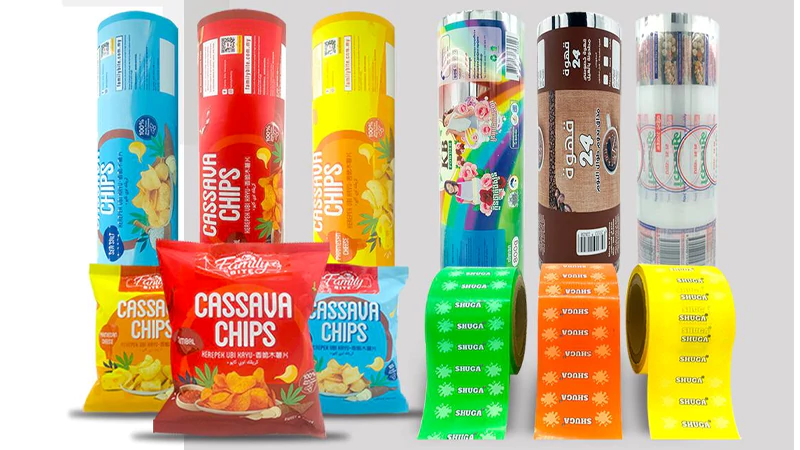
When it comes to food packaging, safety is paramount. The most critical, yet often invisible, risk in laminated films is Solvent Retention.
Most packaging film roll manufacturers in China use solvent-based dry lamination processes. This involves dissolving the adhesive in a solvent (usually ethyl acetate), applying it to the film, and then passing the web through a long drying tunnel to evaporate the solvent before bonding the layers.
The “Bad Factory” Scenario: To save on electricity costs or speed up production, some manufacturers run their machines too fast or lower the drying tunnel temperature. The result? The solvent doesn’t fully evaporate. It gets trapped between the layers of the film. Once the film is wound into a tight roll, the residual solvent migrates through the plastic and is absorbed by your food product. This leads to the dreaded “chemical taste” complaint and potential recalls.
The “Expert” Standard: A premium manufacturer treats solvent retention as a critical control point (CCP). At our facility, we utilize Gas Chromatography (GC) technology to test every single batch before it leaves the factory floor.
While the Chinese national standard allows for higher limits, we adhere to strict international standards comparable to EU 10/2011 regulations.
| Feature | Standard Factory / Workshop | Premium Manufacturer (Our Standard) |
| Testing Frequency | Random spot checks (once a month) | Every single batch (Every Roll) |
| Testing Equipment | Smell test (Subjective) | Gas Chromatography (GC) Lab |
| Solvent Retention Limit | < 10 mg/m² (High Risk) | < 2 mg/m² (Safe for Food) |
| Ink & Glue Brands | Unknown / Generic Local Brands | DIC / Sun Chemical / Toyo (Certified) |
| Technology Option | Solvent-Based Only | Solvent-Free Lamination Available |
Why Solvent-Free Matters: If you are packaging sensitive products like baby food, chocolate, or pet treats, we strongly recommend asking your packaging bag supplier about Solvent-Free Lamination. This technology uses adhesives that do not require solvents at all, eliminating the risk of retention entirely.
Factor 2: Technical Expertise in COF (Friction) Management
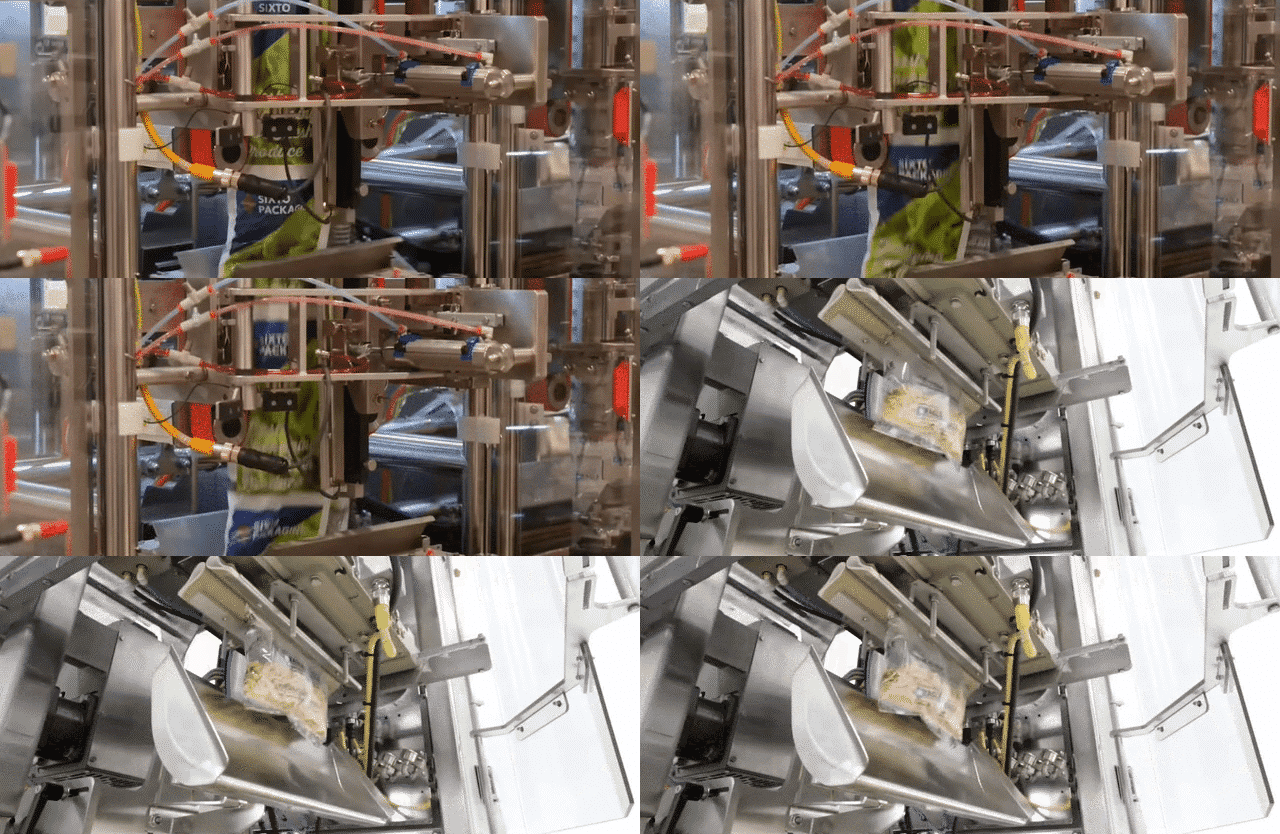
Your packaging machine runs at speeds of 60 to 120 bags per minute. At this velocity, the physical behavior of the film surface is governed by the Coefficient of Friction (COF). This is arguably the most technical aspect of sourcing packaging film rolls, and it is where inexperienced suppliers fail.
If the film’s COF is too high (sticky), the film creates drag as it is pulled over the forming collar. This tension causes the film to stretch.
The Result: The “Eye Mark” (registration mark) drifts, the machine loses synchronization, and the cutting knife slices through your logo instead of the seal area. This is known as “Bag Length Variation.”
Conversely, if the COF is too low (slippery), the film slips in the drive belts, causing misalignment and poor seal integrity.
The “China Manufacturer” Difference: A generic supplier uses a “one-size-fits-all” slip agent formula. They don’t ask about your machinery.
A strategic partner will ask: “What type of VFFS machine are you running? What is the ambient temperature of your packing facility?”
Technical Deep Dive: Kinetic vs. Static COF According to ASTM D1894 standards, we measure two types of friction:
- Static COF: The force required to start the film moving.
- Kinetic COF: The force required to keep the film moving.
For standard high-speed VFFS machines, a Kinetic COF between 0.20 and 0.30 is typically ideal. However, this changes based on the material.
Special Focus: Aluminum-Plated Films When producing aluminum-plated packaging roll film (VMPET structures), controlling COF is difficult because the metalized surface interacts differently with slip agents. If you source low price aluminum-plated packaging roll film, you often find that the COF changes over time. The slip agents migrate to the surface too quickly or degrade in hot warehouses. Our engineers customize the slip agent content (ppm) and curing time to ensure that the COF remains stable from the moment it leaves China until it runs on your machine in the USA or Europe.
Factor 3: Advanced Equipment & Printing Capability
In China, for high-volume flexible packaging, Rotogravure Printing (Gravure) is King. While Flexo is popular in the West for shorter runs, Gravure offers superior consistency and lower unit costs for long-run packaging film rolls.
The Consistency Argument: Why do we champion Gravure? Because it uses chrome-plated steel cylinders engraved with the image. Unlike polymer Flexo plates which can swell or distort, a steel cylinder is immutable. This means the brand color on the 1st meter of the roll will be identical to the color on the 100,000th meter.
The 10-Color Advantage: Many smaller workshops operate older 6-color or 8-color presses. This limits your design. You might have to sacrifice a Spot Pantone color or a special varnish. We operate state-of-the-art 10-color Rotogravure presses. This capacity allows for:
- CMYK for imagery.
- White Base (critical for metallic films).
- Spot Colors (for precise brand logo matching).
- Matte Varnish (for that premium “paper-touch” look).
- Spot Gloss (to highlight specific areas).
Online Inspection Systems (AVT): How do we ensure zero defects? We don’t rely solely on human eyes. Our presses are equipped with AVT Automatic Inspection Systems. These are high-speed cameras that scan the web in real-time against the digital proof. If the system detects a streak, a missing dot, or a color shift (Delta E > 2), it alerts the operator immediately. This technology drastically reduces the risk of receiving a roll with a printing defect hidden in the middle of the reel.
Factor 4: Supply Chain & Material Integrity
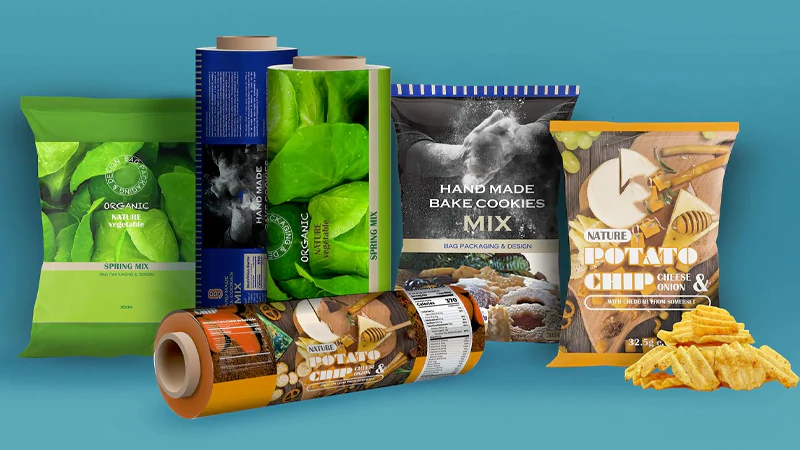
The quality of your final China packaging roll film is entirely dependent on the raw substrates used.
Raw Material Sourcing: Low-cost suppliers cut corners by buying “B-grade” or recycled films from the spot market. These films often have uneven thickness (gauge bands) or poor ink adhesion. We maintain strategic partnerships with Tier-1 resin and film suppliers. For example, our PE resins are sourced from global giants like ExxonMobil and Dow, ensuring consistent sealing temperatures and puncture resistance. Our BOPP and PET base films come from certified producers that guarantee uniform thickness distribution.
The Aluminum Factor: This is particularly critical if you are looking for a china aluminum-plated packaging roll film supplier. Not all metallized films are the same. The key metric is Optical Density (OD).
Cheap Film: Has a low OD (e.g., < 2.0). If you hold it up to a light, you can see through it. It offers poor moisture and oxygen barriers.
Premium Film: Has a high OD (e.g., > 2.2). It blocks light effectively and provides a robust barrier for chips, coffee, or milk powder.
Warning: The “Metal Transfer” Risk Be extremely wary of low price aluminum-plated packaging roll film. These often suffer from poor metal adhesion. During the heat sealing process on your machine, the aluminum layer can flake off or crack (a phenomenon known as “crazing”). This destroys the barrier properties of the package. We perform a Tape Test and heat seal integrity test on all metallized rolls to ensure the aluminum layer is firmly bonded to the PET substrate.
Factor 5: Logistics, Packaging, and Core Protection
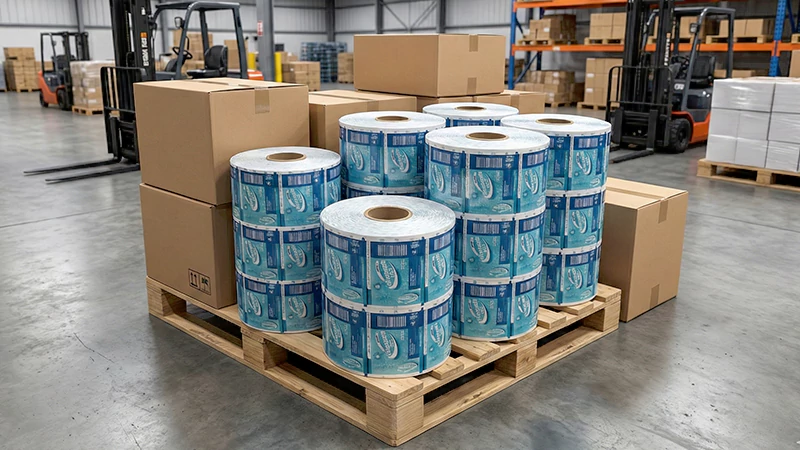
You have manufactured the perfect roll of film. Now, it has to survive a 30-day ocean voyage, extreme humidity changes, and rough handling by forklift drivers. Logistics is not an afterthought; it is a critical quality component.
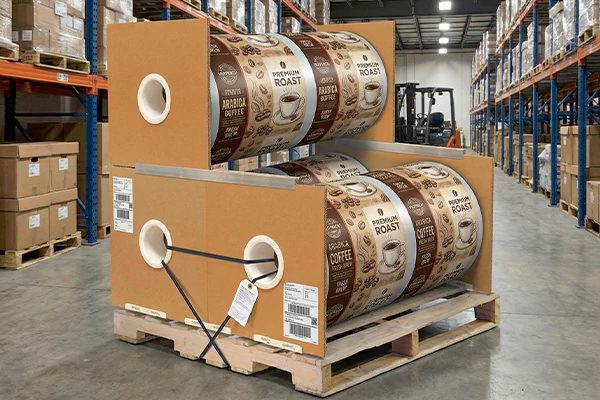
The Hidden Risk: Core Crushing A typical packaging film roll weighs between 20kg to 50kg. If these are stacked incorrectly, the weight of the top rolls crushes the paper cores of the bottom rolls.
When the roll arrives, the core is oval-shaped, not round. It will not fit onto the circular spindle of your packaging machine. The entire roll becomes useless scrap.
To prevent this, we utilize specific packing methods based on the film type:
- Overhead Suspension (Hanging): For pressure-sensitive films or high-end metallized rolls, we use suspension packaging. The rolls “float” between two end-boards and never touch the pallet or each other. This eliminates pressure damage.
- Vertical Stacking with Separators: For standard films, we stack vertically (eye-to-sky) with robust foam or corrugated separators between layers.
- Fumigated Pallets: All our wooden pallets undergo certified fumigation to comply with US and EU customs regulations, preventing delays at the port.
Humidity Protection: Sea freight containers are humid environments. We wrap every single roll in a protective PE bag and add desiccant packs before shrink-wrapping the entire pallet. This ensures the paper cores remain dry and maintain their structural integrity (3-inch or 6-inch precision).
Case Study: Helping a US Snack Brand Fix “Telescoping” Issues
The Problem: A mid-sized snack food company in California approached us after a disastrous experience with another supplier. They had purchased a container of packaging film rolls for their automated pretzel line. When they ran the rolls, the film layers started slipping sideways, creating a cone shape. This phenomenon, known as “telescoping,” caused the film to misalign with the machine’s forming collar, leading to constant jamming.
The Diagnosis: Our engineers requested a sample roll and identified the root cause: Poor Winding Tension Control. The previous factory had wound the film with constant tension from the core to the outer layer. As the roll got larger, the internal pressure built up, squeezing the inner layers out.
The Solution: We took over the production and applied a “Tapered Tension” winding profile.
We started winding near the core with higher tension (tight).
We gradually reduced the tension as the roll diameter increased (softer). This relieved the internal stress distribution within the roll.
The client tested our pilot rolls on their high-speed VFFS machines. The rolls remained perfectly flat with zero telescoping. The line speed increased by 15% because they no longer had to stop for manual adjustments. Today, we are their exclusive packaging film roll manufacturer.
A Red Flag Checklist: When to Run Away
Before you sign a contract, use this quick checklist to audit potential China packaging roll film suppliers. If you see these red flags, walk away.
- Price is Too Good to Be True: If a quote is 20% lower than the market average, they are likely using recycled (B-grade) substrates or reducing the adhesive weight (risk of delamination).
- Refusal to Send “Retention Samples”: A reputable factory keeps a sample of every batch produced for 2 years. If they can’t show you their retention room, they have no traceability.
- No Lab Equipment: If they don’t have a Gas Chromatograph (GC) or a Friction Tester on site, they are guessing, not measuring.
- Lack of English Technical Support: Miscommunication on “Unwind Direction” or “Eye Mark” placement is the #1 cause of waste. If their sales rep can’t understand a technical drawing, mistakes are inevitable.
Conclusion: Making the Right Partnership Choice
Sourcing packaging film rolls from China is a strategic move that can transform your business’s profitability, but only if you mitigate the risks.
Price is important, but production stability is critical. A saving of $0.50 per kg is meaningless if the film jams your machine or compromises your food safety. By focusing on solvent retention, COF control, printing consistency, material integrity, and logistics protection, you can find a packaging film roll manufacturer that delivers Western quality at Eastern prices.
We are not just a vendor; we are your production partners.
Ready to upgrade your packaging supply chain? Don’t leave your production line to chance. Contact us today for a free audit of your current film specifications. Our engineers will review your machine parameters and provide a quote for high-performance film within 24 hours.