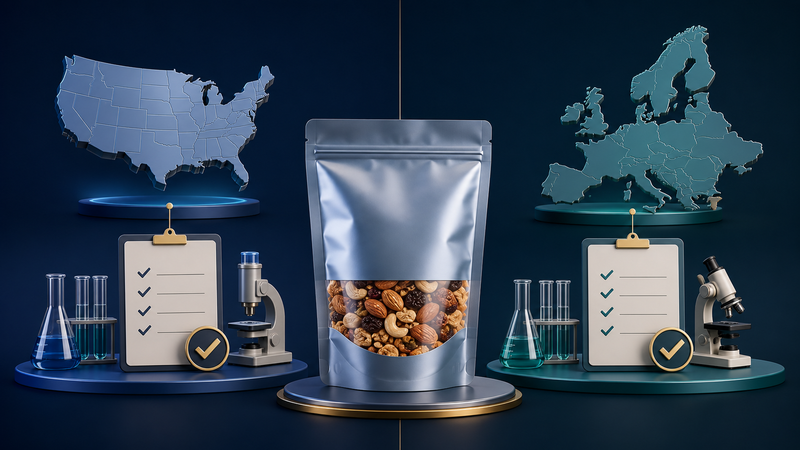
A food pouch sold in the United States and the European Union may look identical, but the evidence used to support it can differ. Both systems aim to prevent unsafe transfer from packaging to food, and both link compliance to intended use. Their legal architecture, documentation habits, positive lists, migration framework, and market responsibilities are not interchangeable.
This brand-level checklist explains the practical differences without treating either market as a single certificate. It is general information, not legal advice. Regulations, guidance, enforcement priorities, and national provisions can change, so verify the current rules for the precise material, food, use conditions, and countries where the product will be sold.
The Shared Starting Point
In both markets, begin with the finished food-contact article and its intended use. Document the food type, contact time, filling and processing temperature, storage, reheating, and whether the package is single or repeated use. A material acceptable for dry food at room temperature is not automatically suitable for fatty food, hot fill, retort, or microwave use.
Also identify the full composition. Modern flexible packaging materials may include substrates, polymers, additives, colorants, inks, adhesives, coatings, tie layers, recycled content, and closures. The printed outer web can still matter even when it does not intentionally touch food. Compliance cannot be reduced to a resin name or a generic statement that a pouch is food grade.
How the U.S. Framework Works
The U.S. FDA regulates food-contact substances under the Federal Food, Drug, and Cosmetic Act. A substance expected to migrate to food must have an appropriate regulatory basis for its identity and intended use. Depending on the substance and circumstances, that basis may be a regulation in Title 21 of the Code of Federal Regulations, an effective Food Contact Substance Notification, a Threshold of Regulation exemption, a prior sanction, or another applicable status.
Conditions of use are central. FDA resources classify food types and temperature/contact conditions, and an authorization may include specifications and limitations. An effective Food Contact Substance Notification is generally specific to the notified manufacturer, substance, and conditions identified, so supply-chain traceability can matter. A converter should be able to connect the material actually supplied to the relevant regulatory basis.
FDA does not issue a universal finished-package approval certificate for every custom pouch. Suppliers commonly provide compliance statements or letters of guaranty supported by component authorizations and intended-use analysis. Migration and toxicological data may be relevant to authorization and safety. Brand owners should read the scope of any “FDA compliant” statement and confirm that it covers the food and use rather than just the raw polymer.
How the EU Framework Works
The EU begins with Regulation (EC) No 1935/2004, which establishes general requirements for materials intended to contact food. Materials should not transfer constituents in quantities that could endanger health, cause an unacceptable change in food composition, or deteriorate organoleptic characteristics. Good manufacturing practice requirements also apply through Regulation (EC) No 2023/2006.
Plastic materials and articles are subject to more detailed rules under Commission Regulation (EU) No 10/2011, including an EU Union list for authorized substances, restrictions, overall and specific migration requirements, testing rules, and declaration-of-compliance provisions. Multimaterial multilayer structures require careful interpretation because not every layer or material type is harmonized in the same way. Inks, adhesives, coatings, paper, and national measures may introduce additional assessment needs.
EU compliance work often produces a formal declaration of compliance for materials within scope, supported by documentation that competent authorities can request. The declaration is not merely a test certificate: it links identity, applicable legislation, restrictions, specifications, and conditions of use. Migration testing or modeling must be appropriate to the intended food and time–temperature scenario.
Key Differences Brands Should Manage
The first difference is the authorization model. In the United States, teams trace relevant components to FDA regulations, notifications, exemptions, or other status. In the EU plastics framework, teams work with a harmonized Union list plus restrictions and migration provisions. Neither approach means that one document automatically satisfies the other.
The second difference is documentation format. U.S. supply chains often rely on detailed compliance letters and supporting references. EU plastic supply chains place strong emphasis on the declaration of compliance and supporting documents. A good global technical file can use one core specification and bill of materials, then add market-specific evidence and conclusions.
The third difference is the role of migration testing. Both systems care about transfer and exposure, but the EU plastics regulation provides structured overall and specific migration rules and standardized conditions. In the United States, migration information is interpreted within the applicable authorization and safety framework. Do not assume that passing an EU migration report proves FDA status, or that an FDA letter eliminates EU testing and declaration duties.
The fourth difference is broader packaging regulation. Food-contact compliance addresses chemical safety and suitability, while sustainability, labeling, producer responsibility, waste, and environmental claims may sit under other laws. Regulation (EU) 2025/40 on packaging and packaging waste adds a major EU layer beyond food contact. Use an up-to-date EU PPWR overview for planning, but keep PPWR evidence separate from the food-contact technical file so responsibilities remain clear.
Brand Checklist Before Approval
- Define the exact SKU, food, package size, fill process, shelf life, storage, and consumer use.
- Freeze the material specification, including every layer, thickness, adhesive, ink, coating, and closure.
- Identify the manufacturer and production site for components where authorization or traceability is supplier-specific.
- For the U.S., map relevant substances and intended uses to an appropriate FDA regulatory basis and limitations.
- For the EU, obtain and review required declarations, restrictions, migration evidence, and supporting documentation.
- Test representative finished packaging under justified food-simulant and time–temperature conditions where required.
- Review set-off, residual solvents, non-intentionally added substances, and organoleptic risks based on the structure and process.
- Create change-control rules for supplier, formulation, thickness, ink, adhesive, recycled content, and process changes.
- Maintain lot traceability and version-controlled evidence for every market.
- Have a qualified regulatory professional confirm the final conclusion before launch.
How to Work Efficiently With a Packaging Supplier
Send a written use profile before requesting documents. State the product category, fat and alcohol content where relevant, maximum temperature, duration of contact, treatment such as hot fill or retort, storage, target markets, and package dimensions. Ask the supplier to respond against the exact structure and identify exclusions. This is much more useful than asking, “Is this bag FDA and EU approved?”
For common plastic food packaging bags, request a layer-by-layer specification, intended food-contact side, and change-notification agreement. Review whether evidence covers the printed and laminated finished material. If information is incomplete, contact BN PACK or the selected converter with a concise gap list rather than exchanging broad compliance claims. A precise question receives a precise answer.
Common Mistakes
Do not treat a resin data sheet as finished-package compliance. Do not use a report for a different film, supplier, food type, or temperature without a written rationale. Do not assume that a compostability, recyclability, quality-system, or factory audit certificate proves food-contact suitability. Do not overlook adhesives, inks, coatings, spouts, zippers, or recycled content. Finally, do not archive documents without a revision and change-control process; evidence loses value when nobody can connect it to the material being purchased.
Conclusion
FDA and EU food-contact requirements share a safety objective but use different regulatory pathways and documentation conventions. Build compliance from a stable product-use profile and complete package specification, then create separate market assessments supported by supplier evidence, testing, and expert review. This approach is more reliable than chasing a single global certificate—and far easier to maintain when the package or regulation changes.