
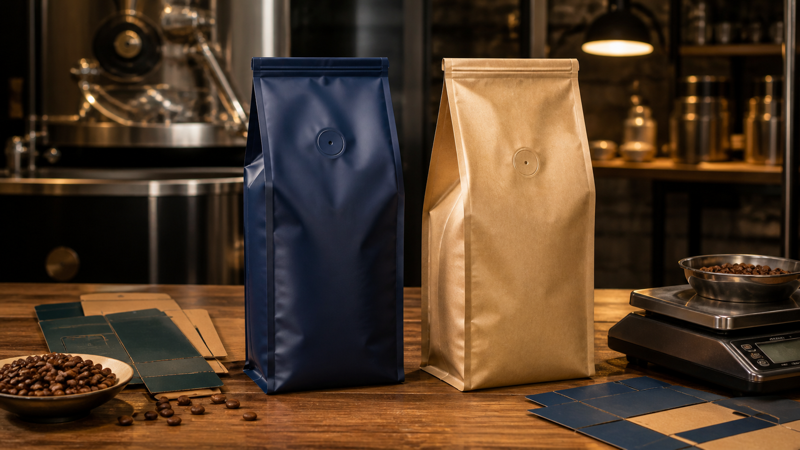
A one-kilogram coffee bag carries enough product for package geometry to matter. The filled bag must support a relatively heavy, shifting load, protect aroma, release carbon dioxide when required, fit the filling line, stand or stack in cartons, and present a large printed surface without collapsing. Flat-bottom and side-gusset bags can both work, but they create different tradeoffs in shelf stability, material use, valve placement, filling, and cost.
The right format depends on whether the coffee is whole bean or ground, the expected degassing rate, distribution channel, display method, carton system, and brand position. A decision based only on an empty sample can be misleading because both formats change shape after one kilogram of coffee settles.
Format Comparison
| Decision factor | Flat-bottom bag | Side-gusset bag |
|---|---|---|
| Shelf stance | Broad rectangular base; normally strong freestanding presentation | Often stands when filled but may rely more on product shape and sealed bottom geometry |
| Printable panels | Front, back, two sides, and bottom | Broad front/back with expanding side gussets |
| Material and converting | More panels and complex seals; often higher cost | Established construction with efficient material use |
| Carton shape | Box-like form can pack in regular rows | Filled profile can be pillow-like or brick-shaped depending on closure and packing |
| Valve placement | Flexible front or side-panel options with good visibility | Commonly placed on front panel; must avoid gusset folds and compression |
| Premium appearance | Strong shelf block and defined panel architecture | Traditional coffee appearance with efficient large-pack format |
These tendencies vary with dimensions, laminate stiffness, top closure, and filling method. Compare production samples at the same coffee weight rather than judging format names.
Flat-Bottom Bags
Flat-bottom pouches use a separate bottom panel and two side gussets to form a box-like package. The wide base helps the bag stand upright and creates a defined front panel even when the coffee settles. Five printable surfaces provide room for branding, brewing instructions, origin details, barcodes, and regulatory copy.
For premium one-kilogram coffee, the format can create a strong shelf presence and a clean rectangular shape. Side panels can organize secondary information without crowding the front. The bottom panel may carry traceability or design elements, although important copy should remain visible in normal use.
The construction is more complex than a conventional side-gusset bag. Multiple panels, seals, and folds can increase material use, converting steps, setup, and minimum order. The bottom and side transitions must withstand drops and compression under a dense load. If dimensions are poorly matched to the product, the bag can bulge and lose its intended box shape.
Flat-bottom bags may include a zipper, but the heavy fill and wide opening require a robust profile and adequate flange seals. A sealed header above the zipper protects the unopened product. If the bag is intended for foodservice rather than retail reclosure, a folded or tin-tie-style top may be considered, depending on the process and barrier requirement.
Side-Gusset Bags
Side-gusset bags expand along folds on the left and right sides. When filled, they create a substantial front and back panel and can form a compact brick-like package. The format has a long history in coffee because it handles larger volumes efficiently and works with various top closures and valve configurations.
Material use can be efficient, and the structure may run well on established coffee packing equipment. The broad panels provide strong branding, while gussets accommodate volume without a separate box-style bottom panel. For warehouse or foodservice products, the traditional form may be more important than perfect freestanding retail display.
Shelf stance depends on the bottom seal and how the coffee settles. Some side-gusset bags stand well; others lean, round out, or require support. The gusset folds can hide artwork, and fine copy should not be placed where it disappears after filling. The comparison of side-gusset vs stand-up coffee bags provides additional context on these format differences.
Side-gusset bags may be closed with a top seal, folded top, adhesive tape, or other system. A zipper is possible in some constructions but may require specialized geometry.
Capacity and Dimensions
One kilogram of coffee does not occupy one fixed volume. Whole-bean density varies with origin, roast degree, bean size, and breakage. Dark roasts are often less dense and may need more package volume than lighter roasts. Ground coffee can settle more densely but may trap air during filling.
Measure several production-representative batches and run fill trials. A package sized for the densest coffee may be too tight for a lower-density roast. Conversely, adding excessive volume creates loose appearance, wasted material, and carton inefficiency.
Record filled height, width, depth, headspace, and the highest product level after settling. Leave sufficient clearance for the valve, top seal, zipper, or fold. The bag must remain stable at the minimum and maximum expected bulk density.
Degassing Valve Placement
Fresh roasted coffee releases carbon dioxide. One-way coffee bags with valve allow gas to escape while limiting inward oxygen flow when the valve and package are correctly specified. Valve need and timing depend on roast, packing delay, product form, and distribution.
On a flat-bottom bag, the valve can often be positioned on the front or a side panel. A side placement can preserve front artwork but may be compressed in a tight carton. On a side-gusset bag, front-panel placement is common because a gusset fold can bend or obstruct the valve.
Keep the valve above the settled coffee level when required by its design and away from seals, folds, zipper flanges, and high-ink or coating conflicts. Check filling-machine clearance and pack orientation. During case packing, adjacent bags should not press directly against the valve and prevent venting.
Test valve flow, seal, and oxygen performance with the actual laminate. A high-barrier bag cannot compensate for a poorly installed or damaged valve.
Barrier and Structure
Both formats can use foil, metallized film, or clear high-barrier laminates. Coffee protection depends on oxygen, moisture, light, aroma, seal, and valve performance—not pouch shape alone. Choose the laminate for target shelf life and distribution, then ensure it can tolerate the folds and bottom stresses of the selected format.
A very stiff laminate supports panel shape but may crease at corners. A softer structure can improve toughness yet round out under load. One-kilogram packs need sufficient puncture and drop resistance because beans create localized pressure and the product mass amplifies impact.
If a clear window is requested, evaluate light and oxygen exposure and how the coffee presses against it. The feature can also show oil marks or broken beans after shipping.
Filling-Line Compatibility
Confirm whether the bag is premade or formed from rollstock, how it is opened, filled, settled, gas flushed, fitted with a valve, and sealed. Flat-bottom bags may need equipment capable of handling their wider base and multiple panels. Side-gusset bags may integrate more easily with established coffee lines, but actual performance depends on dimensions and closure.
Measure mouth opening, gripper area, seal-jaw clearance, fill speed, dust control, code area, and changeover time. Ground coffee can contaminate seals and zippers, while whole beans can bridge in narrow openings. A line trial should measure good packs per hour and rejects, not only whether one sample can be filled.
Cartons, Pallets, and Retail Display
Flat-bottom bags often create regular filled blocks that arrange efficiently in retail cases. Side-gusset bags may nest or compress efficiently, but their shape depends more on product distribution and top closure. Pack actual filled samples in the intended carton and conduct vibration and compression testing.
For e-commerce, protect valves and seals from concentrated loads. For wholesale, consider case weight and stacking. For retail, compare facing width, shelf depth, stability after consumers remove neighboring bags, and how much artwork remains visible.
Cost and Commercial Fit
Compare total landed cost, not only unit pouch price. Include tooling, MOQ, filling speed, waste, cartons, freight, shelf presentation, and inventory risk. Flat-bottom construction may justify a premium when it supports brand positioning and efficient display. Side-gusset packaging may offer a better balance for high-volume, traditional, or foodservice applications.
Selection Checklist
- Measure bulk density across the lightest and darkest expected roasts.
- Fill and settle both formats at the exact one-kilogram target.
- Compare stance, panel shape, headspace, opening, and closure access.
- Validate valve position, venting, carton pressure, and barrier performance.
- Run both candidates on the intended filling and sealing equipment.
- Pack final cartons and test drops, vibration, compression, and pallet stacking.
- Calculate landed cost per good filled pack, including line speed and logistics.
- Approve the exact structure, dimensions, valve, closure, and filled reference.
Flat-bottom bags provide a structured premium presentation and broad stable base, while side-gusset bags offer an efficient, proven format for larger coffee volumes. For a one-kilogram pack, real fill trials and packed-case testing are more decisive than appearance on a sample table. Choose the format that protects the coffee, runs efficiently, and fits the intended channel.