
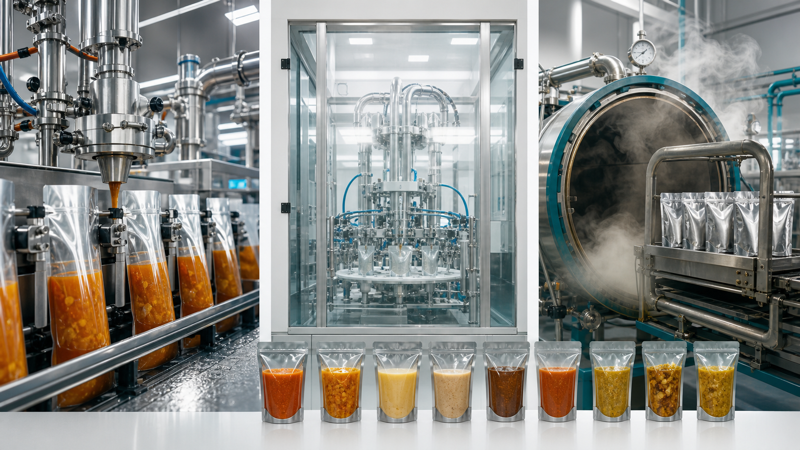
Hot fill, aseptic processing, and retort are three ways to place shelf-stable or extended-life foods and beverages into flexible packaging, but they control microorganisms through different process sequences. The choice affects product flavor and texture, formulation, packaging material, fitments, filling equipment, validation, distribution, and capital investment. A pouch that tolerates hot filling may not survive retort, while an excellent retort laminate may be unnecessary for an aseptically processed product.
Process selection belongs to a qualified food-process authority and the responsible regulatory and quality teams. The packaging supplier can help specify a compatible pouch only after the product, thermal process, shelf-life target, filling method, and markets are defined. The comparison below is a planning framework, not a validated process schedule.
High-Level Process Comparison
| Factor | Hot fill | Aseptic | Retort |
|---|---|---|---|
| Basic approach | Product is heated, filled hot, and held or cooled in the package | Product and package are sterilized separately, then combined in a sterile environment | Product is filled and sealed, then thermally processed inside the package |
| Typical product fit | Acidic beverages, sauces, and products validated for hot-fill control | Pumpable products where quality retention and sterile filling justify the system | Low-acid and other products requiring in-package commercial sterilization |
| Package demand | Heat resistance, hot-seal integrity, controlled shrink and vacuum response | Sterile-barrier compatibility, clean fitments, validated decontamination | High heat, pressure, seal, delamination, puncture, and flex resistance |
| Quality effect | Moderate heat exposure; formulation and cooling influence flavor and texture | Short controlled product treatment can preserve quality well | Strongest in-package heat exposure; formulation and pouch geometry affect cook value |
| Equipment profile | Comparatively accessible for suitable products | High process control and sterile-zone investment | Retorts, baskets or racks, pressure control, cooling, and validated schedules |
| Distribution | Often ambient after validated processing | Often ambient when the complete sterile system is validated | Ambient when the scheduled process and package are validated |
How Hot Fill Works
In hot filling, the product receives a heat treatment and enters the package at an elevated temperature. The product, closure, headspace, and package surfaces must remain under validated conditions long enough to achieve the required control before cooling. The method is commonly associated with acidic beverages, fruit products, sauces, and similar formulations where the process authority confirms suitability.
The pouch must resist fill temperature without shrinking excessively, distorting, blocking, weakening seals, or transferring unwanted odor. Sealant choice is critical because the final seal may be made while the product and film are hot. Product splashes or condensation in the seal area can create channels.
Cooling changes internal volume and pressure. As product and headspace cool, the pouch may pull inward. This can be acceptable or even visually expected, but severe panel distortion can affect shelf presentation, fitments, and labels. Design headspace and pouch stiffness around the cooling behavior.
Hot fill is not a universal route to ambient shelf stability. Product acidity, water activity, formulation, particulates, hygiene, container inversion where used, fill temperature, time, closure, and cooling all belong to the validated system.
How Aseptic Processing Works
Aseptic systems sterilize the product and package or package-contact surfaces separately, then fill and seal under controlled sterile conditions. Because the product can receive a rapid heat treatment before filling, the method can preserve flavor, color, and nutrients better than longer in-package heating for some foods.
The packaging challenge moves from surviving a full retort cycle to maintaining sterility through material handling, decontamination, filling, sealing, and shelf life. Film, spouts, caps, and seals must be compatible with the chosen sterilization or decontamination method. Hidden surfaces, fitment geometry, and equipment interfaces must be reachable and controlled.
Aseptic lines require rigorous environmental, process, and package-integrity control. A small seal defect can defeat an otherwise sterile process. The package should run consistently on the filler with controlled web tension, registration, surface condition, and sealability. Film roll packaging is often relevant where pouches are formed or managed inline, but the exact system may also use premade sterile components.
How Retort Processing Works
Retort pouches are filled and hermetically sealed before entering a pressure vessel for thermal processing. Heat reaches the product through the package until the scheduled process delivers the required lethality at the slowest-heating location. Cooling then occurs under controlled conditions to protect package integrity and product safety.
Retort is widely used for low-acid foods, ready meals, proteins, sauces, pet food, and other products that need in-package commercial sterilization. Product viscosity, piece size, pouch thickness, fill weight, residual air, orientation, and rack loading all influence heat penetration. A process established for a can or a different pouch cannot simply be copied.
The article on what is a retort pouch explains the package concept in more detail. Compared with rigid containers, the thin pouch profile can support efficient heat transfer, but only when fill distribution and retort loading are controlled.
Packaging Structures for Each Process
Hot-fill structures commonly use heat-resistant outer layers, stable inks and adhesives, and sealants designed for the fill and seal conditions. Transparent high-barrier structures may be possible depending on product sensitivity. The material must also tolerate cooling contraction and distribution.
Aseptic structures need the required oxygen, moisture, and light barrier for shelf life plus compatibility with the sterilization method and aseptic machine. Seal surfaces must remain clean and controllable. Fitments can become critical pathways, so the body laminate, spout, cap, and interface should be assessed as one barrier system.
Retort laminates often include heat-resistant polyester, nylon, aluminum foil or transparent high-barrier layers, specialized adhesives, and retort-grade sealants. Aluminum foil pouches can provide excellent oxygen and light barrier, but foil must be protected from flex cracking and pinholes. Transparent retort structures may support product visibility or microwave use, depending on the design and validation.
Spouts, Caps, and Closures
Spouted pouches can support beverages, purees, sauces, and other pumpable products across different processes, but fitments must be designed for the chosen route. Hot fill can soften cap or spout resins and alter torque. Aseptic fitments must be compatible with sterilization and sterile handling. Retort fitments must tolerate the complete thermal and pressure cycle without leakage or distortion.
Product Quality and Formulation
Heat affects flavor, color, texture, nutrients, emulsions, and particulates. Retort generally exposes the sealed product to a substantial thermal load, although thin pouches can heat faster than some rigid formats. Aseptic processing may reduce total product heat exposure but requires a product that can be pumped and handled by the system. Hot fill lies between these routes for suitable formulations.
Formulation is part of process design. Acidity, salt, sugar, fat, starch, particle size, viscosity, and entrained air influence microbial control and heating. A formulation change can invalidate both the process schedule and packaging assumptions. Establish change-control rules before launch.
Run sensory and physical shelf-life trials using production-representative process conditions. Assess separation, texture, color, aroma, oxidation, package interaction, seal integrity, and consumer use. Accelerated testing can support development but should not replace appropriate real-time evidence.
Validation and Quality Control
For every route, validate the complete system: raw product, preparation, process, package, closure, equipment, operators, cooling, storage, and distribution. Define critical limits, monitoring, records, deviations, and corrective actions with qualified experts.
Package testing may include seal-strength and integrity methods, burst or creep, dye or bubble testing, residual oxygen, torque, bond strength, migration or compatibility, barrier, drop, compression, and incubation or microbiological evaluation as appropriate. Test after processing because heat can reveal defects not visible in empty pouches.
Retort validation should represent worst-case fill, product heating characteristics, pouch orientation, loading pattern, residual air, and equipment conditions. Aseptic validation must address sterilization and sterile-zone integrity. Hot-fill validation must confirm product and package exposure throughout filling, holding, sealing, and cooling.
Selection Workflow
- Define product pH, water activity, viscosity, particles, formulation, and microbiological risk.
- Set target shelf life, storage temperature, distribution, and desired sensory quality.
- Engage a qualified process authority before choosing package materials or equipment.
- Compare hot-fill, aseptic, and retort routes for product suitability and commercial scale.
- Specify the full pouch, adhesive, ink, sealant, spout, cap, and closure system.
- Run filling and processing trials using worst-case product and package conditions.
- Validate package integrity, process control, product safety, and shelf life after processing.
- Reassess whenever formulation, size, fill weight, material, fitment, equipment, or schedule changes.
Hot fill can be efficient for suitable acidic products, aseptic processing can protect quality while enabling ambient distribution, and retort can deliver in-package commercial sterility for demanding foods. The correct choice is the process that a qualified team can validate for the exact product, package, equipment, and market—not the process with the simplest label or the lowest pouch price.