

When it comes to packaging, understanding how to calculate the volume of a stand up pouch is crucial. Whether you’re a packaging manufacturer or a product owner, knowing the exact volume of your pouch helps to ensure the right fit, minimize material waste, and maximize product shelf life. Accurate pouch sizing can contribute to reduced waste, lower costs, and higher customer satisfaction. This guide provides step-by-step instructions on how to easily calculate the volume of your stand-up pouch, ensuring that your packaging process runs smoothly.
Step 1: Gather the Right Tools and Information
Before you can begin calculating the volume of a stand-up pouch, make sure you have all the necessary tools and data. Accurate measurements are key to obtaining the correct result.
Tape Measure or Ruler
- A flexible tape measure works best for measuring curved areas, especially if your pouch has a gusset.
- Ensure your measurements are precise to avoid errors in volume calculations.
Know Your Pouch’s Shape and Size
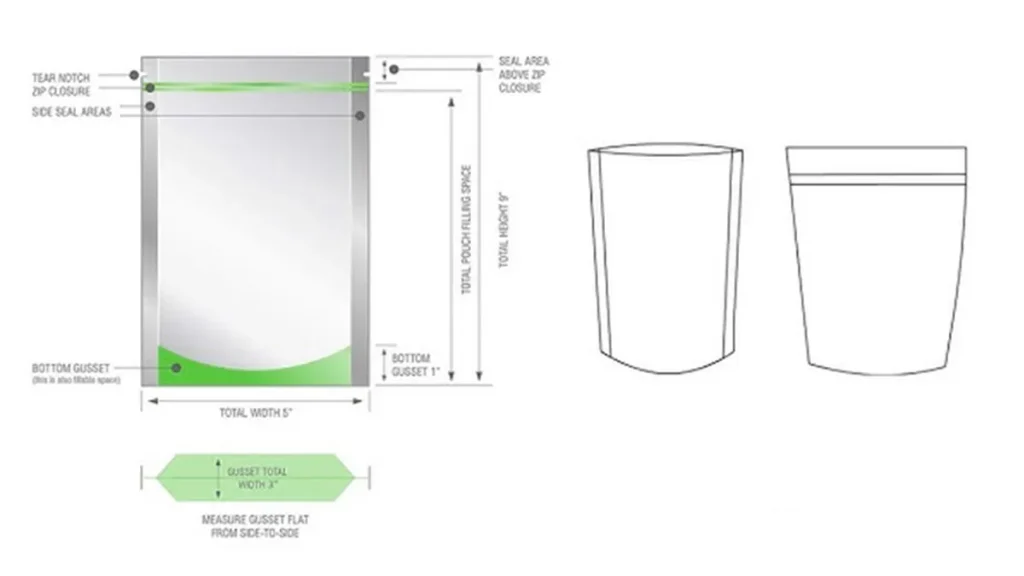
Stand-up pouches can come in many different shapes and sizes. Some have straight sides, while others have gussets. Here are some key measurements you’ll need:
- Height: The total height of the pouch from bottom to top.
- Width: The width of the pouch’s opening (mouth).
- Gusset Depth: The expandable side folds of a gusseted pouch.
- Thickness: The material thickness, which can affect the internal space of the pouch.
Data from Manufacturer
Check if your pouch manufacturer has provided any volume information. If the pouch specifications are available, you can use them as a baseline for calculations.
Step 2: Measure the Dimensions
Measuring the pouch accurately is vital for calculating its true internal volume.
Measure Height and Width
- Height: Measure the pouch’s full height, from the bottom to the top of the opening or zipper.
- Width: Measure the width across the top opening of the pouch. This should be the widest point.
Measure Bottom and Side Gussets
- Gusset Depth: If your pouch has gussets, measure the width and depth of the gussets at the bottom.
- Side Gussets: Record the measurements for side gussets. These help the pouch stand up and increase the internal capacity.
Measure Thickness and Air Space
- Thickness: Measure the thickness of the pouch material, usually in millimeters (mm). Material thickness can slightly reduce the available internal volume.
- Air Space: If your pouch contains air when sealed, account for that as well. This can slightly alter the internal volume depending on how full the pouch is.
Step 3: Calculate the Volume
The next step is to use the dimensions you’ve gathered to calculate the internal volume of the stand-up pouch.
Basic Mathematical Formula
For different types of pouches, the formula for calculating volume will vary. The most common pouch types are:
- Rectangular Pouches: If the pouch doesn’t have gussets, the formula is straightforward:
Volume = Height × Width × Depth - Gusseted Pouches: For gusseted pouches, the gusset depth must be added to the width measurement in the formula:
Volume = Height × (Width + 2 × Gusset Depth) × Gusset Depth
Using the Dimensions
Make sure all your measurements are in consistent units (e.g., cm or inches). If your measurements are in centimeters, the volume will be in cubic centimeters (mL).
If the pouch has material thickness, subtract this thickness from each dimension before calculating the internal volume. For example, if the thickness is 0.2mm, subtract this from the height, width, and gusset depth.
Step 4: Apply Real-World Example
Let’s apply the formulas to a sample pouch for clarity.
Sample Pouch Data
- Height: 20 cm
- Width: 10 cm
- Gusset Depth: 5 cm
- Material Thickness: 0.2 mm
Step-by-Step Calculation
- Adjust for material thickness:
Adjusted height = 20 cm – 0.02 cm (0.2 mm) = 19.98 cm
Adjusted width = 10 cm – 0.02 cm = 9.98 cm
Adjusted gusset = 5 cm – 0.02 cm = 4.98 cm - Calculate Internal Volume:
Volume = Height × (Width + 2 × Gusset Depth) × Gusset Depth
Volume = 19.98 cm × (9.98 cm + 2 × 4.98 cm) × 4.98 cm
Volume ≈ 19.98 cm × 19.94 cm × 4.98 cm
Volume ≈ 1995.4 cubic cm or 1.995 liters
Step 5: Validation and Adjustment
Now that you’ve calculated the theoretical volume, it’s time to verify it.
Use a Water Displacement Test
Fill the pouch with water and measure how much water it holds. This is an effective way to validate the theoretical calculation and ensure that it corresponds to the actual capacity of the pouch.
- Fill the Pouch: Carefully pour water into the pouch until it’s full.
- Measure the Water: Use a measuring cup or another reliable method to check the exact volume of water the pouch holds.
- Compare Results: Compare the measured water volume to your calculated volume. If they match, your calculation is accurate.
Learn from Industry Standards
Typically, stand-up pouches are designed to hold anywhere from 100 grams to 500 grams of product, depending on the product type. By applying the same formula, you can adjust the measurements based on your product’s density.
Tips from Experts
- Accuracy is Key: “Always measure multiple times for precision,” says Jane Doe, a senior packaging engineer.
- Monitor Regularly: Packaging materials or designs may change over time. Regularly check pouch specifications to ensure consistent results.
- Account for Air Space: If you’re packing products that contain air or gas, remember to account for that space when calculating the volume.
Conclusion
By following these easy steps, you can accurately calculate the volume of any stand-up pouch, whether you’re working with a standard or gusseted design. Knowing your pouch’s volume not only helps you achieve the best fit for your product but also ensures you’re optimizing your packaging process.
Summary of Key Steps:
- Gather Tools and Information: Get a flexible tape measure and gather pouch data.
- Measure Dimensions: Measure the pouch’s height, width, gusset, and thickness.
- Calculate Volume: Use the formulas based on your pouch type to calculate the internal volume.
- Validate with Water Displacement: Confirm your calculated volume by filling the pouch with water.
- Adjust Based on Product Density: Modify your calculations according to the product you plan to package.
By mastering the art of volume calculation, you’ll improve packaging efficiency, reduce waste, and ultimately enhance customer satisfaction with products that fit perfectly in your stand-up pouches.
Table 1: Common Stand-Up Pouch Measurement Parameters
| Measurement | Description | Unit of Measure | Impact on Volume |
|---|---|---|---|
| Height | The full height of the pouch from the bottom to the zipper or closure. | cm or inches | Affects internal volume calculation directly. |
| Width | The measurement across the pouch opening (mouth). | cm or inches | Influences volume, especially for gusseted pouches. |
| Gusset Depth | The expandable side folds that allow the pouch to stand upright. | cm or inches | Increases the overall volume of the pouch. |
| Material Thickness | The thickness of the layers that make up the pouch. | mm | Reduces the internal volume if not considered. |
| Internal Volume | The actual usable space inside the pouch once it is sealed. | cubic cm (mL) | Directly derived from the height, width, gusset depth, and material thickness. |
Table 2: Step-by-Step Formula Breakdown for Stand-Up Pouch Volume Calculation
| Pouch Type | Formula | Description | Example Calculation |
|---|---|---|---|
| Rectangular Pouch | Volume = Height × Width × Depth | For standard pouches without gussets. | 20cm × 10cm × 5cm = 1000 cubic cm |
| Gusseted Pouch | Volume = Height × (Width + 2 × Gusset Depth) × Gusset Depth | For gusseted pouches, includes gusset depth and width. | 20cm × (10cm + 2 × 5cm) × 5cm = 2000 cubic cm |
| Adjusting for Material Thickness | Subtract material thickness from each dimension to get adjusted internal volume. | Accounts for the material thickness when calculating internal space. | Adjusted height = 20cm – 0.2mm, Adjusted width = 10cm – 0.2mm, Adjusted gusset = 5cm – 0.2mm |
By following this guide and using the tables as references, you’ll be able to accurately calculate the volume of any stand-up pouch, whether you’re in the food packaging industry, cosmetics, or any other sector. This simple process can help enhance your packaging process, reduce errors, and lead to better customer satisfaction.

At BN Packaging, we specialize in providing customizable, high-quality packaging solutions designed to meet the unique needs of your business. Whether you’re looking for eco-friendly options, innovative designs, or precise dimensions, our expert team is ready to support you every step of the way. Contact us today to learn how we can help streamline your packaging needs with custom solutions tailored to your brand’s requirements.