

It’s a warm afternoon, you’re at your favorite café seeking a refreshing caffeine boost, and you scan the menu. Your eyes land on two enticing options: Iced Coffee and Cold Brew. They’re both cold, they’re both coffee, and they both promise a delightful escape from the heat. Yet, there’s often a noticeable difference in price and a loyal following for each. This leads to a cascade of questions that have puzzled coffee drinkers for years.
The core confusion often boils down to this: Is iced coffee just cold coffee? And if so, is cold brew and iced coffee the same? It’s a common assumption to think they are simply two names for the same thing. However, while both are served over ice and provide a chilled coffee experience, they are two fundamentally different beverages, distinguished not by their final temperature, but by their unique creation story.
This definitive guide will explore the entire world of chilled coffee. We will break down the precise brewing methods, the science behind their distinct flavor profiles, and their differences in acidity and caffeine, ultimately settling the great iced coffee vs. cold brew debate so you can order or craft your next drink with confidence.
What is Iced Coffee? The Classic Cooldown
Iced coffee is the most straightforward and traditional way to enjoy a chilled coffee beverage. At its core, the answer to the question, “is iced coffee just coffee with ice?” is essentially yes. The process begins by brewing coffee hot, using any conventional method you prefer—from a standard drip coffee machine to a pour-over, AeroPress, or French press. Once the coffee is brewed, it is then cooled down and served over ice.
The chemistry and resulting flavor profile are a direct result of this hot-brewing process. Hot water is an extremely efficient solvent, quickly extracting a wide range of soluble compounds from the coffee grounds, including the oils and acids that contribute to the bright, and often more acidic, notes of a hot cup. When this hot coffee is rapidly chilled by pouring it over ice, these characteristics are preserved. This can sometimes accentuate certain bitter notes and the perceived acidity, resulting in a crisp and refreshing iced coffee taste that many people love. However, this method also means the coffee is diluted as the hot liquid melts some of the ice.
To combat this dilution and preserve more of the coffee’s delicate aromatics, many specialty cafés use a method known as “flash chilling” or the “Japanese Iced Coffee” method. This technique involves brewing a slightly stronger batch of hot coffee directly onto a pre-weighed amount of ice. The instantaneous cooling locks in the volatile aromatic compounds that would otherwise escape as steam, resulting in a more flavorful, vibrant, and aromatic cup of iced coffee that is perfectly chilled without being watered down.
What is Cold Brew Coffee? The Art of Slow & Cold Steeping

If iced coffee is a fast cooldown, cold brew is a slow, patient infusion. This is where the fundamental difference between the two drinks lies, and it’s a process that completely changes the chemistry and flavor of the final cup. Cold brew is not brewed hot and then chilled; it is brewed entirely without heat from the very beginning.
The method involves steeping coarsely ground coffee in cold or room-temperature water for an extended period, typically anywhere from 12 to 24 hours. Instead of using heat as a fast and aggressive solvent, this process uses time to gently coax the flavor out of the coffee grounds. The principle here is simple: brew coffee cold water. This slow, gentle infusion is key to understanding how is cold brew different.
The science behind its unique flavor lies in the solubility of the coffee’s chemical compounds. Cold water extracts flavors differently than hot water. It is excellent at dissolving the compounds that create the smooth, sweet, and rich chocolatey notes in coffee, but it is much less effective at dissolving the compounds that are perceived as acidic or bitter. This results in a taste of cold brew coffee that is remarkably smooth, mellow, and naturally sweet, with a round, full body and significantly lower perceived acidity than its hot-brewed counterpart.
It’s also important to understand the difference between cold brew vs cold brew concentrate. Because the steeping process is so lengthy, cold brew is often made at a very high coffee-to-water ratio to create a potent concentrate. This concentrate is then diluted with water or milk to the desired strength before serving. However, it can also be brewed at a lower, ready-to-drink strength, which can be enjoyed straight over ice.
The Head-to-Head Comparison: Cold Brew vs. Iced Coffee
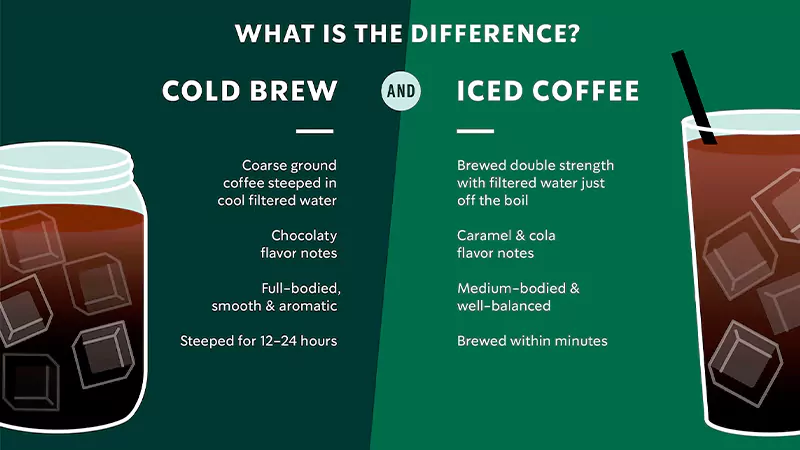
Now that we understand how each drink is made, we can put them side-by-side to clearly see the differences. The choice between them comes down to four key factors: the method, the flavor, the acidity, and the caffeine content.
Brewing Method: Heat vs. Time
This is the fundamental difference that drives all the others.
- Iced Coffee: Brewed hot and fast (minutes), using heat to extract flavor, then chilled.
- Cold Brew: Brewed cold and slow (12-24 hours), using time to extract flavor.
Flavor Profile: Bright vs. Smooth
The brewing method directly impacts how the final drink tastes and feels.
- Iced Coffee: The flavor is a direct reflection of a hot-brewed coffee. It is often brighter, crisper, and has a lighter body. It can have a more pronounced acidity and sometimes a touch of bitterness, which many find refreshing.
- Cold Brew: The flavor is smooth, mellow, and rich. It is known for its naturally sweet, chocolatey, and nutty notes. It has a fuller, rounder body and is significantly less bitter.
Acidity: The Comfort Factor
One of the most celebrated characteristics of cold brew is its lower perceived acidity.
- Iced Coffee: Because it’s brewed hot, the full range of acids present in the coffee bean is extracted, making the final cup have a similar acidic profile to regular hot coffee.
- Cold Brew: The cold brewed coffee acidity is noticeably lower. This is because many of the specific chemical compounds that we perceive as sour or acidic are much less soluble in cold water. For this reason, many people with sensitive stomachs find cold brew to be much gentler and easier to drink.
Caffeine Content: The Ratio Rules
This is the most debated and misunderstood difference. So, does cold brew have more caffeine than iced coffee? The answer is more complex than a simple yes or no.
It is a common myth that the cold brewing process itself extracts more caffeine. In reality, caffeine is readily soluble in both hot and cold water, so the brewing temperature has a minimal effect. The true determining factor is the coffee-to-water ratio.
Because cold brew is a slow, inefficient process, it is often brewed as a concentrate, using a much larger amount of coffee grounds per unit of water than you would for a standard hot brew. Therefore, an undiluted serving of cold brew concentrate will have significantly more caffeine than a standard cup of hot coffee or iced coffee. However, once that concentrate is diluted with water or milk to a drinkable strength, the final caffeine content can be very similar to, or even less than, a strongly brewed iced coffee.
So, when comparing iced coffee vs cold brew caffeine, it all comes down to how it was prepared.
The Extended Family: How Does Cold Brew Compare to Other Drinks?
To fully understand its place, it’s helpful to see how cold brew stacks up against other café mainstays like espresso, nitro, and lattes.
Cold Brew vs. Espresso
This is a comparison of two entirely different extraction philosophies. The difference between cold brew and espresso comes down to time and pressure.
Method: Cold brew uses a long, gentle, and pressure-free immersion of coffee grounds in cold water. Espresso uses immense pressure to force hot water through finely-ground coffee in under 30 seconds.
Flavor: Cold brew is known for its smooth, mellow, low-acid, and often chocolatey profile. Espresso is intense, syrupy, and acidic, with a signature layer of rich crema on top.
Use: While both are concentrated, cold brew is typically diluted to make a longer drink. Espresso is served as a small, potent shot or used as the coffee base for milk drinks like lattes and cappuccinos.
Nitro Cold Brew vs. Cold Brew
So, what’s the difference between cold brew and nitro cold brew? Think of Nitro as an enhanced version of the original.
Method: Nitro cold brew starts as regular cold brew. It is then placed in a keg and infused with tiny, pressurized nitrogen gas bubbles. It is served from a tap, much like a stout beer.
Texture & Flavor: This infusion is all about texture. The nitrogen gives the coffee a rich, creamy, and velvety mouthfeel that is remarkably smooth. It also creates a beautiful cascading effect and a thick, long-lasting foam head. Many people find that the nitrogen infusion enhances the coffee’s perceived sweetness without any added sugar.
Cold Brew vs. Iced Latte
The difference between latte and cold brew is a matter of composition.
Iced Latte: This is a milk-based drink. It is made by combining a shot (or two) of espresso with a large volume of cold milk and serving it over ice. The dominant ingredient and flavor is milk, with coffee as the flavoring.
Cold Brew: This is a coffee-based drink. Its core ingredients are simply coffee and water. While many people add milk or cream to their cold brew, the drink itself is fundamentally coffee.
In short, a latte is a specific type of coffee and milk beverage, while cold brew is a distinct method of brewing coffee.
The Business of Cold Coffee: Packaging for the RTD Market

The immense and growing popularity of both iced coffee and cold brew has propelled them far beyond the café counter. This has fueled a massive boom in the ready-to-drink (RTD) market, with options for cold brew coffee in grocery stores and specialty shops expanding every year. For coffee roasters and beverage brands, this represents a tremendous opportunity to scale their production and reach a new audience.
However, moving from a made-to-order beverage to a retail product presents a new set of challenges. Selling a store bought chilled coffee, whether it’s an iced coffee in can or a bottled cold brew, requires packaging that can overcome three critical hurdles:
- Flavor Preservation: The delicate flavor of coffee is highly susceptible to degradation from oxygen and UV light, which can quickly make a product taste flat or stale.
- Shelf Life: The package must be able to maintain the product’s integrity for weeks or even months.
- Consumer Convenience: The packaging must be easy to transport, store, and use for the modern, on-the-go consumer.
Whether you’re producing a bright, flash-chilled iced coffee or a smooth, rich cold brew, the right packaging is crucial for commercial success. Liquid Spout Pouches from BN Pack are the ideal solution for the modern RTD beverage market. Their high-barrier, multi-layer construction protects the delicate flavor of your coffee from oxygen and UV light, preserving its intended taste. The resealable spout offers unparalleled convenience for both single-servings and multi-use concentrates. Lightweight, durable, and shatterproof, they are the perfect vehicle for delivering your premium chilled coffee to the modern, on-the-go consumer.
Conlusion
The great iced coffee vs. cold brew debate is ultimately not about which drink is superior, but about which experience you prefer. The core takeaway is simple: Iced coffee is hot coffee that has been chilled, while cold brew is coffee that was brewed with cold water from the very beginning. This single, fundamental difference in the brewing process is the source of all the variations in taste, texture, and acidity.
So, how do you choose? It comes down to what you value most in your cup.
- Choose Iced Coffee if: You love the bright, crisp, and often zesty acidity of a traditionally brewed coffee. If you enjoy the familiar flavor profile of your favorite hot pour-over or drip coffee and simply want it in a refreshing, chilled format, then iced coffee is the perfect choice for you.
- Choose Cold Brew if: You prefer a smoother, mellower, and less acidic coffee experience. If you are sensitive to bitterness or acidity, or you simply love a rich, naturally sweet, and chocolatey flavor profile with a full body, then cold brew will be your ideal companion.
Now that you’re an expert on the difference between coffee and cold brew, you can navigate any café menu or home-brewing project with confidence. You know the story behind each drink, and you can choose the perfect chilled coffee to match your mood and your palate.