
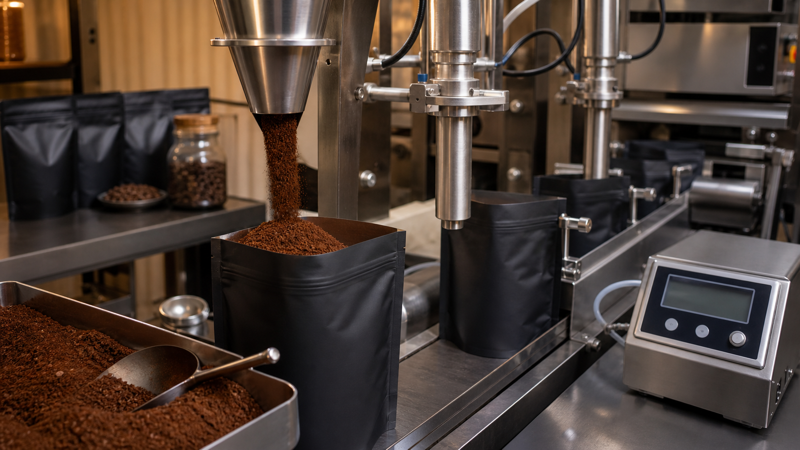
Grinding coffee accelerates aroma loss and oxidation by creating far more exposed surface area than whole beans. Nitrogen flushing can reduce oxygen in the package headspace and delay quality loss, but the result depends on the complete system: coffee condition, purge location, gas purity, headspace, fill sequence, sealing speed, package barrier, and residual-oxygen measurement. Adding a nitrogen nozzle without controlling those variables rarely produces consistent shelf life.
The objective is not to make a pouch visibly full of gas. It is to replace oxygen-rich air around the coffee with an inert atmosphere and seal the package before air re-enters. A well-designed setup controls both average performance and variation across line speed, hopper level, pouch size, and production time.
Define the Freshness Objective
Begin with target shelf life, distribution temperature, coffee style, grind, roast-to-pack delay, and acceptable sensory change. Nitrogen flushing is one tool within a broader oxidation-control plan. Fast processing, low oxygen exposure before filling, high-barrier packaging, clean seals, and controlled storage remain important.
Coffee grounds pouches should be specified for oxygen, moisture, aroma, light, and seal performance. A low initial residual-oxygen result will not protect coffee if oxygen later enters through film, seals, zipper, or valve.
Set a measurable internal target rather than “nitrogen flushed.” Many operations aim for low residual oxygen, but the correct limit and test timing should be validated for the product, package, and shelf-life goal. Include an action limit, sampling frequency, and response when results trend upward.
Control Coffee Before the Filler
Ground coffee can entrain air within the particle bed. A headspace measurement alone may look good immediately while oxygen trapped between particles diffuses out later. Grind size, roast, temperature, conveying, hopper residence, and vibration influence the amount of trapped gas.
Minimize unnecessary aeration during grinding and transfer. Keep hopper exposure controlled and avoid long waits in open containers. Warm coffee can release gas and affect volume; overly cold product can create condensation if exposed to humid air. Establish a consistent temperature and resting window before packing.
Roast-to-pack timing also affects carbon dioxide release. Fresh coffee may continue degassing, changing package pressure after sealing. Ground coffee releases gas quickly but remains sensitive to oxygen. The production schedule should balance these behaviors rather than treating nitrogen as a substitute for process control.
Choose the Flushing Method
Gas can be introduced into an empty pouch before filling, around the product stream during filling, into the headspace after filling, or through a combination of stages. The most effective arrangement depends on machine geometry, pouch format, speed, and coffee behavior.
A preflush displaces air from the empty package but can be partly lost when coffee falls in. Product-stream flushing surrounds falling coffee with nitrogen and can reduce air entrainment. Headspace flushing addresses air above the filled coffee immediately before sealing. Combining product and headspace purge often improves consistency, but gas use and machine complexity increase.
Nozzle position is critical. It should deliver gas into the package without blowing coffee dust into seals or ejecting product. Turbulence can mix nitrogen with room air rather than creating an effective displacement. Test nozzle depth, angle, flow, and timing using smoke visualization or other safe engineering methods without contaminating production.
Synchronize Filling, Purging, and Sealing
The interval between final purge and seal should be short and repeatable. If a pouch remains open while the machine indexes or waits, ambient air diffuses back into the headspace. Line stops and slow restarts often produce the worst packages.
Tie gas timing to machine position and speed. Confirm that valves open fully, flow remains stable, and pressure does not fluctuate when multiple nozzles operate. Monitor the first packs after startup, changeover, roll splice, hopper refill, and unplanned stop.
Seal jaws need a clean, flat area. Ground coffee dust can create channels even when the seal looks acceptable. Use fill-nozzle design, dust extraction, pouch settling, static control, and adequate headspace to keep coffee below the seal. Nitrogen flow should not push particles upward.
Set Gas Quality and Supply Controls
Specify food-grade nitrogen suitable for the market and application. Confirm purity, supply pressure, filtration, connections, and traceability. Bulk tanks, cylinders, or on-site generation each have different maintenance and monitoring requirements.
Gas purity at the source is only one variable. Leaks, incorrect regulators, blocked nozzles, unstable pressure, or ambient-air entrainment can reduce package performance. Install flow or pressure monitoring where it provides useful control and include supply checks in startup procedures.
Calculate gas consumption per good package and track it. A sudden decrease may signal blocked flow; a sudden increase may indicate a leak or poor timing. More gas is not always better if it creates turbulence, dust, or excessive package inflation.
Select the Package Structure
Custom coffee bags can use foil, metallized film, or transparent high-barrier laminates. Select the structure from measured oxygen and moisture performance, seal window, puncture resistance, print, and distribution—not material name alone.
Package size affects headspace and purge demand. An oversized pouch contains more air and may require more gas, while an overfilled pouch leaves insufficient seal clearance. Standardize fill weight and settled volume across coffee variants.
Zippers support consumer reclosure but add potential leakage paths and more material above the product. The original top seal protects the unopened package; after opening, the zipper cannot recreate the original nitrogen environment. Size packs for a reasonable consumption period.
Decide Whether to Use a Degassing Valve
One-way coffee bags with valve allow carbon dioxide to escape while limiting oxygen entry. Ground coffee can release gas quickly, but the need for a valve depends on roast freshness, holding time before packing, pack size, and structure.
A valve can also become part of the oxygen path if it is damaged, contaminated, or poorly sealed. Fine coffee dust may interfere with some valve designs. Position it above the settled product and away from folds, zipper flanges, seals, and carton pressure points.
If the coffee is sufficiently degassed before packing, a valve-free high-barrier pouch may be considered. Validate package pressure and sensory shelf life. Do not add a valve automatically because the product is coffee, and do not remove it solely to save cost.
Measure Residual Oxygen Correctly
Residual oxygen can be measured with destructive headspace sampling, optical sensors, or other validated methods. Select a method with appropriate range, accuracy, sample preparation, and package compatibility. Define where and when the package is tested.
Immediate readings show purge and sealing performance, but delayed readings reveal oxygen released from the coffee or entering through the package. Establish checks shortly after packing and at selected aging points. Sample across lanes, nozzles, line speeds, and the beginning, middle, and end of runs.
Trend data rather than recording only pass or fail. Rising oxygen on one nozzle can identify flow imbalance; spikes after stops can reveal air re-entry; variation by roast may show entrained-gas differences. Connect measurements to lot, machine settings, gas supply, film roll, and operator.
The discussion of nitrogen flushing single-serve coffee offers related principles, but ground-coffee pouches have different headspace, closure, and consumer-use conditions. Use application-specific evidence.
Validate Shelf Life
Prepare comparison groups with the proposed nitrogen process, normal air packs, and relevant packaging alternatives. Measure residual oxygen, package pressure, seal integrity, and product quality over real-time and justified accelerated storage.
Sensory evaluation is essential because the goal is flavor and aroma protection. Include aroma intensity, staling, rancidity, flavor clarity, and brew performance. Where useful, add chemical oxidation or volatile markers. Store samples under realistic distribution temperatures and light exposure.
Run distribution tests before shelf-life evaluation. Drops, vibration, flexing, and valve compression can create leaks not present in laboratory-held pouches. Test final cartons and parcel configurations.
Setup Checklist
- Define shelf-life and sensory targets plus a measurable residual-oxygen limit.
- Control coffee temperature, roast-to-pack delay, grind, hopper time, and aeration.
- Select preflush, product-stream, headspace, or combined purge based on line trials.
- Minimize the time between final purge and seal, including during stops and restarts.
- Keep dust out of seal areas and valve interfaces.
- Monitor nitrogen purity, pressure, flow, timing, and consumption.
- Choose a high-barrier pouch with validated seals, zipper, and valve where used.
- Measure oxygen immediately and after equilibration across lanes and production stages.
- Confirm sensory shelf life after storage and distribution testing.
Nitrogen flushing works when gas displacement, coffee handling, sealing, and package barrier are controlled as one process. Residual-oxygen data shows whether the setup is stable, while sensory shelf-life testing proves whether that stability protects the coffee. The most reliable system uses only the gas needed to achieve a validated result and detects drift before finished inventory is released.