
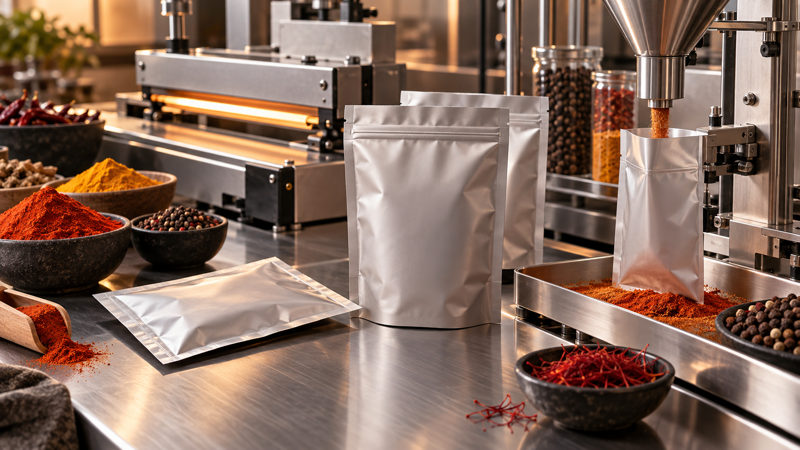
Spices challenge flexible packaging in several ways at once. Volatile aromas can escape, moisture can trigger clumping, fine particles can contaminate seals, and natural oils may interact with films or adhesives. Powders can also carry static charge, making them cling to filling equipment, pouch walls, and zipper profiles. A package that looks suitable for one spice may perform poorly with another because particle size, oil content, aroma strength, and distribution conditions vary widely.
Effective spice packaging therefore begins with the product and filling process. Barrier, sealant, pouch format, and equipment settings must work as a system. The goal is to retain flavor, keep the package clean and easy to use, and produce dependable seals at commercial speed.
Map the Product Risks First
Whole peppercorns, ground cinnamon, dried herbs, chili powder, and oily seasoning blends do not create the same packaging demands. Whole spices may have sharp edges that rub against the laminate. Fine powders can become airborne and settle across the seal area. Leafy herbs occupy more volume, while dense powders create higher weight in a small footprint.
Build a product profile for every SKU or logical family. Record particle size distribution, bulk density, moisture sensitivity, oil content, aroma intensity, dust generation, intended shelf life, fill temperature, and market climate. Include inclusions such as salt, sugar, dehydrated vegetables, or acids because they can change flow and moisture behavior.
Do not assume a spice is dry enough to be low risk. Hygroscopic powders can pull moisture through a weak package or absorb humidity each time the pouch is opened. Caking may then begin even though the product was within specification at filling.
Protect Volatile Aroma
Aroma retention depends on more than simply choosing a thick film. Different polymers resist oxygen, moisture, and aroma compounds differently, and the weakest component can control total performance. Seals, zipper tracks, pinholes, and poorly bonded layers matter alongside the main laminate.
Aluminum foil pouches can provide strong protection against oxygen, moisture, light, and aroma transfer when the laminate remains intact. Metallized films may provide a useful balance of barrier and flex resistance for many products. Clear high-barrier structures support visibility, but their performance should be verified for the exact spice and shelf-life target.
Highly aromatic products also need odor containment. A package should prevent strong spice notes from affecting adjacent products in warehouses, retail displays, or subscription boxes. Conduct sensory checks with packaged samples stored beside neutral products, not only instrumental tests on flat film.
Natural spice oils can be aggressive. They may soften a sealant, reduce bond strength, stain a paper layer, or migrate toward seals. Compatibility testing should use the finished spice, intended laminate, and realistic time and temperature conditions.
Control Static During Filling
Static is especially troublesome with light, fine powders. Particles may cling to the inner pouch wall, rise into the zipper, collect on sensors, or bridge across the sealing surface. The resulting package looks dusty and may develop leak channels.
Anti-static performance can come from material formulation, surface treatment, equipment controls, or a combination. Ask the supplier where the function is located and whether it remains effective throughout filling and storage.
Production conditions also matter. Very dry air can increase electrostatic charge, while uncontrolled humidity may create product-quality risks. Grounding, ionizing bars, conductive machine components, and appropriate conveying speeds can reduce charge without changing the film. Verify that equipment controls do not introduce dust, moisture, or maintenance problems.
Observe the product during full-speed trials. A film that behaves well during slow hand filling may show severe clinging on an automatic line. Check pouch opening, powder release from the filler, dust movement, code readability, and sensor reliability.
Design a Seal That Tolerates Powder
The strongest barrier laminate cannot compensate for a contaminated seal. Fine powder between hot sealant layers can create microscopic channels or visibly weak bands. Oils make the problem worse by reducing surface contact.
Start by keeping the sealing zone clean. Adjust the filler cut-off, drop height, timing, dust extraction, and pouch handling so product settles below the seal before the jaws close. A wider seal may improve process tolerance, but width alone cannot solve heavy contamination.
Select an inner sealant with an appropriate seal-initiation temperature, hot-tack strength, contamination tolerance, and chemical compatibility. The operating window should be broad enough for normal variation in line speed, film temperature, pressure, and dwell time. Excessive heat can distort the pouch or damage outer printing, while insufficient energy creates weak or incomplete fusion.
Inspect seals through peel testing and leak methods appropriate to the package. Cut cross-sections or carefully open failed seals to distinguish contamination, wrinkles, channel leaks, and insufficient sealing. Record settings by SKU because a dusty turmeric powder may require a different control strategy from whole cloves.
Choose the Pouch Format Around Use
Stand-up pouches provide strong shelf presentation, a broad front panel, and optional reclosure. They suit retail spices and blends used over multiple occasions. The bottom gusset must open reliably, and the zipper needs protection from powder during filling.
Three-side seal pouches are efficient for small doses, refill packs, meal kits, and single-use seasoning. Their flat shape supports compact shipping and predictable sealing. A tear notch or laser score can improve opening, but the tear path must not run into the product or create fragments.
Rollstock used on vertical or horizontal equipment may be preferable for high-volume sachets and pillow packs. Film roll packaging must match the forming collar, sealing jaws, registration system, coefficient of friction, and line speed. Powder control at the longitudinal and cross seals becomes a central process issue.
For larger foodservice packs, a gusseted format may improve capacity and handling. Confirm lifting, pouring, and reclosing ergonomics. A package that is stable on a retail shelf may be difficult for a kitchen operator to dose accurately.
Protect Zippers and Dispensing Features
Zippers are convenient but create ledges where powder accumulates. A clogged profile may feel closed while leaving a small pathway for moisture and aroma. Test repeated opening and closing with actual product present, including after the pouch has been shaken in transit.
Position the fill line far enough below the zipper and consider filling aids that shield the profile. A tamper-evident top seal above the zipper protects the unopened product and provides a clean first presentation. The consumer still needs enough header to grip and tear comfortably.
Spouts, shaker fitments, or dispensing closures may improve dose control for selected products, but each component adds sealing and compatibility requirements. Fine powders can bridge in narrow openings, while coarse blends may block a small fitment. Prototype the real dispensing task before committing to tooling.
Plan Artwork and Coding for Dusty Products
Spice packaging often uses dark colors, matte finishes, and detailed food imagery. Make sure lot codes and best-before information remain readable on the chosen surface. Coding areas should be flat, accessible, and free from heavy varnish or texture that reduces adhesion.
Transparent windows can display color and grind, but light exposure may accelerate fading in sensitive spices. Windows also reduce the uniformity of the barrier. If visibility is essential, use a modest area and validate color and aroma during shelf-life testing.
Leave enough label space for ingredients, allergens, net quantity, origin statements, preparation instructions, and market-specific requirements. Variable labels should not cover seals, tear features, or the zipper grip area.
Validate the Complete Package
Laboratory barrier data helps compare materials, but the finished package must be tested with the spice inside. Run storage studies under normal and challenging climate conditions. Evaluate aroma intensity, color, moisture, caking, oil staining, seal strength, zipper function, and overall appearance.
Distribution testing should include vibration, compression, and drops in the final carton. Powder may migrate into closures during transport even when filling was clean. Sharp whole spices can create abrasion or pinholes after repeated movement.
Use production-scale trials to measure seal rejects, dust accumulation, cleaning frequency, filling accuracy, and packages per minute. A more forgiving film and seal design may have greater commercial value than a lower-priced structure that slows the line or increases waste.
Spice Packaging Checklist
- Characterize particle size, bulk density, oils, aroma, and moisture sensitivity.
- Select oxygen, moisture, light, and aroma barrier for the intended shelf life.
- Confirm film and adhesive compatibility with natural oils and flavor compounds.
- Evaluate anti-static behavior on the real filling line.
- Keep powder away from zipper tracks and heat-seal surfaces.
- Establish a validated temperature, pressure, and dwell-time window.
- Test pouch opening, dispensing, reclosing, coding, and shelf presentation.
- Validate finished packs through storage and distribution trials.
Spice packaging works when product behavior is reflected in every design decision. The laminate retains aroma, the surface and equipment control static, the filling process protects the seal zone, and the pouch format makes dosing simple. By testing the finished product rather than relying on a generic dry-food specification, brands can reduce caking, leaks, dusty presentation, and flavor loss across the full supply chain.