
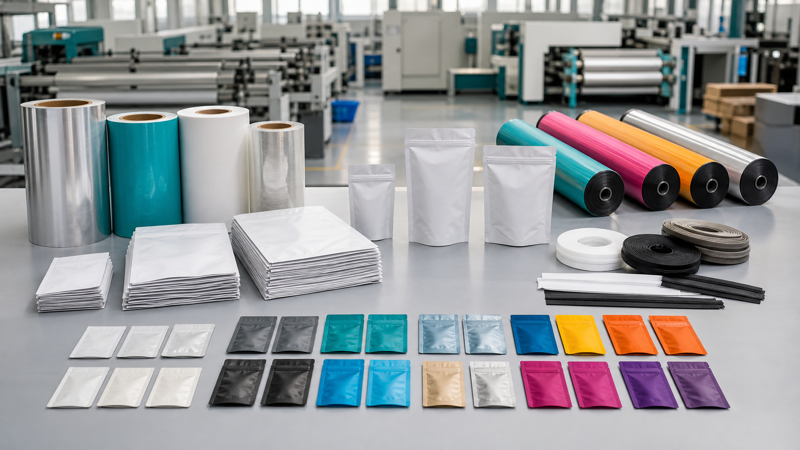
The minimum order quantity for a custom pouch is not chosen from one universal table. It is the quantity required to make a specific combination of film, printing, lamination, slitting, pouch making, and accessories practical. Two pouches with the same finished dimensions can have very different minimums when one uses stock film and digital printing while the other requires a custom barrier structure, eight-color gravure artwork, a special zipper, and ten SKUs.
Understanding the cost drivers helps brands ask better questions and compare quotations fairly. The goal is not always to obtain the lowest published MOQ. It is to find the smallest commercially sensible order that meets product protection, brand, filling, and landed-cost requirements. Start by sharing an accurate specification through the supplier’s how to customize packaging process.
Material Availability Sets the First Minimum
Flexible packaging is normally produced from rolls of film or paper. If the desired laminate uses standard materials already purchased regularly by the converter, the material minimum may be relatively manageable. A custom resin grade, uncommon thickness, specialty barrier, colored film, paper, recycled content, or certified source may require a mill or laminator to make an entire roll or batch.
The quoted pouch MOQ may therefore reflect raw-material procurement rather than printing speed. Even if a digital press can economically print a short run, the converter still needs enough of the specified film to cover setup, lamination, curing, slitting, pouch making, and unavoidable process waste. Ask whether the structure is stocked, made to order, or shared with other customers.
Substituting a standard structure can lower the minimum, but the change must still meet barrier, sealability, stiffness, puncture resistance, food-contact, and shelf-life needs. A small order of unsuitable film is not a saving. Request a layer-by-layer specification and validate the actual product conditions before accepting a shortcut.
Printing Method Changes the Economic Crossover
Digital printing avoids conventional plates and cylinders, making it attractive for low quantities, multiple versions, and frequent artwork changes. The minimum may be driven by press setup, finishing, and material rather than color tooling. Unit cost can remain higher than conventional printing as volume grows, but lower inventory exposure may justify it during launch.
Flexographic printing requires a plate for each color and includes mounting, ink preparation, registration, and startup waste. Gravure requires engraved cylinders and generally carries higher tooling investment. These setup costs become reasonable when they are spread across a longer run. Each supplier has a different crossover based on press width, speed, tooling, local costs, and workload.
The number of colors and special effects also matters. CMYK, opaque white, two spot colors, and a registered varnish may use eight stations. More stations mean more tooling, ink, setup, and waste. Simplifying the color architecture can reduce cost, although it does not always reduce the physical film minimum.
The article on low-MOQ custom coffee packaging illustrates why printing and inventory strategy should be evaluated together. Small roasters may benefit from shorter digitally printed runs while their demand and artwork are still changing.
Pouch Size and Web Layout Affect Yield
Pouches are arranged across a roll according to web width and repeat length. A pouch that nests efficiently may produce several lanes with little trim waste. A slightly wider format may reduce the layout from three lanes to two, increasing material used per pouch and the run length needed to consume a practical roll.
The relevant figure is not only finished pouch count but printed area and converted meters. Small sachets may deliver many units from a modest film run, while large pet-food or bulk pouches consume far more material per unit. This is why suppliers sometimes quote minimums by square meters, kilograms, or linear meters before converting them to approximate pieces.
Complex shapes and features can increase setup waste. Rounded profiles, laser scoring, spouts, valves, special hang holes, child-resistant zippers, and registered windows may need dedicated tooling or slower converting. A common zipper and standard corner radius are easier to combine with established production than an uncommon component purchased only for one short order.
Stand-up pouches also use bottom-gusset material and require forming and sealing steps that differ from flat sachets. Flat-bottom and side-gusset formats introduce other panels and tooling. Compare MOQ for the exact pouch type rather than assuming that all bags of similar capacity are equivalent.
SKU Count Divides the Order
A total order of 50,000 pouches across ten designs is not operationally the same as 50,000 identical pouches. Each SKU may require its own artwork check, color separations, plates or cylinders, ink setup, changeover, startup waste, quality records, packing labels, and finished-goods handling. Conventional print minimums often apply per artwork, even when all versions use the same material and size.
Digital printing may allow several designs to share one material run, but constraints still apply. The SKUs may need the same structure, width, repeat, finishing, and pouch format. The converter may also set a minimum quantity per design to keep sorting and pouch-making practical. Ask whether the quoted MOQ is total, per size, per artwork, per material, or per purchase-order line.
Brands can reduce versions by using common printed packaging with variable labels, thermal-transfer coding, or overprinting. That approach lowers print fragmentation but adds labeling labor, label inventory, and possible appearance compromises. Regulatory and barcode data must remain securely connected to the correct product.
Custom Tooling and Components
Printing is only one tooling category. A custom pouch may need a cutting die, shaped-pouch die, zipper applicator setup, valve hole, spout fixture, laser-score pattern, or filling-machine-specific roll dimensions. Some tooling is a one-time investment that can be reused; other setup costs occur with every run.
Ask who owns each tool, how long it is stored, which changes make it obsolete, and whether replacement is charged. A new pouch width can invalidate printing plates, cylinders, and converting tools at once. Freezing size and features before artwork helps protect the investment.
Component suppliers may impose their own carton or case minimums. If a special zipper or valve is purchased in a quantity larger than the pouch order, clarify whether the balance will be stored, charged, or discarded. Long storage can also affect adhesives, films, and components, so buying excess is not always practical.
Production Waste and Quality Allowance
Every process needs material for threading, color adjustment, registration, lamination, slitting, pouch-machine setup, and inspection. Short runs can have a high waste percentage because setup consumption does not shrink in proportion to order size. A converter may need to print more than the ordered quantity to deliver the agreed number of saleable pouches.
Purchase terms often include an overrun or underrun tolerance. Determine whether invoices are based on ordered quantity, produced quantity, or accepted quantity within the tolerance. For a small launch, a 10 percent overrun may be meaningful. For a large stable SKU, it may be routine. Include this range in inventory and cash-flow planning.
How to Lower MOQ Without Creating New Risk
First, separate essentials from preferences. Protect product performance, filling compatibility, and legal requirements, then identify where standardization is acceptable. A stock laminate, established pouch size, standard zipper, shared structure across SKUs, and simpler print architecture can all improve production efficiency.
Second, phase the project. Use blank stock pouches with labels for early product testing, then move to digital custom printing, and adopt conventional printing after demand is proven. This can reduce obsolete inventory even if the initial unit price is higher.
Third, consolidate intelligently. SKUs with the same dimensions and structure may share material procurement or production scheduling. Flexible ordering across a longer forecast can help, but only if the supplier can manufacture, store, and release inventory under clear quality and payment terms.
Review the available packaging products to identify established formats before requesting a completely new construction. Standardization should be a deliberate commercial choice, not an undocumented substitution.
Questions to Ask When Comparing MOQs
- Is the minimum stated per order, material, size, artwork, color set, or SKU?
- Which material, accessory, tooling, or process creates the minimum?
- How does MOQ change for digital, flexographic, and gravure printing?
- What setup waste, overrun, and underrun should be expected?
- Can several designs share one material and finishing run?
- Which pouch sizes fit the web efficiently, and how many lanes are produced?
- Are plates, cylinders, dies, and components reusable, owned, and stored?
- What price breaks apply above the minimum, and what is the landed cost per usable pouch?
- Can a stock structure or standard feature reduce MOQ without compromising performance?
Custom pouch MOQ is the result of a production system. Materials, print setup, web yield, format, accessories, SKU fragmentation, and waste all contribute. Once the true constraint is identified, brands can redesign the order around it—standardizing where sensible, testing demand in stages, and investing in scale only when the commercial case is strong.