
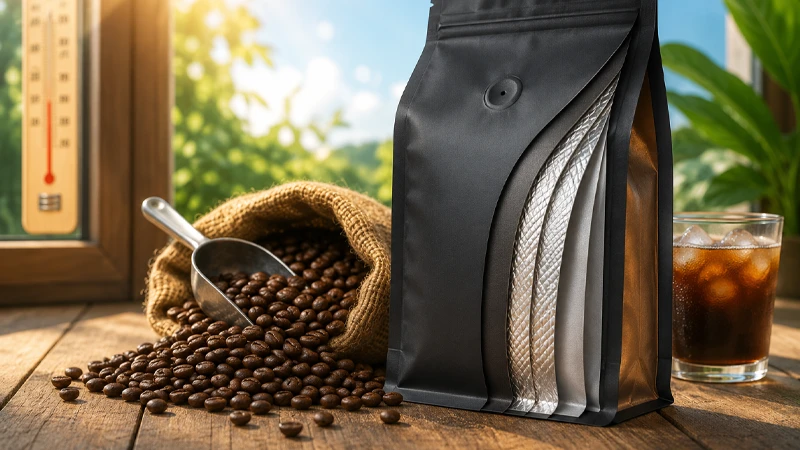
Summer places unusual pressure on roasted coffee packaging. Higher temperatures accelerate quality loss, while humid air drives water vapor toward the dry coffee inside the pouch. Coffee that leaves the roastery with a bright aroma can become flat or oxidized after spending weeks in warm warehouses, delivery vehicles, or retail stockrooms.
For this reason, high barrier coffee bags matter more during hot weather. They must slow oxygen and moisture transmission, block light where necessary, retain volatile aromas, and maintain reliable seals throughout storage and distribution.
Their performance is commonly evaluated through oxygen transmission rate and water vapor transmission rate. These measurements help roasters compare aluminum foil, metallized film, and recyclable structures more accurately.
Why Summer Accelerates Coffee Staling
Roasted coffee remains chemically active after roasting. It releases carbon dioxide, loses volatile aroma compounds, and contains oils that can oxidize. Heat does not create these processes, but it makes them occur faster.
Accelerated-storage research on ground coffee found that higher temperatures increased the loss of volatile compounds and intensified sensory changes related to aging and oxidation. Research on packaged coffee stored under different temperature and humidity conditions also found that moisture uptake and quality deterioration became faster as both factors increased. A pouch that performs adequately in winter may therefore provide a smaller safety margin during summer.
The risk is greater when coffee passes through non-air-conditioned warehouses, containers, trucks, and retail stockrooms. Ground coffee is particularly vulnerable because grinding creates more exposed surface area, although whole beans also require protection.
What Makes a Coffee Bag High Barrier?
A high-barrier pouch is normally a multilayer structure. The outer film provides strength and printability. A middle layer supplies most of the oxygen, moisture, aroma, and light protection. The inner layer provides a food-contact surface and heat-sealing performance.
The term “high barrier” should describe measured performance, not just a metallic appearance. Film thickness, coating quality, adhesive curing, valve installation, pouch folds, and seal integrity all influence the finished package.
Roasters should request barrier data for the complete laminate under stated test conditions.
Understanding OTR and WVTR
Oxygen transmission rate, or OTR, measures how much oxygen passes through a packaging material over a defined area and period. ASTM D3985 covers oxygen transmission testing for films, laminates, coextrusions, and coated materials. ASTM identifies OTR as an important indicator of packaging protection, although it is not the only factor affecting performance.
A lower OTR means that less oxygen can enter through the film. Oxygen reacts with coffee oils and aroma compounds, contributing to stale, papery, or rancid notes. Since heat accelerates oxidative changes, a low-OTR structure becomes more valuable in summer.
Water vapor transmission rate, or WVTR, measures water vapor passing through a packaging material. ASTM F1249 applies to flexible barriers, including multilayer films, coated materials, and foils, and notes that WVTR can be directly related to product stability and shelf life.
A lower WVTR generally means stronger moisture protection. One study of coffee stored at temperatures up to 45°C and relative humidity up to 75% found that higher temperature and humidity increased moisture uptake and accelerated quality decay when the barrier was inadequate.
OTR and WVTR should be compared only when the test temperature, humidity, units, and method are the same.
| Packaging property | What it controls | Summer risk if inadequate |
|---|---|---|
| OTR | Oxygen entering the pouch | Faster oxidation and aroma loss |
| WVTR | Water vapor entering the pouch | Moisture uptake and reduced stability |
| Light barrier | Light reaching the coffee | Additional degradation |
| Seal integrity | Leakage through seals and valves | Local oxygen and moisture entry |
A low OTR without a good WVTR is not enough for humid regions. Strong moisture resistance also cannot prevent deterioration if oxygen enters freely. The best high barrier coffee bags balance both properties while remaining compatible with the zipper, valve, and intended shelf life.
Aluminum Foil Coffee Bags
Aluminum foil remains one of the strongest conventional barrier materials used in coffee packaging. In a typical laminate, foil sits between an outer printable film and an inner heat-sealing film. When continuous and undamaged, it provides extremely strong resistance to oxygen, moisture, light, and aroma migration. A review of aluminum foil in food packaging describes its barrier performance as generally higher than that of plastic laminate materials.
This makes foil laminates suitable for ground coffee, long shelf-life products, exports, and distribution systems without consistent climate control.
Foil can still be damaged. Very thin foil may contain pinholes, while severe folding and repeated flexing can create cracks. Converting, transportation, and handling therefore affect the final barrier. Foil laminates may also be heavier and more difficult to recycle than mono-material structures.
A typical foil coffee bag may use a PET/AL/PE laminate. The outer PET layer provides printability, puncture resistance, and dimensional stability. The aluminum layer creates the primary barrier, while the inner PE layer provides food-contact safety and heat-sealing performance.
This type of structure is particularly suitable for ground coffee, flavored coffee, premium beans with long shelf-life requirements, and products shipped through hot international supply chains.
Metallized Coffee Bags
Metallized coffee bags usually use PET coated with an extremely thin layer of aluminum. Common names include metallized PET, VMPET, and MPET. Metallization improves oxygen, moisture, and light protection compared with an uncoated film.
Because the metal layer is much thinner than aluminum foil, metallized structures are generally lighter, more flexible, and often more economical. PET/VMPET/PE can provide a practical balance for whole-bean coffee, regional distribution, and moderate shelf-life requirements.
The trade-off is that metallized film usually does not equal intact foil in absolute barrier performance. Microscopic defects, scratching, folding, stretching, and flexing can reduce protection. Comparative research shows that material combinations and processing variables strongly influence oxygen and water-vapor barrier results.
A metallic appearance is therefore not proof of a specific barrier level. Roasters should request actual OTR and WVTR data for the proposed laminate.
Metallized structures can be highly effective when the coffee has a relatively fast turnover, the distribution route is controlled, and the package does not need to support an exceptionally long shelf life. However, the metallized layer must be protected by the surrounding films because surface damage can reduce its effectiveness.
Aluminum Foil vs. Metallized Film in Summer
| Factor | Aluminum foil laminate | Metallized film laminate |
| Barrier level | Typically excellent when undamaged | Good to high, depending on coating |
| Light protection | Complete or nearly complete | Strong but structure-dependent |
| Flexibility | More sensitive to hard creasing | Generally more flexible |
| Cost and weight | Usually higher | Usually lower |
| Typical use | Ground coffee, exports, long shelf life | Whole beans, regional sales, faster turnover |
Foil may provide the safer margin for coffee expected to remain unopened for months, travel internationally, or encounter severe heat and humidity. A well-engineered metallized laminate may be sufficient for faster-moving whole-bean coffee with shorter and better-controlled distribution.
Summer should be treated as the most demanding part of the distribution cycle.
The Finished Pouch Matters as Much as the Film
Strong film data does not guarantee a strong package. Heat seals, zipper ends, gusset folds, valve welds, and tear notches can become local entry points for oxygen and moisture.
Summer heat may expose weaknesses in adhesive curing, delamination resistance, sealant selection, or hot-tack performance. The finished pouch should therefore be tested for seal strength, leakage, valve attachment, and barrier retention after handling.
The heat-sealing layer must create a consistent seal across flat areas, gusset intersections, and zipper ends. Coffee dust or oil in the sealing area can prevent complete closure, allowing oxygen and humidity to enter even when the laminate itself has excellent barrier values.
A one-way degassing valve allows carbon dioxide to escape while limiting outside oxygen entry. Nitrogen flushing reduces the oxygen present when the bag is sealed. These features support the barrier, but neither replaces it. The film, valve, zipper, flushing process, and seals must work as one system.
Can Recyclable Coffee Bags Provide a High Barrier?
Recyclable mono-PE and mono-PP coffee bags are increasingly being developed with barrier coatings, specialized films, or compatible barrier layers. These structures may provide sufficient protection for certain coffee products, but the word “recyclable” does not automatically mean that the pouch is suitable for summer storage.
Their OTR and WVTR should be evaluated under realistic temperature and humidity conditions. Performance should also be confirmed after printing, coating, pouch making, valve installation, filling, and heat sealing.
For coffee brands with sustainability goals, the most appropriate structure is one that balances recyclability with actual product protection. A package that creates premature coffee staling and product waste may not deliver the intended environmental benefit.
Choosing High Barrier Coffee Bags
A roaster should begin with the coffee format, fill weight, roasting-to-packing interval, valve requirement, nitrogen-flushing process, target shelf life, and expected summer distribution conditions.
Instead of requesting only “a high-barrier bag,” buyers should ask for the OTR and WVTR of the proposed laminate, including test methods and conditions. Finished-pouch trials should examine residual oxygen, seal integrity, valve performance, aroma retention, and product quality after accelerated storage.
For local whole-bean coffee with rapid turnover, a qualified metallized structure may offer the best balance of barrier, flexibility, and cost. For ground coffee, exports, or long shelf-life products exposed to harsh summer conditions, an aluminum-foil laminate may provide a more dependable margin of protection.
Packaging specifications should be based on the most difficult conditions that the product is likely to experience, rather than the conditions inside the roastery. This approach helps protect coffee when it enters hot warehouses, vehicles, retail stores, and customers’ homes.
Conclusion
High barrier coffee bags matter more in summer because heat and humidity place additional pressure on the entire packaging system. Oxygen accelerates staling, moisture changes the condition of the coffee, and elevated temperatures speed the loss of desirable aroma compounds.
OTR indicates how effectively a structure slows oxygen transmission, while WVTR measures resistance to water vapor. Both values should be low, measured under relevant conditions, and supported by reliable seals and valve installation.
Aluminum foil offers the strongest conventional barrier for demanding shelf-life and distribution requirements. Metallized film provides a lighter and often more economical alternative when its measured performance matches the product’s needs. The best summer coffee package is the structure that protects the coffee through the hottest stage of its journey from roaster to cup.