
If your customers report “rocky” grounds, inconsistent dosing, or puffy bags that go stale too soon, you’re not alone. Clumping is a symptom of deeper physical forces acting on ground coffee—moisture, static, and rapid CO2 release—made better or worse by your packaging choices.
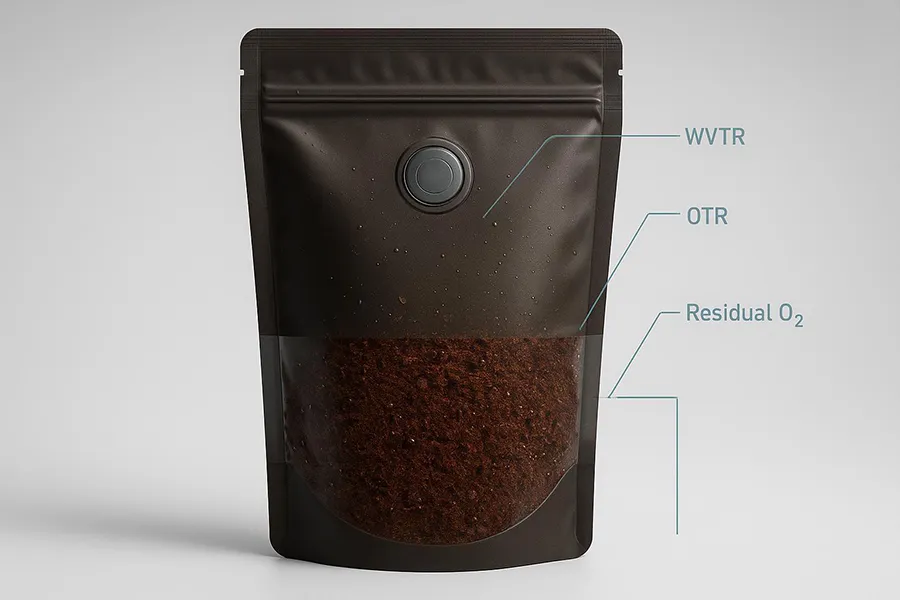
This guide translates those mechanisms into practical packaging specifications and a validation playbook you can run with your roaster, co‑packer, or supplier. You’ll find engineering targets (WVTR, OTR, residual O2), valve and nitrogen guidance, and the exact tests to prove your results before you scale.
Why Ground Coffee Clumps: The Science
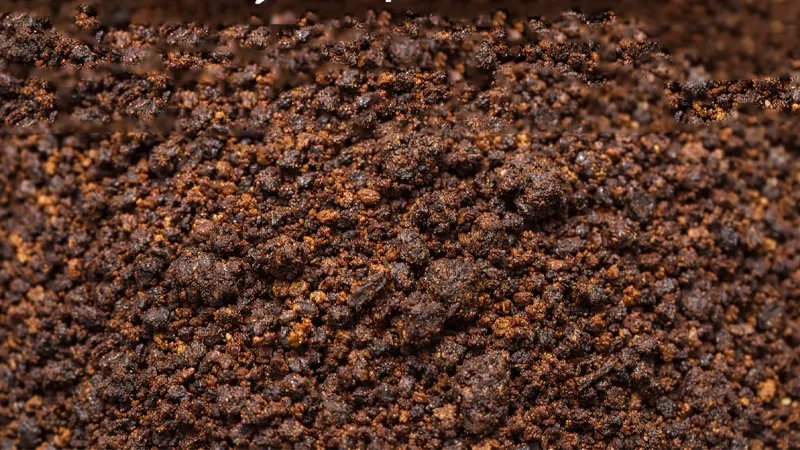
Ground coffee is hygroscopic and electrostatically active. That’s a fancy way of saying it loves to absorb moisture and it holds charge easily. Both properties promote particle bridging and caking over time. Moisture uptake increases capillary and van der Waals forces between particles; even small relative humidity increases can turn a free‑flowing grind into tiny clusters. At the same time, grinding dry, insulating particles generates static so fines cling to everything, from hopper walls to neighboring particles. The Specialty Coffee Association has described how electrification during grinding reduces flow and dosing consistency—and how measures like controlled RH and ionization help reset the system, as summarized in It’s Electric: Understanding—and Reducing—Static Electricity During Grinding (SCA, 2024).
Then there’s degassing. Freshly roasted coffee releases CO2 rapidly, and grounds degas even faster than whole beans due to their surface area. In sealed bags, pressure can build unless a valve vents it effectively. CO2 movement also jostles particles, encouraging contact and adhesion. SCA materials on freshness and degassing highlight how headspace gases evolve in early storage and why robust packaging—and proper venting—matters.
So, why do we care as packaging specifiers? Because each mechanism maps to a controllable packaging variable: barrier against water vapor and oxygen, controlled venting via one‑way valves, and low‑oxygen headspace via nitrogen flushing. Get these right and you’ll materially cut clumping complaints and slow staling.
Packaging Fixes That Actually Work
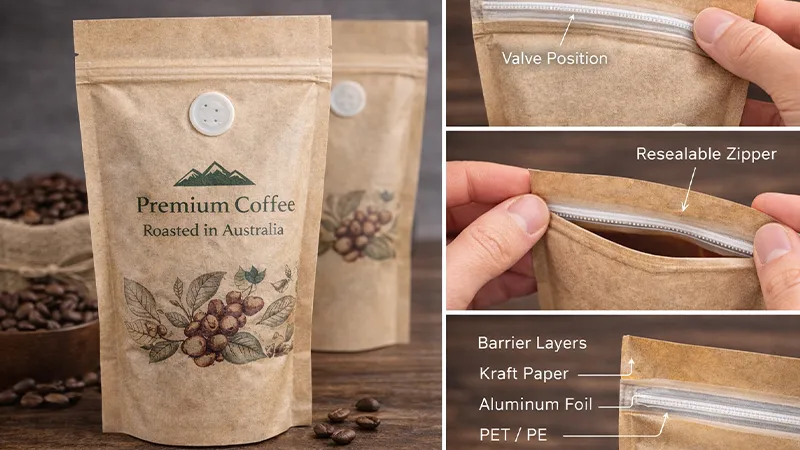
High‑barrier films reduce moisture and oxygen ingress. One‑way valves release CO2 while resisting back‑diffusion. And modified‑atmosphere packaging (MAP) with nitrogen displaces oxygen so oxidation chemistry slows down. Think of your pouch as a small ecosystem: barrier determines what leaks in; the valve decides what escapes; and headspace composition sets the pace of chemistry.
- High‑barrier films. For multi‑month shelf life on ground coffee, start with multilayer laminates such as PET/AL/PE (foil) or PET/EVOH/PE (polymer barrier), or high‑barrier mono‑PE designed for recyclability. Barrier performance is characterized by water vapor transmission rate (WVTR) and oxygen transmission rate (OTR) using standardized methods.
- One‑way valves. Degassing valves let CO2 out while limiting oxygen and moisture in. Choose a valve with sufficient vent capacity for your roast profile and bag geometry, and place it away from seal lines (commonly lower‑front on stand‑up pouches). Public catalogs and landing pages describe architectures and application notes. Engage suppliers directly for numeric flow and opening‑pressure data when sizing your valve.
- Nitrogen flushing. Your target is very low residual oxygen immediately after sealing, verified by headspace analysis.
- Optional aids. Anti‑static inner surfaces or process‑level ionization can reduce adhesion of fines. In demanding routes (hot/humid), right‑sized desiccants can stabilize internal RH—but only as a complement to strong barrier.
Engineering targets to validate (use in pilots)
| Dimension | Target starting point | How to measure | Why it matters |
|---|---|---|---|
| Residual O2 (immediately post‑seal) | ≤0.5% ideal; ≤2% acceptable | Headspace analyzer; sample after short stabilization | Slows oxidation and flavor loss; reduces stale notes |
| WVTR (38°C/90% RH) | Low single digits g/m²/day | ASTM F1249 at specified conditions | Limits moisture uptake that drives clumping |
| OTR (23°C, dry) | Low single digits cc/m²/day | ASTM D3985 or F1927 | Slows oxidative staling of aromatics |
| Valve capacity/placement | Match early degassing; place away from seals | Supplier data + pilot swelling checks | Prevents bag ballooning and seal stress |
| Seal strength/leak | Pass burst/pressure decay, peel strength ≥ line spec | ASTM F2095 (leak), ASTM F88 (peel) | Keeps the system tight while still openable |
These are engineering starting points, not legal standards. Validate with your coffee, equipment, and distribution.
Validation Playbook: Prove It Before You Scale
You wouldn’t change a roast curve without cupping side‑by‑side. Packaging changes deserve the same rigor. Here’s how to verify performance with minimal disruption.
Headspace oxygen testing. After dialing your nitrogen flush, measure residual O2 immediately post‑seal and again after short stabilization (e.g., 5–15 minutes) to let gases equilibrate. Document your acceptance criteria and sampling frequency. For practical MAP QC concepts, Campden BRI’s MAP FAQs and similar references offer helpful context on program design; see Campden BRI’s overview of MAP program questions (accessed 2026).
Barrier and ingress. Verify supplier WVTR and OTR certificates and, for critical lines, commission independent lab tests using ASTM F1249 for WVTR and D3985/F1927 for OTR. If you need system‑level confirmation (film + valves + seals), use whole‑package oxygen ingress testing (ASTM F1307) during pilot lots as a spot check. AMETEK MOCON’s instrumentation overview provides context for the OX‑TRAN platforms that run these methods: MOCON oxygen permeation analyzers (D3985‑compliant).
Seals under pressure. Degassing means pouches see internal pressure. Confirm your sealing window and integrity via peel testing (ASTM F88) and package leak/pressure‑decay or burst tests (ASTM F2095). Record minimum passing values that survive your worst‑case route.
Shelf‑life simulation. Run an accelerated shelf‑life hold at 38°C/90% RH for 2–4 weeks to stress moisture‑driven clumping while tracking headspace O2, a simple visual clump index, and cupping variance. In parallel, run real‑time checks at ambient for 3–6 months. It’s not overkill; it’s cheaper than a wave of returns.
Implementation SOP (Roastery or Co‑Packer)

- Specify materials. Choose a high‑barrier laminate (foil for maximum barrier or EVOH/high‑barrier mono‑PE for recyclability) and request current WVTR/OTR certificates with test conditions.
- Select and place the valve. Engage the valve supplier to match vent capacity to your degassing profile; place the valve away from seal lines, typically low‑front on stand‑up pouches.
- Set your gas program. Calibrate nitrogen flush (or vacuum‑plus‑nitrogen) to hit residual O2 ≤0.5% ideal (≤2% acceptable) immediately after sealing; verify with a calibrated headspace analyzer.
- Validate seals. Establish your sealing window and confirm peel strength and leak performance under simulated CO2 load; document machine settings.
- Pilot and monitor. Run a pilot lot and track headspace O2 over 72 hours, bag swelling/venting behavior, and clump index under accelerated and ambient holds.
- Lock the QC plan. Define sampling frequencies, acceptance thresholds, and corrective actions for line checks (headspace O2, weight, seal, valve adhesion) and shelf‑life monitoring.
Example Workflow
Here’s a practical, replicable workflow I’ve used with roasters switching from generic PET/PE bags to high‑barrier pouches with valves and nitrogen. Suppose you select a stand‑up pouch from BN PACK’s coffee range, using a PET/AL/PE laminate for a dark‑roast ground SKU. You can review options and formats on BN PACK’s coffee bags page.
- Construction and features. Choose a 3‑layer PET/AL/PE film with a laser‑scored easy‑open and a single one‑way valve positioned low‑front. Request current supplier certificates: WVTR via ASTM F1249 at 38°C/90% RH and OTR via ASTM D3985 or F1927 at 23°C.
- Gas and sealing. Set your line for a nitrogen flush that consistently delivers ≤0.5% residual O2 immediately post‑seal (verify after short stabilization). Confirm a sealing window that passes peel (ASTM F88) and pressure‑decay leak checks (ASTM F2095) with no failures under expected CO2 load.
- Pilot proof. Pack 250 g ground coffee bags on a pilot lot. Over 72 hours, log headspace O2 trend, observe valve venting (no persistent ballooning), and run an accelerated hold at 38°C/90% RH for two weeks. Score visible clumping and cup for variance versus baseline packs. If results pass, proceed to scale with the documented SOP.
Note the language here: engineering targets to validate, not promises. If you prefer a recyclable path, swap to a high‑barrier mono‑PE option and confirm barrier via the same tests; adjust nitrogen and valve sizing as needed.
Troubleshooting: If Clumps Persist
Still seeing clusters? Start with environment. Grinding and filling in very dry air (<40% RH) increases static and adhesion; in very humid air (>60% RH), moisture uptake accelerates caking. Aim for a moderate, controlled RH band and ensure your grinders and conveyors are grounded or ionized.
Next, check particle distribution and oil management. Very fine grind profiles and higher surface oils raise adhesion forces; slight adjustments to your grind curve can improve flow without sacrificing extraction.
Inspect the valve. If bags balloon for days, your valve may be undersized or misplaced; if they never swell yet O2 climbs, you might have leaks or back‑diffusion issues. Re‑verify valve seating and try a different capacity or position.
Finally, revisit seals and film choice. Marginal seals or lower‑barrier films allow moisture ingress and oxygen creep. Confirm your sealing window and, if needed, step up your barrier or add a small desiccant for tough, humid routes—validating that it doesn’t overdry and affect flavor.
Why “Why Ground Coffee Clumps” Belongs in Your Specs
If you’re writing the packaging brief or managing a private‑label line, this isn’t just a QA curiosity. Why ground coffee clumps is fundamentally a packaging and process question: moisture, static, and CO2 are controllable—with barrier, valves, and gas. Lock those down, and the payoff shows up in more consistent dosing, steadier extraction, and fewer stale‑bag complaints. Isn’t that what your customers notice first?
Next Steps
Request current barrier test certificates (ASTM F1249/D3985), valve application notes, and a pilot‑run plan from your supplier. If you need example formats and features to discuss internally, you can browse BN PACK’s coffee pouches and request datasheets or a small pilot quote to validate targets in your plant. As always, confirm key claims with independent lab tests before updating your labels or shelf‑life promises.