
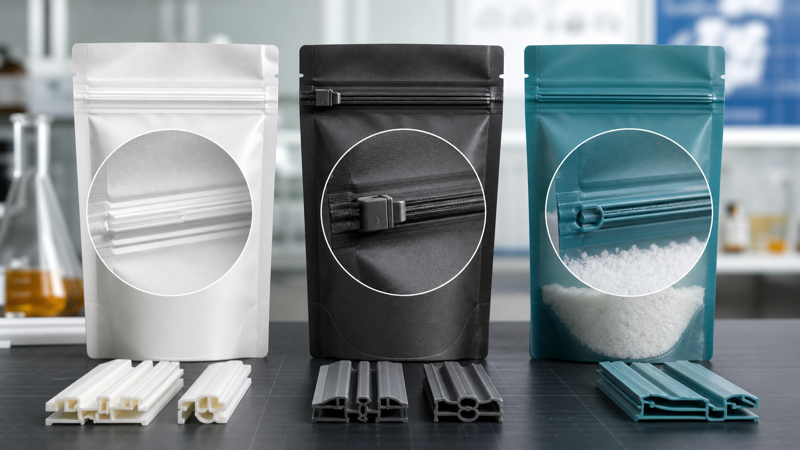
A resealable zipper can improve freshness and convenience, but only when its profile matches the product, pouch, consumer, and filling process. A standard press-to-close zipper may work well for coffee beans or snacks yet become unreliable when fine powder contaminates its grooves. A slider can improve accessibility but adds material, components, and conversion complexity. Child-resistant designs answer a different safety need and must not be confused with ordinary reclosure.
Zipper selection should begin with how the package is filled, opened, cleaned, reclosed, stored, and handled after opening. The zipper is not normally the package’s original hermetic seal; an intact top seal above it protects the unopened product. After opening, the zipper becomes a consumer reclosure that helps limit spills and environmental exposure.
Comparison of Common Zipper Options
| Zipper type | Main advantage | Main limitation | Suitable product examples | Key validation point |
|---|---|---|---|---|
| Standard press-to-close | Familiar, economical, broad availability | Needs accurate finger alignment and clean profiles | Snacks, beans, dried fruit, pet treats | Reclose force and leak resistance after repeated cycles |
| Slider | Easy visual and tactile operation | Higher cost and more header space | Family packs, accessibility-focused products | End stops, slider retention, filling-equipment clearance |
| Powder-proof profile | Resists interference from fine particles | Product-specific performance; not completely contamination-proof | Protein, nutrition, spice, and drink powders | Closure after realistic dust exposure |
| Child-resistant zipper | Controlled opening sequence supports restricted access | Requires certified system and user instructions | Regulated or safety-sensitive products | Compliance testing and adult usability |
The table shows functional tendencies, not universal guarantees. Profiles vary in geometry, resin, flange design, application method, and supplier tolerances. Testing must use the final pouch and real product.
Standard Press-to-Close Zippers
A press-to-close zipper uses mating male and female profiles that interlock under finger pressure. Consumers align the tracks and press across the opening. It is widely used because it is compact, familiar, and compatible with many premade pouch formats.
The standard profile suits products that do not heavily contaminate the zipper and are opened repeatedly over a moderate shelf period. Coffee beans, nuts, confectionery, dried fruit, cereal, and pet treats are common examples. The zipper should provide clear tactile feedback without requiring excessive force.
Usability depends on flange position, pouch stiffness, opening width, product headspace, and the distance between the zipper and cut line. If the header is too short, consumers may struggle to grip both sides. If the zipper is too close to the product, contents can enter the track during first opening. A stiff laminate can make alignment difficult; a very soft web may buckle instead of transmitting pressure.
Explore established stand-up zipper pouches before requesting an unusual profile. Standard dimensions and proven converting setups can reduce tooling, MOQ, and production risk.
Slider Zippers
A slider moves along the zipper profile to open and close it. The device can make operation more obvious and reduce the need to align profiles with both hands. It is useful for larger family packs, frequent-use products, and consumers who may have limited dexterity.
The convenience comes with additional considerations. The slider and end stops occupy space near the pouch header and can interfere with filling jaws, hang holes, tear notches, or carton fit. The pouch may need greater top clearance, increasing material use. Components and application equipment also add cost and may raise the minimum order.
Validate that the slider cannot detach under reasonable consumer use and that it reaches the end stops without leaving a small open channel. Test repeated cycling, drops, packed-case compression, and cold or warm storage. The slider should remain operable when the pouch is partly empty and flexible.
Artwork needs extra clearance around the device because the raised component can distort small text and create a visible bump. Consider retail display as well: a slider near the top may affect how pouches stack, hang, or fit a narrow shelf tray.
Powder-Proof Zippers
Fine particles can lodge in ordinary zipper grooves and prevent complete engagement. Powder-proof or powder-resistant profiles use geometry intended to displace, clear, or tolerate particles during closure. Some designs have ribs, channels, or wider engagement features that help powder escape rather than forming a continuous obstruction.
The term does not mean that every powder will be removed. Particle size, shape, oil content, static charge, flowability, and humidity all matter. Cocoa, flour, protein, spices, drink mixes, and powdered supplements behave differently. A profile that works with coarse granules may struggle with electrostatically charged dust.
For protein powder pouches, zipper performance is closely connected to headspace, scoop use, powder settling, and consumer handling. Leave enough space above the fill to access and clean the track. A wider opening may reduce spills, while an anti-static or lower-cling inner surface can help keep dust away from the closure.
Test closure after deliberately exposing the track to a controlled amount of real product. Cycle the zipper repeatedly, then evaluate visible engagement, opening force, sift leakage, moisture protection, and consumer usability. Testing only a clean empty pouch defeats the purpose of selecting a powder-resistant design.
Child-Resistant Zippers
Child-resistant zipper systems require a deliberate opening sequence, such as aligning marks, applying pressure at a specific point, or using two coordinated motions. They are used where accidental access creates a safety concern. The entire package—not just the loose zipper component—must meet applicable requirements for the target market and product.
Child-resistant zipper bags should be sourced as validated systems with documented structure, zipper, opening instructions, and production controls. Changing film stiffness, zipper position, pouch size, or instructions can affect performance. Adult usability is also critical; a closure that frustrates intended users may be left open or transferred to another container.
Child resistance is not the same as tamper evidence. The package may still need a sealed header, tear strip, or another feature that shows first opening. Regulatory and product specialists should confirm which protections are required.
Zipper Flange and Application Method
Profiles are attached to the pouch through flanges. Premade-pouch converters can insert zipper during pouch making, while form-fill-seal systems may use films with applied zipper or equipment that attaches it inline. Flange width, sealant compatibility, application temperature, and position tolerances affect seal quality.
The zipper area contains multiple layers, creating transitions where sealing pressure and temperature must be controlled. Poor application can cause distorted profiles, weak flange seals, channels at the side seals, or puckering. Ask for cross-sectional leak and seal-strength checks near zipper endpoints.
The general guide to zipper closures for stand-up pouches can help frame the available configurations. Final selection must match the converter and filling line rather than artwork preference alone.
Product Protection After Opening
A zipper slows exposure but does not automatically restore the original oxygen or moisture barrier. Reclosure effectiveness depends on full engagement, product contamination, headspace, user behavior, and the barrier of the remaining pouch. For a highly moisture-sensitive powder, the open-close cycle may dominate shelf life after first use.
Define the expected consumption period after opening. Test product quality under realistic use: open the pouch, remove a serving, expose it to ambient conditions, reclose it as a consumer would, and repeat. Monitor caking, texture, aroma, oxidation, microbial risk where relevant, and closure cleanliness.
If longer in-use protection is required, consider smaller pack sizes, individual sachets, desiccants where appropriate, or clearer storage instructions. A heavier zipper alone cannot correct a package that is repeatedly left open or used in an extremely humid environment.
Design and Filling Checklist
- Match the zipper to product particle size, dust, oil, static, and expected use period.
- Confirm the profile, flange, resin, and application process as one specification.
- Leave enough headspace and finger room for opening, cleaning, and reclosing.
- Keep top seals, tear notches, hang holes, sliders, and artwork from conflicting.
- Validate zipper-end seals and transitions for channels or weak spots.
- Test closure when clean and after controlled real-product contamination.
- Cycle the zipper through the expected number of consumer uses.
- Verify performance after filling, distribution, temperature, and humidity exposure.
- Treat child-resistant and tamper-evident functions as separate requirements.
The best zipper is not the most elaborate one. Standard press-to-close profiles offer efficient reclosure for many foods, sliders improve ease of use in selected formats, and powder-resistant designs address a specific contamination problem. Choose with the real product and consumer in mind, then validate the complete package under filling and repeated-use conditions.