
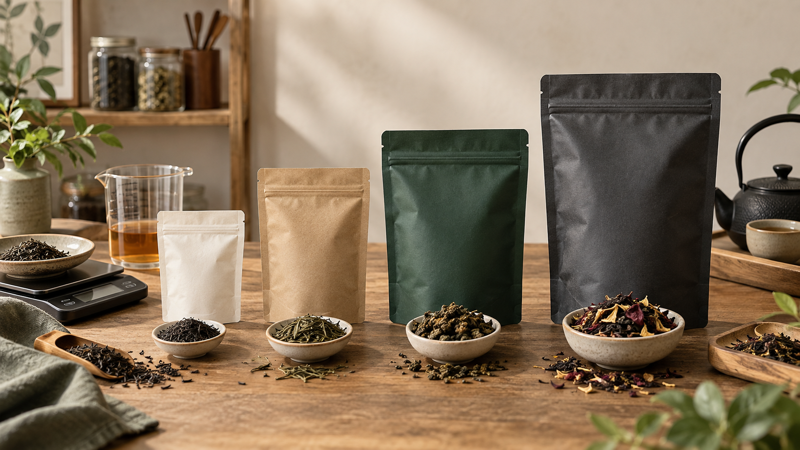
Choosing a tea pouch by net weight alone is one of the fastest ways to create a package that is either overfilled or visually empty. Twenty-five grams of dense rolled oolong occupies far less space than 25 grams of a long, wiry white tea. Broken black tea settles differently from whole-leaf green tea, while powdered tea brings its own dust and sealing problems. A reliable size decision therefore starts with the physical tea, the filling process, and the way the consumer will use the pack.
Tea needs enough working space for filling and sealing, but excess headspace increases material use, carton volume, and the chance that a package looks underfilled. The best size protects the leaf and fits the intended shelf or shipping system.
Start With Bulk Density, Not a Generic Size Chart
Bulk density is the mass of tea that fits into a known volume under defined conditions. It changes with leaf shape, cut, moisture, and the amount of settling caused by transport. Even two teas sold under the same category can produce very different filled pouch dimensions.
Measure several representative production lots rather than one hand-picked sample. Weigh the target quantity, pour it into a graduated container without crushing the leaves, and record the loose volume. Then repeat after a controlled settling step that resembles normal filling and handling. The difference between loose and settled volume helps define both the required pouch capacity and the expected shelf appearance.
Fragile whole leaves should not be compressed simply to fit a smaller bag. Compression can break leaves, alter appearance, and create sharp points that stress the film. A denser tea may tolerate a narrower pouch, but it still needs clearance around the seal area and any zipper.
Use Weight Bands as a Starting Point
The following framework is useful for early sampling, but it is not a final dimension chart. Each format must be tested with the actual tea and production equipment.
| Net weight | Common commercial use | Practical pouch direction | Main sizing risk |
|---|---|---|---|
| 25 g | Trial pack, premium micro-lot, gift assortment | Compact flat pouch or small stand-up pouch | Tall leaves may require more volume than expected |
| 50 g | Specialty retail pack or tasting size | Small stand-up or three-side-seal pouch | Zipper and header can consume too much usable space |
| 100 g | Core loose-leaf retail size | Medium stand-up zipper pouch | One size may not suit both dense and bulky teas |
| 250 g | Refill, foodservice, or high-consumption pack | Larger stand-up or side-gusset pouch | Filled bag may become unstable or too thick for cartons |
Treat these as packaging roles, not universal dimensions. A 50 g pouch for gunpowder green tea may be much smaller than a 50 g pouch for silver needle white tea. If the product range varies widely, create size families based on loose volume rather than forcing every SKU into a single footprint.
Compare Flat and Stand-Up Formats
Flat pouches use material efficiently and work well for samples, refills, and slim mailers. They can be filled and sealed quickly, but a very bulky leaf may create an uneven pillow shape. A generous opening is important when leaves are long or easily caught in the seal.
Stand-up pouches create a strong retail presentation and offer room for a zipper, label, and storytelling. The bottom gusset expands as tea enters, so the pouch must be opened fully during filling. If the gusset remains partially folded, the bag may appear undersized or lean on the shelf.
Stand-up zipper pouches are especially useful for 100 g and 250 g packs that consumers open repeatedly. The zipper should close without trapped leaf fragments, and enough space must remain above it for an intact heat seal and tear notch. Small 25 g packs may not justify the space and cost of a zipper if the tea is consumed quickly.
For an artisanal look, kraft paper bags can support natural positioning. However, the visible paper layer does not define barrier performance. The complete laminate, including the inner sealant and any barrier layer, must protect the tea from moisture, oxygen, light, and external odors.
Allow for Filling and Sealing Space
Usable capacity is smaller than the apparent outer dimensions. Side seals, the bottom gusset, zipper flange, tear notch, top seal, and rounded corners all consume area. Artwork may make the front panel look large, while the actual product cavity is restricted.
Create a simple fill-line specification for each SKU. It should define the target product level, minimum clearance below the zipper or top seal, and acceptable finished thickness. During trials, check whether loose leaves spring upward after dosing or migrate into the seal area.
Manual filling usually needs a wider opening and more working headspace than a well-controlled automatic system. Funnels should not crush the leaf or scrape the sealant. If a vibratory settling step is used, confirm that it does not separate tea components or damage delicate leaves.
Match Barrier to the Tea
Tea can absorb moisture and surrounding odors, and its aroma compounds may gradually escape. Light and oxygen can also reduce color and flavor quality. The required barrier depends on tea type, expected shelf life, distribution climate, and whether the product is flavored.
Foil stand-up pouches provide strong light, oxygen, and moisture protection for sensitive or premium teas. Metallized structures may offer a different balance of barrier, appearance, flex resistance, and cost. Transparent windows improve product visibility but introduce a lower-barrier area and more light exposure. If a window is important, keep it small and validate the complete package through shelf-life testing.
Flavored teas need particular attention to aroma retention and cross-odor protection. Strong oils or inclusions may also affect film selection. Confirm compatibility with the packaging supplier rather than assuming a structure used for plain tea will behave identically.
Consider Resealing and Consumer Use
A 25 g pack may be opened once or twice, while a 250 g pouch may remain in use for weeks. The larger the pack and the longer the use period, the more important zipper performance becomes. Test opening force, reclosure, and contamination with real leaves.
Position the zipper where consumers can reach it after removing the top seal. Leave enough grip area above the tear line, especially on matte or smooth films. A narrow header can be difficult to open, while an oversized header wastes material and display height.
The zipper cannot restore the original barrier after repeated opening, but it can limit exposure between uses. Brewing instructions should encourage consumers to press excess air out gently, close the zipper completely, and store the pouch away from heat, humidity, light, and strong odors.
Design Around Retail and Shipping
Shelf width, peg display, carton count, and parcel size can determine whether a pouch is commercially efficient. A broad 100 g bag may communicate value but reduce the number of facings. A narrow pouch may fit the shelf yet become unstable after filling.
For e-commerce, measure filled pouches in the intended mailer, then test drops, vibration, and compression. Avoid folding a pouch to fit because repeated creasing can damage the barrier.
Run a Structured Pouch Trial
Request unprinted samples in more than one size and, where possible, in the intended material structure. Fill each with at least the bulkiest and densest teas planned for that format. Evaluate fill level, leaf damage, seal clearance, zipper use, standing stability, label area, and carton fit.
Seal the samples on the actual equipment at realistic line speed. Inspect for leaf fragments, wrinkles, channels, and weak areas. Store the packs under expected conditions and check aroma, moisture, color, seal integrity, and appearance over time.
The broader process described in how to package loose-leaf tea is most effective when sizing, barrier, closure, and filling are treated as one system. A visually attractive pouch is not successful if it damages the tea or slows production.
Tea Pouch Sizing Checklist
- Measure loose and settled volume for representative production lots.
- Group teas by bulk density and leaf shape rather than product name alone.
- Test 25 g, 50 g, 100 g, and 250 g fills in physical samples.
- Reserve space for gussets, zippers, tear notches, coding, and heat seals.
- Choose barrier according to tea sensitivity, shelf life, and climate.
- Confirm zipper usability with actual leaves in the closure area.
- Measure filled packs for shelves, cartons, and shipping mailers.
- Approve size only after filling, sealing, storage, and distribution trials.
The right tea pouch size is the smallest format that holds the actual product without crushing it, contaminating the seal, or creating an awkward consumer experience. Weight narrows the options, but leaf volume, format, barrier, closure, and logistics determine the final answer. Physical trials turn those variables into a repeatable specification that works across production and the shelf.