
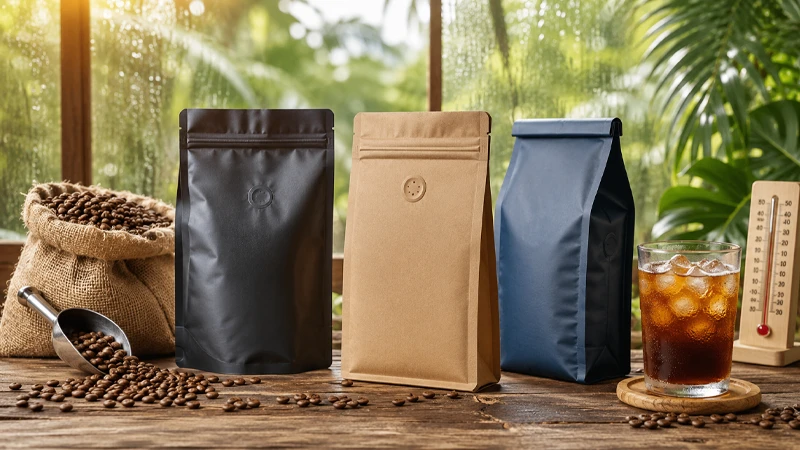
Selling roasted coffee in a hot, humid market creates a packaging challenge that goes far beyond appearance. Coffee may leave the roastery with excellent aroma, yet reach customers after weeks in warm warehouses and delivery vehicles. In these conditions, a pouch with insufficient barrier performance can become the weakest point in shelf-life protection.
The best coffee pouches for humid climates must control three risks at the same time: moisture entering the package, oxygen reaching the coffee, and seal failure caused by heat or contamination. This is important in the southern United States, Southeast Asia, and hot coastal areas of the Middle East, where packaging may face high temperature and humidity.
Why Hot and Humid Conditions Damage Coffee
Roasted coffee is dry and highly sensitive to its storage environment. Research identifies oxygen and moisture as two of the main factors affecting coffee stability and shelf life. Elevated oxygen, humidity, and temperature are also used in accelerated storage studies because they speed up measurable quality changes.
When the air outside a pouch is humid, water vapor gradually moves toward the drier product inside. If the film has inadequate resistance, the coffee may absorb moisture, lose crispness, grind less consistently, and develop a flatter aroma profile.
Heat increases the risk because it accelerates oxidation and places extra stress on films, adhesives, valves, and seals. A pouch that performs in a climate-controlled warehouse may not provide the same protection inside a truck in Florida or a coastal storeroom in Southeast Asia or the Gulf region.
Oxygen is equally damaging. Roasted coffee contains volatile aroma compounds and oils that are vulnerable to oxidation. Studies show that high-barrier packaging, together with reduced oxygen inside the pack, can slow aroma degradation and freshness loss.
Three Requirements for Coffee Pouches for Humid Climates
Strong Moisture Barrier
Water vapor transmission rate, or WVTR, describes water vapor passing through packaging. A lower WVTR generally means better moisture protection.
The barrier must be evaluated as part of the complete laminate, not judged from the visible outer layer. Kraft paper, for example, gives coffee packaging a natural appearance, but paper alone is not an adequate moisture barrier. A kraft pouch intended for tropical markets normally needs a laminated inner barrier and dependable sealant layer.
Aluminum foil provides extremely strong water-vapor protection when it remains undamaged. Metallized films can also deliver good performance at lower weight and cost, although results depend on coating quality and resistance to pinholes or flex cracking. Recyclable high-barrier structures are increasingly practical, but they should be tested at the expected temperature and humidity rather than selected only from room-condition data.
Low Oxygen Transmission
Oxygen transmission rate, or OTR, measures oxygen passing through a film or laminate. Coffee packaging needs a low OTR because small amounts of oxygen entering over time can contribute to oxidation and aroma loss.
The necessary barrier depends on coffee format, shelf-life target, distribution route, and nitrogen flushing. Ground coffee generally needs stronger protection because grinding creates more exposed surface area.
A low-OTR film cannot compensate for a leaking seal, damaged zipper area, poorly installed valve, or excessive residual oxygen after filling. Effective coffee pouches for humid climates combine strong materials with controlled filling and sealing.
Reliable Heat Seals
The seal is often the most underestimated part of a coffee pouch. In hot conditions, inconsistent seals may soften, creep, delaminate, or open during handling. Coffee dust or surface oil can also interfere with sealing.
The pouch should use a sealant with a wide operating window, giving the line more tolerance when temperature, pressure, dwell time, or speed varies. Good hot tack is also important because the seal must resist opening while still warm.
Bottom corners, gusset folds, zipper ends, and the area around the valve deserve particular attention. Several material layers overlap at these points, so heat may not transfer evenly. A seal that looks closed is not necessarily airtight.
Which Pouch Materials Perform Best?
The following structures are commonly considered for coffee sold in demanding climates. Final specifications should be confirmed through shelf-life and line trials.
| Pouch structure | Barrier performance | Suitable use |
|---|---|---|
| PET / aluminum foil / PE | Excellent moisture and oxygen barrier | Long shelf life, exports, premium whole-bean or ground coffee |
| PET / metallized PET / PE | High barrier with lower weight and cost than foil | Mainstream retail coffee and regional distribution |
| Kraft paper / foil or metallized film / PE | Strong barrier with a natural appearance | Specialty coffee brands using kraft-style packaging |
| High-barrier mono-PE | Recyclable potential with good sealability | Sustainability-focused brands after barrier validation |
| High-barrier mono-PP | Good stiffness and heat resistance | Selected recyclable flat-bottom or stand-up pouches |
Foil laminates remain dependable when maximum protection is the priority, especially for long shipping routes and storage without reliable climate control. Severe folding can damage foil, so converting and transportation must limit repeated flexing.
Metallized PET offers a practical balance of barrier, cost, and appearance, but not all metallized films perform equally. Buyers should compare actual OTR and WVTR data for the finished laminate.
Mono-material recyclable pouches can also work in humid climates when engineered with compatible high-barrier layers or coatings. Their performance should be checked after printing, lamination, pouch making, valve installation, filling, and sealing. A film data sheet alone does not represent the finished bag.
Why a Degassing Valve Still Matters
Freshly roasted coffee releases carbon dioxide after roasting. A one-way degassing valve allows this gas to escape while limiting outside air from entering. Without a valve, roasters may need to delay packing or accept pouch swelling and additional stress on the seals.
In hot environments, internal pressure can change as package temperature rises, making valve consistency and attachment quality especially important. The valve must be compatible with the laminate and applied with an airtight weld. A poor installation can become an entry point for moisture and oxygen even when the film itself has excellent barrier properties.
A valve does not replace oxygen control. Nitrogen flushing, low residual oxygen, and rapid sealing still matter. Research also indicates that valve-equipped packaging can help preserve roasted coffee when oxygen permeability and moisture control are properly managed.
Pouch Style and Construction Affect Protection
Flat-bottom bags provide strong shelf presence, but their folded corners and multiple seals require precise converting. Stand-up pouches suit smaller retail sizes, while side-gusset bags remain useful for larger volumes.
The zipper should sit below a fully sealed top section. After opening, it reduces exposure but cannot restore the original package environment, so it must close reliably even when fine coffee particles are present.
Opaque structures also reduce light exposure. When a window is required, a smaller carefully engineered panel is safer for long shelf-life products.
Testing Packaging for Tropical Distribution
Packaging should be qualified under realistic conditions, not selected only from a supplier’s specification sheet. ASTM F1249 is commonly used to measure WVTR, while ASTM D3985 addresses oxygen transmission through films and laminates. ASTM F88 measures flexible-package seal strength, and other package-integrity methods can evaluate leaks or burst resistance.
A practical validation program stores filled pouches at elevated temperature and humidity, then checks coffee moisture, aroma, residual oxygen, seal strength, valve performance, and delamination. Use finished production pouches because converted and valve-fitted bags may behave differently from raw film.
Sealing trials should also cover start-up, normal speed, and maximum production speed. Testing at one ideal temperature does not show whether the material has a sufficiently wide sealing window.
For coffee sold in the United States, food-contact layers, adhesives, coatings, and valve components should be appropriate for their intended use. The FDA regulates substances that contact food, including packaging components, adhesives, and coatings.
Choosing the Right Specification
There is no single structure that is automatically best for every hot and humid market. Coffee roasted in Texas and consumed within eight weeks has different requirements from ground coffee shipped internationally with a twelve-month shelf-life target.
The supplier should understand the coffee type, pack size, degassing period, nitrogen flushing, target shelf life, transport route, warehouse conditions, and sustainability goals. These factors determine whether foil, metallized film, kraft laminate, or a recyclable structure is most practical.
For demanding climates, specify performance before appearance. Begin with moisture barrier, oxygen barrier, seal strength, and package-integrity targets. Then choose the pouch style, printing, finish, and decorative features that can be added without weakening those functions.
Conclusion
The best coffee pouches for humid climates are complete protection systems. They use a low-WVTR structure to resist moisture, a low-OTR barrier to slow oxidation, and a sealant layer that remains dependable during filling, shipping, and storage. Valves, zippers, gussets, and windows must be integrated without creating weak points.
For brands entering the southern United States, Southeast Asia, or hot coastal Middle Eastern markets, trials under realistic temperature and humidity are essential. A well-designed pouch does more than prevent leaks. It protects aroma, supports shelf life, reduces complaints, and helps the coffee taste closer to the way the roaster intended.