
Understanding the VFFS Process: From Roll Stock to Sealed Coffee Bag
Are you trying to figure out which coffee packaging can you use on vertical form fill seal machines to scale up your roastery? If you want to move away from slow, manual hand-filling and transition to automated production, understanding the vertical form fill seal (VFFS) process is your first step.
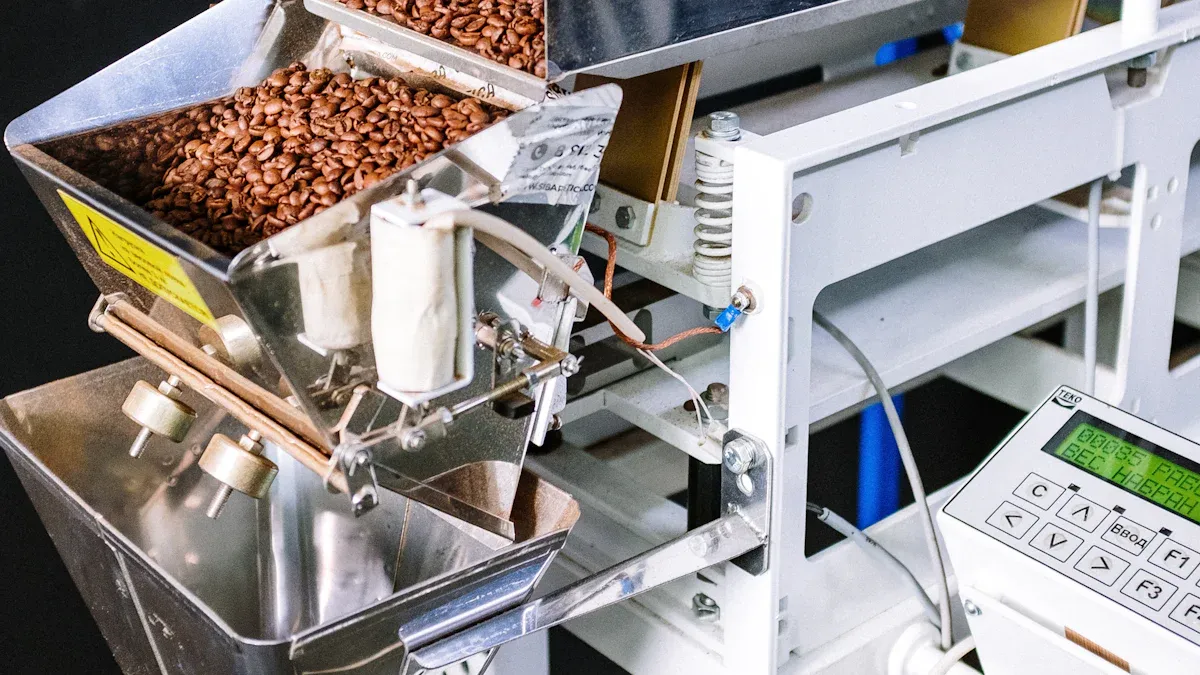
How an Automated Coffee Bagging Machine Works
- The Pulling Phase: The machine pulls the flexible roll stock over a forming tube.
- The Shaping Phase: As the film wraps around the tube, it shapes into a continuous cylinder.
- The Sealing Phase: A vertical heat sealing jaw configuration seals the back seam.
- The Filling Phase: Your coffee beans or grounds drop down through the center of the tube.
- The Cutoff Phase: Horizontal jaws seal the top of the filled bag and the bottom of the next one simultaneously, cutting them apart.
Why Flexible Roll Stock Lowers Per-Unit Packaging Costs
Switching from pre-made pouches to coffee rollstock film is the fastest way to drop your overhead.
| Packaging Type | Labor Cost | Material Cost | Production Speed |
|---|---|---|---|
| Pre-made Pouches | High (Manual loading) | Higher per bag | Slow |
| Flexible Roll Stock | Low (Fully automated) | Lowest per bag | Fast |
When you buy packaging in bulk rolls rather than individual pre-formed pouches, the manufacturing costs drop significantly. You also eliminate the labor expenses of opening, filling, and sealing each bag by hand.
Intermittent vs Continuous Motion VFFS
Choosing the right machine style impacts your throughput and the types of sustainable coffee packaging materials you can run.
- Intermittent Motion VFFS: The film stops moving every time the heat sealing jaw configuration closes to seal the bag. It is highly reliable, precise, and perfect for standard production speeds.
- Continuous Motion VFFS: The film moves forward without stopping. The sealing jaws move alongside the film to seal it on the fly. This mechanical setup offers the highest production speeds for high-volume commercial roasters.
Top 4 Coffee Bag Formats Compatible with VFFS Machines
When deciding which coffee packaging can you use on vertical form fill seal machines, the choice comes down to your target market, your production volume, and the specific equipment setup. Automated coffee bagging machines running flexible roll stock can form a surprisingly wide variety of bag styles.
Here are the top four most efficient and popular coffee bag formats you can run on standard VFFS lines.
Pillow Bags & Frac Packs (Fractional Packaging)
Pillow bags are the most straightforward, economical, and high-speed option for vertical packaging lines. Commonly referred to as a fractional pack (frac pack) coffee, this format features a top seal, a bottom seal, and a single vertical back seal.
- Best For: Hotel in-room coffee, restaurant portion packs, and office coffee service (OCS).
- Key Advantage: Incredible throughput speeds on VFFS machines with minimal material waste.
- Market Impact: Perfect for roasters specializing in high-volume commercial accounts or those packaging pre-measured grounds for quick brewing.
Side-Gusseted Coffee Bags
The side-gusseted pouch is a traditional staple in retail coffee culture. As the side gusseted roll film feeds through the VFFS forming tube, the machine tucks the sides inwards to create deep folds, allowing the bag to expand as it fills with fresh beans.
- Best For: 1lb and 2lb retail bags of whole bean specialty coffee.
- Key Advantage: Maximizes shelf space while allowing plenty of room for branding on both the front and back panels.
- Shelf Appeal: Provides that classic, artisanal look that American specialty coffee consumers recognize and love, making it a great fit for highlighting distinct origins like a rich, deeply developed Sumatran coffee roasting guide profile.
Quad-Seal (Four-Corner Seal) Bags
For a more premium retail presentation, a quad seal coffee pouch delivers maximum structural integrity. The VFFS machine seals all four corners of the bag, which reinforces the structure and prevents the package from bowing out or losing its shape on retail shelves.
- Best For: Premium, high-end retail coffee brands and club-store sizing.
- Key Advantage: Stands completely upright on its own with completely flat panels for crisp labeling or printing.
- Premium Feel: Offers a clean, box-like silhouette without the higher cost of pre-made boxes, making your product pop in competitive grocery aisles.
Sachet and Stick Packs
Sachet and stick packs are narrow, single-serving formats designed for maximum convenience on the go. These are formed using specialized, multi-lane VFFS configurations that split a wide roll of film into smaller individual strips.
- Best For: Instant coffee crystals, finely ground espresso portions, or functional mushroom coffee blends.
- Key Advantage: Extreme portability and precise single-serve dosing.
- Consumer Shift: Directly targets the fast-growing US demographic of busy commuters, outdoor enthusiasts, and travelers looking for premium coffee without a machine.
Essential Material & Film Structures for Coffee VFFS Lines
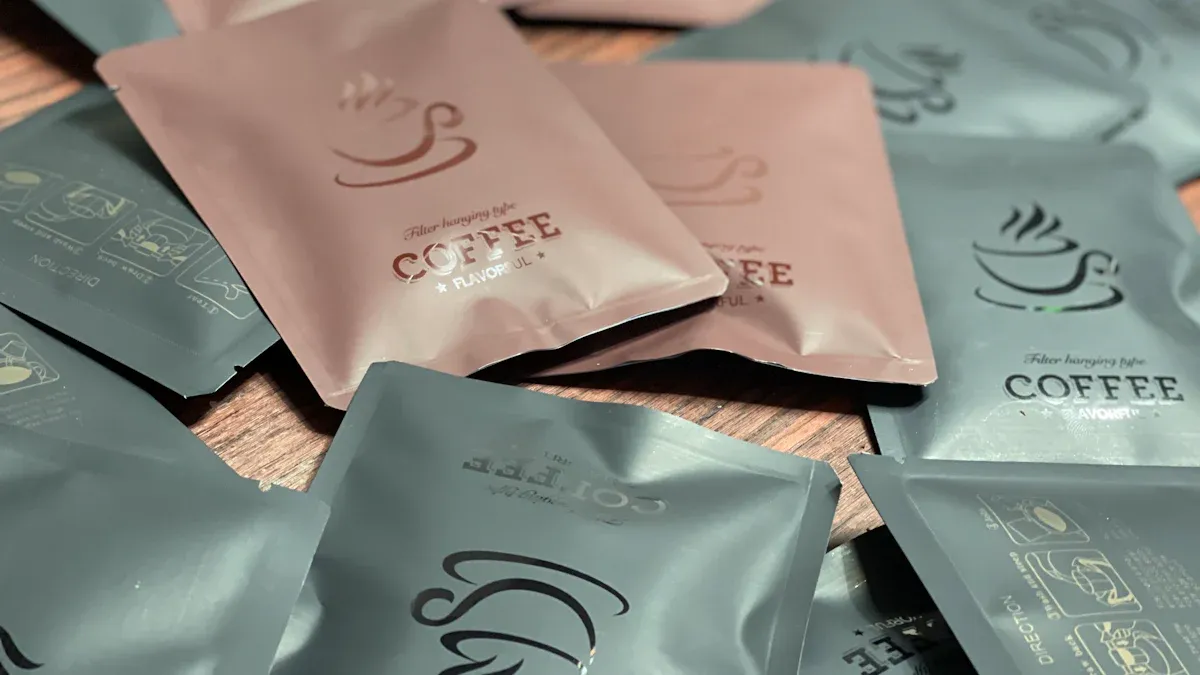
Choosing the right coffee packaging film for vertical form fill seal (VFFS) machines determines both your shelf life and production speed. The film must handle high-heat sealing jaws while keeping oxygen and light completely out.
Why Barrier Properties Matter
Coffee beans and grounds are highly sensitive to oxygen, moisture, and UV light. Without a strong barrier layer, volatile aromatics escape, and lipids oxidize, leaving you with stale coffee. For automated coffee bagging machines, high-barrier laminates are non-negotiable to maintain freshness from the roastery to the consumer’s cup.
Popular Flexible Film Laminates Available at BN PACK
We engineer our flexible roll stock to feed smoothly through VFFS systems while providing maximum protection. Here are the most reliable structures we produce for the US market:
| Material Structure | Barrier Level | Best Used For |
|---|---|---|
| PET / AL / PE | Ultra-High | Maximum shelf life, premium retail whole bean coffee |
| PET / VMPET / PE | High | Standard retail bags, fractional packs, and ground coffee |
| MOPP / VMPET / PE | High | Matte finish branding with excellent moisture resistance |
For roasters looking to display their product cleanly on shelves before transitioning to automated lines, our foil stand up pouches offer an identical high-barrier material benchmarking standard.
Eco-Friendly Roll Stock Options
US consumers demand sustainability, and your packaging line needs to adapt. We offer eco-friendly coffee rollstock film options designed to run on vertical packaging lines without melting or dragging:
- Recyclable PE/PE Film: A mono-material structure that can be recycled in standard US store drop-off programs while maintaining a reliable moisture barrier.
- Compostable Laminates: PLA and paper-based laminates that break down naturally. If you want to explore sustainable bulk options beyond roll stock, you can check out our compost bags wholesale solutions to align your entire brand with green initiatives.
Integrating Coffee-Specific Features on a VFFS Machine
To compete in the US coffee market, your packaging needs to do more than just hold beans; it has to preserve freshness and offer convenience. Integrating specialized hardware onto your automated coffee bagging machine allows you to move beyond basic pouches to professional, retail-ready solutions.
The One-Way Degassing Valve Integration
Freshly roasted coffee releases carbon dioxide, which can cause bags to bloat or even burst. We integrate valve applicators directly into the VFFS timeline. These valves allow $CO_2$ to escape without letting oxygen in, which is why most experts agree that coffee bags need a valve to maintain peak flavor profiles during transit and shelf life.
Gas Flushing (Nitrogen Flush System)
Oxygen is the enemy of coffee oils. By adding a nitrogen gas flushing system to your VFFS line, we displace oxygen within the bag before the final heat seal. This process significantly extends the “roasted-on” freshness of your product, ensuring the customer experiences the full aroma when they first open the pack.
Resealable Zippers & Tear Notches
For larger formats like side-gusseted or quad-seal bags, convenience is a major selling point for American consumers. We offer specialized resealable zipper roll stock and precision laser scoring to ensure a clean open and a secure close.
| Feature | Primary Benefit | Machine Requirement |
|---|---|---|
| One-Way Valve | Prevents bag bursting; preserves aroma | Ultrasonic or thermal valve applicator |
| Nitrogen Flush | Reduces O2 levels to <1%; extends shelf life | Gas injection lance & regulator |
| Tear Notches | Easy, tool-free opening for customers | Punch die on the sealing jaw |
| Press-to-Close Zip | Keeps coffee fresh after opening | Zipper feed and crush-seal module |
By combining high-barrier laminates with these integrated features, your VFFS line becomes a powerhouse for high-volume, professional production. Utilizing these tools effectively ensures your brand stands out for both quality and functionality.
How to Choose the Right VFFS Roll Stock for Your Roastery
Choosing the wrong flexible roll stock will quickly shut down your packaging line. When you transition to an automated coffee bagging machine, your film choice must perfectly match your machinery specs to avoid wasted material, poor seals, and costly downtime.
Key Specifications to Check Before Ordering from BN PACK
To keep your packaging line running at peak efficiency, you must verify how your specific vertical form fill seal machine handles roll film.
| Specification Metric | Why It Matters for Coffee Packaging |
|---|---|
| Film Thickness | Directly impacts barrier protection and heat jaw dwell time. |
| Core Size | Must match your machine’s unwind shaft (typically 3-inch or 6-inch). |
| Max Outer Diameter (OD) | Ensures the physical roll fits within your machine’s unwind cradle. |
| Coefficient of Friction (COF) | Dictates how smoothly the film slides over the forming collar. |
Film Thickness vs. Machine Jaw Dwell Time
Film thickness directly dictates your machine’s sealing settings. Thicker high-barrier laminates offer premium protection for fresh coffee beans, but they require higher temperatures or longer jaw dwell times to fuse completely. If the film is too thick for your heating configuration, you risk weak seals that split open under pressure. Conversely, running a thin film with excessive heat causes burn-through and melts the material.
Core Size and Maximum Outer Roll Diameter
You cannot run a roll that does not physically fit your equipment. Standard commercial VFFS machines in the United States generally require a 3-inch inner core, though some heavy-duty systems use 6-inch cores. Additionally, always check the maximum outer roll diameter and total weight capacity of your machine’s unwind shaft. Ordering rolls that exceed these dimensions leads to mechanical strain, motor failure, or roll stock that simply won’t fit the machine.
Coefficient of Friction (COF) for Smooth Pulling
The Coefficient of Friction (COF) measures how easily the film moves against the metal surfaces of your VFFS machine. For coffee packaging, you want a low, stable COF on the outside layer so the film glides smoothly over the forming collar without sticking, shuddering, or dragging. Proper COF ensures consistent bag lengths, precise cutting, and uniform tracking through the entire sealing cycle.
FAQs About Coffee Packaging on VFFS Machines
Can you run compostable films on standard VFFS heat jaws?
Yes, but it requires careful calibration. Sustainable coffee packaging materials like compostable films have a much narrower sealing window than traditional plastics. If your heat sealing jaw configuration is set too hot, the film will melt and warp; too cool, and it won’t seal properly. When running eco-friendly flexible roll stock, you often need to adjust the dwell time and install precise temperature controls on your vertical form fill seal machine to ensure strong, airtight seams without degrading the material.
What is the fastest bag style to produce on a vertical machine?
The pillow bag (or fractional pack) is by far the fastest format to run on an automated coffee bagging machine. Because the geometry is simple—requiring just a single back seal and two end seals—the machine can operate at maximum cycles per minute. More complex shapes, like a quad seal coffee pouch or a side gusseted roll film, require extra forming steps and cooling time, which naturally slows down the overall production speed.
How do you add a zipper to a vertical form fill seal bag?
Adding a zipper on a vertical line requires a specialized resealable zipper roll stock and a dedicated applicator attachment. As the coffee rollstock film feeds off the unwind reel, the zipper profile is fed into the forming tube inline. The machine’s heat jaws weld the zipper track to the inside of the film structure before the bag is filled and finalized. For roasters who aren’t ready to invest in a zipper applicator module for their VFFS hardware, choosing between roll stock film vs premade pouches is a critical decision, as premade pouches come with zippers pre-installed and ready to fill.