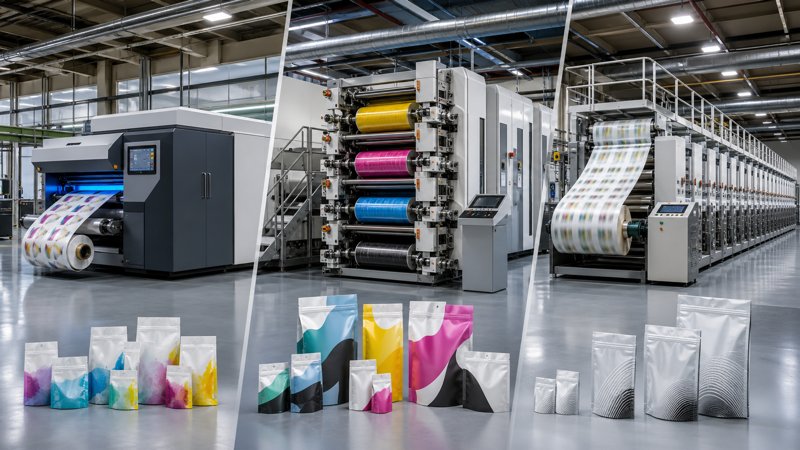
Choosing a printing method for flexible packaging is a business decision as much as a technical one. Digital, flexographic, and gravure printing can all produce attractive pouches, but their economics change with order quantity, number of SKUs, artwork complexity, material, quality expectations, and repeat demand. The lowest unit price on a large run may not be the lowest total cost for a launch with uncertain sales, while a low-setup method can become expensive when volume stabilizes.
MOQ is therefore not the only number to compare. Brands should evaluate setup investment, usable quantity per SKU, changeover waste, lead time, color-control requirements, repeatability, inventory risk, and the likelihood of artwork changes. A supplier’s how to customize packaging process should translate those factors into a quote for the exact package rather than a generic statement that one printing method is always best.
Digital Printing
Digital presses image the design directly without conventional printing plates or engraved cylinders. This removes a major part of the upfront tooling and makes short runs, multiple versions, and frequent artwork changes more practical. Several SKUs can sometimes be produced in one campaign when they share material and format, allowing the total volume to be divided across flavors, languages, seasonal designs, or test markets.
Digital printing is often attractive for product launches, limited editions, samples, regional versions, and brands that value cash flow over the lowest possible long-run unit price. It can shorten the path from approved artwork to print because there are no physical color plates to make. Variable data and design-to-design changes may also be possible, depending on the press and converter workflow.
The tradeoff is that digital has its own click charges, material restrictions, web widths, ink systems, finishing requirements, and economic crossover points. Large solid areas, specialty colors, metallic effects, or exact matches to an existing conventionally printed pack may require careful testing. Unit cost generally does not fall as steeply with volume as it does for flexo or gravure. The press may print quickly, but lamination, curing, slitting, and pouch making still add production time.
Flexographic Printing
Flexography uses flexible relief plates mounted on cylinders. Ink transfers from an anilox roll to the raised image and then to the film. Modern flexo can deliver excellent packaging quality, including process images, fine text, coatings, white ink, and spot colors. It is widely used for rollstock and pouches across medium and high volumes.
Each color normally requires a plate, and setup includes mounting, registration, ink preparation, press adjustment, and startup waste. That makes very small orders less economical. Once the press is running efficiently, however, flexo can offer competitive throughput and cost. Plate costs are usually lower than gravure cylinder costs, and plates can be retained for repeat orders when artwork and dimensions remain unchanged.
Flexo economics suit brands with growing or established demand, especially when several orders will reuse the same artwork. It can also be a good compromise between digital flexibility and gravure scale. The precise crossover depends on pouch size, number of colors, lane layout, run length, film, print coverage, press technology, and local production costs—not a universal pouch count.
Gravure Printing
Gravure printing uses engraved cells in metal cylinders to carry ink. It is known for long-run stability, strong solid coverage, smooth tonal reproduction, and durable tooling. The cylinders can deliver consistent results across large quantities and repeated orders when process control and materials are stable.
The initial investment is significant because every color and design repeat requires an engraved cylinder. Cylinder preparation and logistics can extend preproduction time, while press setup and startup waste make short runs inefficient. At high volumes, fast press speeds and long cylinder life can spread those costs across many packages and produce a low unit printing cost.
Gravure is often considered for established products, national distribution, large seasonal commitments, or global brands with predictable demand. It can be particularly valuable when dense solids, fine tonal work, and repeat consistency are central to the design. Yet high print quality is not exclusive to gravure, and volume alone does not automatically make it the correct choice. Total cost must include cylinder investment, inventory, storage, design obsolescence, and production location.
For a deeper comparison of the conventional processes, see flexo vs gravure printing. The procurement decision should focus on how their differences affect the brand’s order pattern.
Compare Setup Cost and Unit Cost Together
A useful model separates one-time or infrequent costs from variable production costs. Digital may have little conventional tooling but a higher running charge per unit. Flexo adds plate costs and setup, then becomes more efficient as volume grows. Gravure requires the highest cylinder investment and typically needs a large run to distribute it economically.
Do not compare quotations using unit price alone. Add plates or cylinders, prepress, proofs, material minimums, setup waste, freight, duties, storage, financing, expected obsolescence, and the cost of stockouts. If 20 percent of a large “cheap” order is discarded after a label change, the effective unit cost of the packages actually used can exceed a smaller digital run.
Request price breaks at several realistic quantities using the same specification. Divide the total landed cost by the number of usable packages, then model slow, expected, and fast sales. This reveals the point at which tooling investment is justified and the inventory exposure on either side of that point.
SKU Count Can Matter More Than Total Volume
Suppose a brand needs 100,000 pouches across ten flavors. A quote based on 100,000 identical pouches is misleading if each artwork receives only 10,000. Conventional tooling, changeovers, minimum ink and setup requirements may apply to every SKU. Digital production can sometimes combine the designs more efficiently, provided size, material, and finishing remain common.
By contrast, one stable design ordered in hundreds of thousands may strongly favor a conventional process. Consolidating common background artwork and applying some variable information later with labels or coding can reduce print versions, but it may also add labor and weaken appearance. The correct approach balances manufacturing efficiency with brand, traceability, and regulatory needs.
For custom coffee bags, a roaster might use digital printing for rotating origins and limited releases while moving a high-volume house blend to flexo or gravure. Using more than one method is reasonable if color references, pouch construction, and consumer expectations are managed across the range.
Lead Time and Change Risk
Digital printing can reduce tooling lead time, but material availability and finishing capacity still govern delivery. Flexo requires plate production and approval. Gravure requires cylinder engraving, proofing, and transport. Repeat conventional jobs may be faster because tooling already exists, provided no specification or artwork change is needed.
Consider the cost of information arriving late. New regulations, ingredient changes, distributor requirements, or marketing revisions can make printed inventory obsolete. A staged launch with smaller orders may buy valuable market knowledge. Once the design and forecast stabilize, larger conventional runs can capture scale.
For film roll packaging, coordinate print method with the filling line. Registration marks, repeat tolerances, web dimensions, slip, curl, and splice requirements affect efficiency. Savings in printing can disappear if the rollstock runs poorly or creates excessive changeover waste at the co-packer.
Color, Finish, and Material Questions
Ask every supplier to quote the same color architecture: CMYK, white ink, spot colors, matte or gloss varnish, and any specialty effect. A digital simulation of a spot color may not match a mixed flexo or gravure ink. Metallic film, transparent windows, kraft effects, and surface textures also narrow the available process and press options.
Approve process-specific samples. A digital prototype is useful for layout and can closely represent some production, but it should not automatically become the color standard for a later gravure run. Establish measurable targets or signed references and allow realistic tolerance for the material and process.
A Practical Selection Framework
- Choose digital when quantities per SKU are low, artwork changes frequently, launch risk is high, or versioning has strong value.
- Consider flexo when demand is repeatable, medium-to-high volume supports plate setup, and broad material and finish flexibility is needed.
- Consider gravure when volume is high and predictable, long-run consistency is critical, and cylinder investment can be spread across substantial repeat demand.
- Price several quantities and calculate landed cost per usable pouch, including tooling, waste, inventory, and obsolescence.
- Evaluate quantity per artwork, not only total quantity across the purchase order.
- Confirm material, pouch format, color stations, white ink, coatings, and finishing capacity for each process.
- Align print tolerances and roll specifications with filling and pouch-making equipment.
- Revisit the decision as forecasts, SKU count, design stability, and annual volume change.
There is no single MOQ at which every job should switch from digital to flexo or from flexo to gravure. The crossover is specific to the design, structure, supplier, production region, and commercial risk. A sound decision uses the brand’s real order pattern and total cost, preserving flexibility when uncertainty is high and investing in conventional scale when demand is proven.