
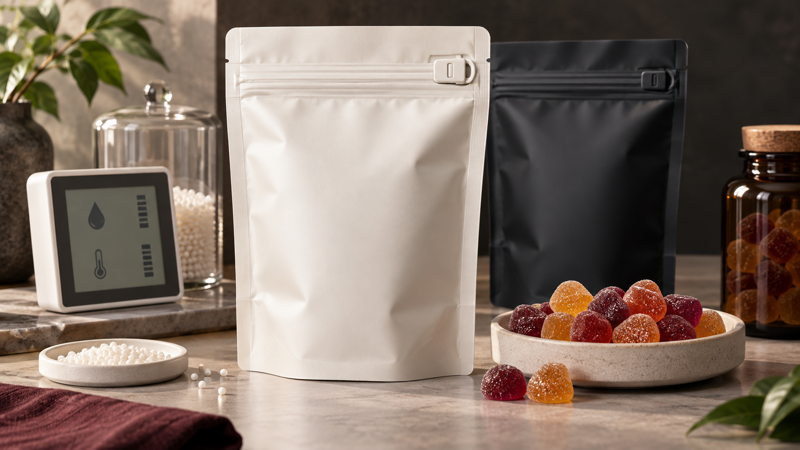
Gummy supplements combine the handling expectations of confectionery with the stability and safety responsibilities of a health product. Their texture can change with humidity and temperature, pieces may stick together, flavors can migrate, and oils or sugar can contaminate the closure. When the formulation or market requires child resistance, the pouch must also remain difficult for children to open while staying practical for adults throughout repeated use.
These requirements cannot be solved by selecting an attractive bag and adding a special zipper. Product formulation, pack size, barrier, headspace, seal design, closure, label content, and distribution testing need to be developed as one system.
Understand the Gummy’s Moisture Response
Gummies can absorb or lose moisture depending on their formulation and the surrounding humidity. Moisture gain may create a wet or sticky surface, soften texture, blur sugar coatings, and cause pieces to form a single mass. Moisture loss may make gummies tough or excessively chewy. The acceptable range is product-specific.
Measure water activity and moisture content during development, but also define sensory limits for texture, surface appearance, flavor, and separation. Two products with similar initial measurements can behave differently because of gelling agents, acids, sweeteners, oils, active ingredients, and coatings.
Determine the humidity conditions at which unacceptable change begins. This gives the packaging team a meaningful target for barrier modeling and stability studies. The analysis should cover both the sealed shelf-life period and the weeks after the consumer first opens the pouch.
Select Barrier for the Target Climate
Gummy bags may require moisture, oxygen, aroma, and light protection. The relative importance of each barrier depends on the formulation. Oxidation-sensitive oils or vitamins may need strong oxygen and light protection, while a hygroscopic gummy may be driven primarily by moisture control.
Review water-vapor and oxygen transmission data under test conditions that relate to the intended market. A material measured under mild conditions may not provide equivalent protection in a hot, humid distribution chain. Temperature also affects permeation and can soften the product, increasing the chance of blocking.
Foil and metallized laminates can provide strong barrier, while clear structures support visibility and may offer different performance. The finished pouch must be evaluated because zippers, seals, folds, and any hang-hole area can influence total protection. The principles behind moisture-resistant gummy packaging are most useful when connected to the actual formulation and use cycle.
Prevent Gummies From Sticking Together
Barrier is only one part of anti-sticking performance. Product temperature at filling, surface oil or sugar application, curing time, package headspace, and shipping exposure all matter. Gummies packed before their texture is stable may release or redistribute moisture inside the pouch.
Avoid filling warm gummies into a package that is immediately sealed unless the process has been validated. Cooling after sealing can change headspace conditions and encourage condensation in some circumstances. Control product temperature and room humidity, and minimize open exposure before packing.
Distribution testing should include prolonged vibration and warm conditioning. A pouch can pass a short room-temperature study yet arrive as a compacted block after a hot parcel route. Evaluate separation force, surface appearance, flavor, and ease of dispensing after the complete test sequence.
Match Pack Size to Daily Use
Serving count influences both stability and safety. A large value pouch may remain open for months, accumulating humidity exposure every day. A smaller pouch costs more per serving but reduces the opened-use period and may better preserve texture.
Calculate the number of servings, pieces per serving, and realistic consumption frequency. Include occasional missed days. Choose a size that consumers can finish within the validated open-life period, not just the longest retail size the equipment can fill.
The pouch opening should allow a controlled number of gummies to be removed without pouring too many into the hand. Test the design with actual piece shape and surface condition. Wide openings simplify filling but can encourage uncontrolled dispensing, while narrow openings may cause pieces to bridge.
Vitamin pouches can be sized across several dosage forms, but gummies require special attention to settled thickness and closure contamination. Fill representative counts, condition them through expected transport, and then assess the final dimensions before approving cartons and labels.
Separate Tamper Evidence From Child Resistance
Tamper evidence shows whether the package may have been opened or altered. A heat-sealed header above the zipper is a common first-opening feature for flexible pouches. Child resistance is a separate function intended to delay access by young children when the full package is correctly designed and tested.
A conventional press-to-close zipper should not be described as child resistant merely because it feels firm. Where child resistance is required, use an appropriate child-resistant zipper bag system and confirm that testing or certification applies to the complete package configuration.
The opening sequence should remain clear to adults. Instructions must be visible after the tamper-evident strip is removed. Test with the intended users, including older adults or people with limited dexterity where relevant. If users struggle, they may cut the package below the closure or transfer gummies to an unsecured container, defeating the design’s purpose.
Child-resistant performance also depends on correct reclosing. The consumer should receive tactile, audible, or visual feedback that the closure is fully engaged. Test the zipper after sugar, oil, or gummy residue has contacted the profile, because a clean laboratory sample may not represent daily use.
Keep the Closure and Seal Clean
Gummies are less dusty than powders, but coatings, oils, sugar particles, and product fragments can still enter the zipper or top-seal area. Residue may prevent reclosure or create weak heat seals.
Set the fill level below the closure and control pouch movement so gummies do not bounce into the header. The filling system should release pieces gently to avoid deformation and fragmentation. Inspect the seal area before the jaws close, especially when sticky products are packed at high speed.
Choose an inner sealant compatible with the gummy’s oils, acids, and flavors. Establish a sealing window for temperature, pressure, and dwell time. Excess heat can distort a child-resistant zipper or pouch mouth, while inadequate energy can leave channels.
Finished packages should undergo seal-strength and leak testing, followed by distribution conditioning. Recheck the closure afterward. A pouch that seals well before shipping may be more difficult to operate after product residue and compression affect the profile.
Evaluate Desiccants and Other Active Components
A desiccant may help control moisture when the formulation and risk assessment support it. Capacity should be calculated from headspace, package permeation, initial product condition, shelf life, and repeated opening. More desiccant is not automatically better; excessive drying can harden some gummies or change texture.
Placement must prevent accidental consumption and avoid interfering with dosing. A loose sachet can be mistaken for the product or removed early. Any active component should be appropriate for food or supplement contact, supported by documentation, and considered in labeling and child-safety assessment.
Create Clear, Durable Labeling
The pouch needs room for identity, serving information, ingredients, directions, warnings, net quantity, lot code, date information, storage guidance, and market-specific statements. Child-safety instructions should be prominent without competing with dosage directions.
Reserve a stable area for lot and date coding. Codes must adhere to the final surface and remain readable after handling. Do not place essential text in the bottom gusset or near the zipper where curvature and repeated flexing make it difficult to read.
Validate the Complete Consumer Journey
Stability testing should use production-equivalent gummies in finished pouches. Monitor texture, stickiness, moisture, water activity, active-ingredient stability, flavor, color, aroma, seal integrity, and closure function under normal and challenging conditions.
Include repeated-opening studies that simulate daily dosing. Expose the package for a defined time, remove the intended serving, introduce realistic closure contamination, and reclose it. Combine this with warm, humid storage to understand the opened-use limit.
Distribution tests should cover vibration, drops, compression, and temperature exposure in the final carton or mailer. Assess not only pouch damage but also gummy blocking, coating loss, code readability, and adult usability of the child-resistant closure.
Gummy Supplement Packaging Checklist
- Define the product’s acceptable moisture and texture range.
- Select barrier using the target climate and complete use period.
- Control gummy temperature, curing, coating, and room humidity before filling.
- Size the pouch for serving count, settled volume, and validated open life.
- Treat tamper evidence and child resistance as separate requirements.
- Test adult opening and reliable reclosing with product residue present.
- Keep gummies and coatings away from the heat seal and zipper.
- Validate stability, distribution, coding, and consumer use together.
Gummy supplement packaging succeeds when it preserves a pleasant, separable texture and supports safe daily use. Moisture control begins with the formulation and extends through the laminate, seals, pack size, and consumer routine. Where child resistance is required, the closure must remain effective after repeated real-world handling—not only when the pouch is new and clean.