
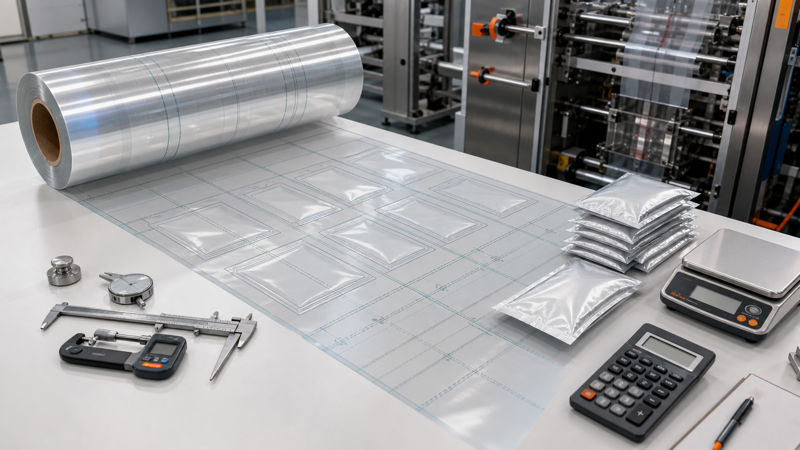
Rollstock quotes are often expressed per kilogram, square meter, or roll, while finance teams need a cost per finished package. Converting one measure into the other requires more than dividing roll length by pouch height. Web width, repeat length, lanes, film density, thickness, seal layout, registration, splices, startup waste, and filling efficiency all affect saleable output.
A transparent yield model helps brands compare films, pouch sizes, suppliers, and machine layouts on the same basis. It also explains why a small change in width or repeat can create a large cost difference when it changes lane count or material waste.
Define the Required Inputs
Collect web width, repeat length, number of packages across the web, film thickness, laminate density or basis weight, roll length or net roll weight, core and outer-diameter limits, print repeat, seal type, edge trim, and expected waste. Use consistent units throughout the calculation.
The specification for film roll packaging should also identify unwind direction, eye mark, fin or lap seal, seal widths, gusset formation, and lane arrangement. A supplier’s theoretical layout must match the actual filling machine. Otherwise, an attractive yield calculation can describe film that cannot run.
For multilayer laminates, do not use the density of one polymer for the entire structure. Either calculate mass from each layer or use the converter’s verified total basis weight in grams per square meter. Adhesive, ink, coatings, foil, paper, and tie layers all contribute.
Method 1: Yield From Roll Length
When net usable roll length is known, theoretical packages per roll can be calculated from machine direction repeats and lanes:
Theoretical packages = (usable roll length ÷ repeat length) × number of lanes
Use the same units for length and repeat. A 3,000-meter roll with a 250-millimeter repeat contains 12,000 repeats. If the web produces three lanes, theoretical output is 36,000 packages.
This calculation assumes every repeat becomes a good package. Real rolls include startup material, register adjustment, splices, defects, roll-end material, sampling, and filling losses. If expected total waste is 5 percent:
Saleable packages = theoretical packages × (1 − waste rate)
The example would yield 34,200 saleable packages. Track printing, slitting, and filling waste separately when possible because each has a different cause and improvement owner.
Method 2: Yield From Roll Weight
If film is sold by weight, first calculate area from basis weight:
Film area in m² = net film weight in kg × 1,000 ÷ basis weight in g/m²
If a laminate weighs 120 g/m² and the net roll contains 500 kg of film, its theoretical area is 4,166.7 m². Divide area by web width in meters to estimate length. At 1.0-meter usable width, the result is about 4,166.7 linear meters.
Basis weight can be estimated from thickness and density for a single material:
Basis weight in g/m² = thickness in microns × density in g/cm³
For example, 100-micron polyethylene at density 0.92 g/cm³ is approximately 92 g/m². For a laminate, calculate each layer and add adhesive and coatings, or use measured basis weight. The guide to plastic film thickness provides useful context for interpreting gauge and micron values.
Roll weight must exclude the core and external packaging. Confirm whether the invoice quantity is gross or net. Moisture in paper structures and normal thickness tolerance can also change actual mass and yield.
Packages per Square Meter
For a simple rectangular repeat, the printed area allocated to one package is:
Area per package = repeat length × lane pitch
Lane pitch includes the package width plus any seal, slit, or trim allowance assigned to that lane. If the web contains three equal lanes across 0.99 meter, lane pitch is 0.33 meter. With a 0.25-meter repeat, each package consumes 0.0825 m² before waste. Theoretical yield is about 12.12 packages per m².
Do not substitute finished face dimensions for pitch. Side seals, gussets, fin-seal overlap, trim, and gaps are material even though they are not part of the visible front panel. Fin and lap seal pouches use different overlap geometry, and the correct allowance must come from the machine and seal design.
Lane Efficiency and Web Utilization
Web utilization shows how much of the purchased width contributes to package repeats:
Web utilization = total lane pitch used for packages ÷ purchased web width
If three 300-millimeter lanes and 30 millimeters of combined trim use a 930-millimeter web, the package lanes occupy 96.8 percent of the width. If increasing pouch width by 15 millimeters forces the layout from three lanes to two, output per meter can fall by one-third even before material area per pouch is considered.
Ask the converter for a lane drawing rather than assuming maximum press width is efficient. Sometimes a narrower dedicated web reduces trim; in other cases a standard web is cheaper because it is stocked and runs well. Price and yield must be considered together.
Add Converting and Filling Waste
Create a waste waterfall so the effect of each stage remains visible. If printing delivers 98 percent good material, lamination and slitting retain 99 percent, and filling converts 96 percent into good packs, combined yield is:
Combined yield = 0.98 × 0.99 × 0.96 = 0.9314, or 93.14%
Adding loss percentages directly would give 93 percent in this example, which is close but mathematically less accurate. Multiplication becomes important when more stages or larger losses are involved.
Typical losses include press setup, color and register adjustment, rejected print, lamination defects, splice removal, slitter trim, roll-end waste, filler threading, eye-mark errors, seal contamination, code rejects, and line stops. Use trial or production data for the exact material and machine rather than a single company-wide assumption.
Calculate Packaging Cost per Good Unit
If the roll is priced as a total amount:
Film cost per good package = total roll cost ÷ saleable packages from the roll
If priced by area:
Film cost per good package = price per m² × area per package ÷ combined yield
If priced by weight:
Film cost per good package = price per kg × kg per package ÷ combined yield
Add printing plates or cylinders, setup, freight, duties, quality testing, and conversion charges according to how they are quoted. For an annual program, amortize reusable tooling across the realistic lifetime volume. For a one-time seasonal design, place the full tooling cost on that order.
Food packaging roll film must also be evaluated for product protection and line performance. The lowest film cost per theoretical pack is irrelevant if seal defects, barrier loss, curl, or coefficient-of-friction problems reduce good output.
Worked Example
Assume a 0.96-meter usable web, four lanes, 0.20-meter repeat, and 2,500-meter usable roll length. Theoretical output is:
(2,500 ÷ 0.20) × 4 = 50,000 packages
If combined printing-to-filling yield is 94 percent, good output is 47,000 packages. At a landed roll cost of $4,230, direct film cost is $0.09 per good package. If reusable tooling amortization adds $0.004, testing adds $0.001, and expected quality loss adds $0.002, the modeled packaging cost becomes $0.097 per saleable unit.
Now compare a slightly wider pouch that permits only three lanes. Even if repeat length and roll length remain unchanged, theoretical output falls to 37,500. Unless the roll width or price also decreases significantly, cost per package rises. This is why size optimization should occur before artwork and tooling approval.
Calculation Checklist
- Use net usable web width, roll length, and film weight.
- Confirm repeat length, lane pitch, lane count, trim, and seal overlap with the filler.
- Use measured laminate basis weight or a layer-by-layer mass calculation.
- Separate theoretical yield from printing, converting, and filling losses.
- Multiply stage yields to calculate combined good output.
- Divide total landed and conversion cost by good packages, not nominal repeats.
- Model how width, repeat, lanes, thickness, and waste change cost.
- Validate the model with actual roll reconciliation after production.
Film yield is a bridge between engineering and finance. When dimensions, material mass, web layout, and real process losses are visible, brands can identify whether savings should come from downgauging, better lane utilization, lower waste, improved line settings, or commercial negotiation—without confusing a lower material quote with a lower cost per good package.