
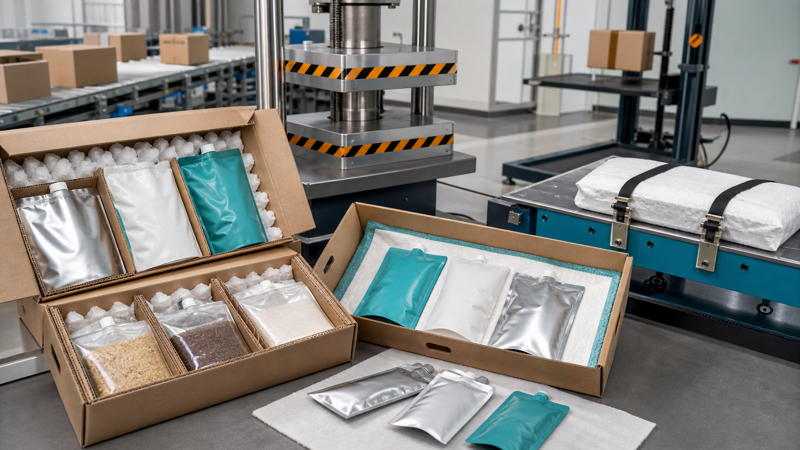
E-commerce distribution exposes flexible pouches to a different hazard pattern from palletized retail freight. One pouch may travel with hard, heavy, or sharp items in a partially filled box. It can be dropped repeatedly, compressed by automated sorting, vibrated for hours, exposed to heat or cold, and carried through altitude changes. A package that survives factory inspection may leak after its seals, corners, zipper, valve, or spout experience those combined stresses.
Preventing leaks requires a package-system approach. The pouch, product, headspace, seals, closure, secondary protection, parcel size, and distribution route must work together. Making the film thicker can help in some cases, but it will not correct contaminated seals, sharp product edges, excessive headspace pressure, or an oversized shipping box.
Identify the Actual Failure Location
Do not describe every damaged pack as “a leaking pouch.” Record where the failure begins. Common locations include the top seal, side seal, bottom gusset, zipper endpoint, valve flange, spout seal, folded corner, body panel, or tear notch. Photograph the unopened parcel, cushioning, neighboring items, wet or oily marks, and the exact pouch orientation.
A seal channel suggests a different cause from a punctured body panel. Burst seals may indicate internal pressure or insufficient seal strength. Fine pinholes can come from flex cracking, abrasion, or sharp contents. A spout leak may involve cap torque, tamper band, fitment damage, or the spout-to-film interface.
Trace failures to production lot, pouch lane, filling time, carton style, carrier route, and weather when possible. A pattern limited to one lane can point to pouch making; failures in mixed parcels may point to secondary packaging or fulfillment handling.
Map E-Commerce Hazards
Drops occur on faces, edges, and corners. Edge drops can drive the product mass toward a bottom-gusset transition or side seal. Repeated low-height drops may be more damaging than one dramatic event because they progressively weaken folds and seals.
Compression comes from stacked parcels, conveyor jams, and heavy products packed above or beside the pouch. Unlike a retail case, the parcel may not distribute load evenly. A small hard object can create a concentrated pressure point against the flexible wall.
Vibration causes products and packages to rub. Rough corrugated surfaces can abrade printing or thin a pouch corner. Granules, beans, frozen pieces, or product inclusions can repeatedly strike the same internal spot. Empty space allows the pouch to accelerate before impact.
Altitude and temperature change internal pressure and material behavior. Gas-filled or warm-filled packages may expand at lower external pressure. Cold films can become less flexible, while heat can soften polymers, increase product vapor pressure, or affect cap and seal behavior. The route profile should guide validation.
Match the Pouch Structure to the Product
Begin with product form. Smooth powders create dust and seal contamination. Beans and granules can puncture under compression. Liquids transmit impact directly to seals and fitments. Products with oil can migrate into weak interfaces. Sharp dehydrated pieces or frozen edges need higher puncture resistance.
The structure should provide the required barrier plus mechanical toughness. Nylon or other tough layers may improve puncture resistance. A thicker sealant can support seals and resist internal abrasion. Foil provides excellent barrier but can crack at severe folds, so supporting layers and geometry matter.
Stand-up pouches need special attention at bottom corners and gusset transitions. The base must carry product weight when upright and survive corner drops in the parcel. Overfilling can prevent the gusset from opening normally and concentrate load near seals.
Three-side seal pouches eliminate a bottom gusset but still need adequate perimeter seals and body strength. Their flatter shape may suit parcel packing, yet product can move toward one sealed corner. Choose format according to the distribution hazard rather than shelf appearance alone.
Build a Robust Seal Window
Seal integrity depends on sealant compatibility, temperature, pressure, dwell time, cooling, cleanliness, and alignment. The production target should sit inside a wide validated window, not at the edge where ordinary variation creates weak seals.
Fine powder, oil, moisture, or product fragments in the seal area can form channels. Improve filling control, dust extraction, settling, nozzle position, and headspace. Inspect sealing jaws for damage, contamination, and uneven pressure. Confirm that wrinkles and gusset folds are controlled before the final seal closes.
Measure seal strength and use leak tests that fit the product and package. A high peel value alone does not prove the absence of channels. Combine visual inspection, peel testing, bubble or vacuum methods, burst or creep testing, and filled-package distribution tests as appropriate.
Seals can change after production. Adhesive cure, hot filling, product contact, cold storage, and time may affect performance. Test after realistic conditioning rather than only immediately after sealing.
Control Headspace and Internal Pressure
Headspace protects some fragile products, but excessive gas can turn the pouch into a balloon during altitude exposure or compression. Insufficient headspace can force product into the zipper or final seal. Set a target range tied to product needs and pouch volume.
For gas-flushed products, measure residual oxygen and gas volume while also evaluating parcel performance. For coffee, degassing continues after packing; the article on shipping coffee provides category-specific considerations. One-way valves need adequate flow and must not be blocked by tightly packed neighboring pouches.
Liquids should leave enough expansion space for temperature change without creating uncontrolled slosh. Vacuum can reduce air but may pull sharp product edges against the film. Validate the actual evacuation level and distribution orientation.
Protect Spouts, Caps, and Zippers
Spouted pouches combine flexible walls with a rigid fitment. The cap can act as a lever when struck, transferring force into the spout seal. Position and protect it so parcel loads do not press directly on the cap.
Verify cap torque, thread engagement, tamper evidence, liner or plug where used, and spout-to-pouch seal integrity. Test side impacts and cap-first drops. A secondary overcap, neck support, or molded guard may be justified for heavy liquids.
Zippers should remain below an intact top seal during shipping. Product must not contaminate zipper-end seals or final seal jaws. If the consumer package is shipped after first use, reclosure alone may not be leakproof enough for liquids or fine powders; provide appropriate instructions and secondary containment.
Design Secondary Packaging Around the Pouch
The shipping parcel should limit movement and isolate the pouch from sharp or heavy items. Use a correctly sized box or mailer, dividers, trays, sleeves, cushioning, or absorbent protection according to risk. Cushioning should support the package without creating concentrated pressure on valves or gussets.
For liquids, consider a sealed secondary bag and absorbent material sized for credible leakage. This does not replace primary-package validation, but it can contain a rare failure and protect other shipments. Retail multipacks may use a corrugated insert that keeps caps separated and distributes compression.
Avoid loose pouches against raw corrugated when long vibration can cause abrasion. Smooth liners or controlled orientation can protect printed surfaces and weak corners. Pack density should prevent movement without crushing the product.
Validate the Complete Parcel
Test the final sale unit inside the final shipping configuration, including labels, inserts, other products, void fill, and carton tape. Condition samples at expected temperature and humidity extremes. Include altitude or reduced-pressure exposure when air transport or high-elevation delivery is credible.
Use a distribution sequence that represents handling: vibration, drops on multiple orientations, compression, and further vibration or drops. Real parcels experience hazards in combination. Test the heaviest fill, largest headspace, weakest pouch orientation, and most damaging mixed-item scenario.
After testing, inspect for gross leaks and microscopic damage. Measure seal integrity, cap torque, valve function, barrier where relevant, and product quality. A pouch may remain dry yet develop a pinhole that shortens shelf life.
Run a monitored pilot shipment across representative routes. Laboratory simulation is controlled and repeatable; field shipments reveal fulfillment errors and unexpected carrier conditions. Use both before a high-volume launch.
E-Commerce Leak-Prevention Checklist
- Record exact failure location, parcel condition, lot, lane, route, and orientation.
- Match laminate toughness and sealant to product shape, chemistry, and temperature.
- Validate a wide, clean sealing window and control product contamination.
- Set headspace, gas flush, vacuum, and valve behavior for altitude and compression.
- Protect zippers, spouts, caps, gussets, and sharp product points.
- Size secondary packaging to prevent movement and concentrated loads.
- Test the complete parcel through conditioned vibration, compression, altitude, and multi-orientation drops.
- Inspect for hidden barrier damage as well as visible leakage.
- Confirm results with pilot shipments and ongoing complaint trending.
E-commerce leaks are rarely solved by one material upgrade. The durable solution begins with the failure location, accounts for product and parcel hazards, controls seals and headspace, and validates the complete shipment. That approach reduces both obvious spills and invisible damage that can shorten shelf life after delivery.