A sample package has a specific job: deliver enough product for someone to try it properly, in a condition that represents your brand.
Making the pouch smaller or choosing the lowest unit price does not always achieve that goal. An undersized sample may prevent a useful trial. A difficult opening, leaking seal, or damaged delivery may undermine the experience before the product is used.
Three side seal bags are one option for sample programs. This guide explains how to decide whether they fit your project, what to specify, and how to compare the complete cost before ordering.

When Does a Three Side Seal Sample Bag Make Sense?
A premade three side seal pouch has three sealed edges and one opening for filling. After the product is added, the remaining opening is sealed.
The format is worth considering when you need a flat package for a defined quantity of product.
| Sample purpose | What the package needs to achieve |
|---|---|
| A single product trial | Provide enough product for the intended use |
| A trade-show giveaway | Remain identifiable, portable, and usable after the event |
| A retailer or distributor sample | Preserve product condition and identify the exact variant |
| A subscription discovery set | Keep individual products separate and easy to compare |
| A professional evaluation sample | Support the recipient’s evaluation procedure and traceability |
For available formats and customization features, explore our three side seal pouches.
A flat pouch is less suitable when the project requires a standing base, substantial repeated access, or another dispensing method. Define the use before selecting the format.
1. Choose the Trial Quantity Before the Bag Dimensions

Start with the question: what must the recipient be able to do with this sample?
One portion may be enough for a simple tasting. It may not be enough for a product that requires preparation, equipment adjustment, or repeated evaluation.
Specify:
- The intended trial or evaluation.
- Product quantity required for that task.
- Whether the sample should support more than one use.
- Any preparation instructions or additional components.
- The expected time between packing and use.
For example, a coffee sample intended for repeated brewing needs a different quantity from a single prepared dose. Our coffee sample pack packaging guide discusses those use cases in more detail.
Do not reduce the fill simply to fit a preferred pouch. That can save packaging space while making the sample less useful.
2. Determine Dimensions With the Actual Product
Grams and milliliters describe the contents. They do not specify the pouch’s external width and height.
Powders, whole beans, irregular snacks, and creams occupy space differently. The opening, seal widths, and final sealing allowance also affect usable capacity.
Ask for a drawing that identifies:
- Outside width and height, with units.
- Side and bottom seal widths.
- Filling opening.
- Clearance for the final seal.
- Tear-notch, window, or closure positions.
Then fill candidate samples with the actual product.
Check whether the product enters cleanly, whether it contaminates the sealing area, and whether the filled pouch fits its display or mailer.
A sample that looks attractive when empty can behave differently after filling. Approve the filled pack rather than the artwork alone.
3. Match Protection to the Product and Distribution Period
A small sample still needs appropriate protection.
Select the structure around the contents, intended storage period, transport conditions, and any processing requirements. Avoid assigning a material solely because it is described as “high barrier.”
| Product characteristic | What to discuss with the supplier |
|---|---|
| Moisture sensitivity | Relevant water vapor transmission data and sealing performance |
| Sensitivity to oxygen | Relevant oxygen transmission data and finished-pack integrity |
| Light sensitivity | Light transmission through the complete design, including windows |
| Oils, acids, or solvents | Compatibility with the formulation and contact conditions |
| Sharp or irregular pieces | Puncture risk and filled-pack handling |
| Heating or freezing | The specific temperatures, durations, and handling conditions |
Material names alone do not establish suitability. Compare the proposed construction and supporting information.
Our laminated packaging page introduces construction options for discussion; the final selection should be application-specific.
For food samples, the FDA explains that food-contact safety assessment considers intended use and migration into food. Request documentation relevant to the proposed material, food, contact conditions, and destination market.
4. Compare Premade Pouches With Rollstock
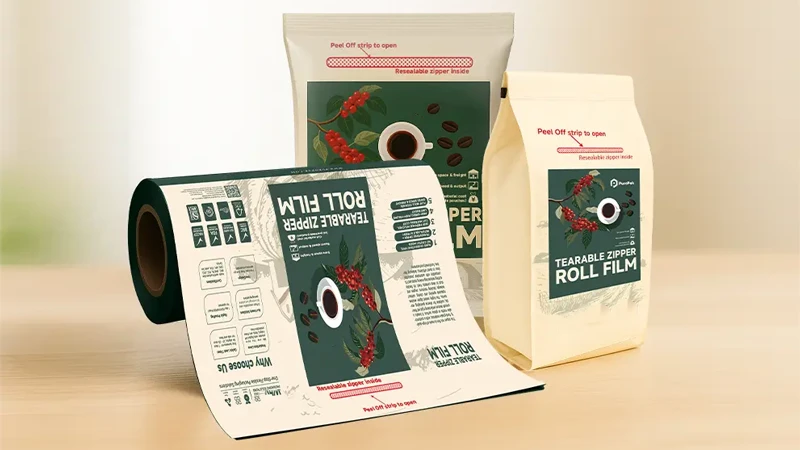
Confirm how the samples will be packed before requesting a quotation.
Premade pouches: assess how bags are opened, filled, and finally sealed on your operation.
Rollstock: assess how the machine forms, fills, and seals the package. Film width, repeat length, sealing arrangement, and equipment requirements become part of the specification.
Do not compare only the price of an empty pouch with the price of film. Include setup, labor, equipment availability, production losses, and the number of designs.
If your operation forms sachets from film, discuss rollstock packaging separately from a premade-bag quotation.
5. Calculate Cost per Usable Sample
The lowest pouch price is not necessarily the lowest sample-program cost.
A useful comparison includes:
- Packaging and printing.
- Setup and artwork-related charges.
- Product fill.
- Filling and sealing labor.
- Rejected or damaged units.
- Labels and inserts.
- Fulfillment and shipping, where applicable.
- Unused or obsolete inventory.
Use the same cost scope for each option.
A Hypothetical Cost Comparison
The following example illustrates the calculation. It is not BN PACK pricing or a reported production result.
Assume both options have the same planned output of 10,000 filled samples. The costs below cover packaging, product, and filling, including units subsequently rejected.
| Measure | Option A | Option B |
|---|---|---|
| Total production cost | $4,000 | $4,300 |
| Usable filled samples | 8,500 | 9,800 |
| Cost per usable sample | $0.471 | $0.439 |
Calculation: total production cost ÷ usable filled samples
Option B costs more overall but less per usable sample in this hypothetical situation.
This does not mean a higher-priced pouch always reduces rejection. Replace the assumptions with quotations and trial results from your project.
6. Make the Sample Easy to Identify and Open
A sample may be separated from its display, event handout, or outer carton. Important information should remain with the individual pack.
Plan space for:
- Product name and variant.
- Brand identification.
- Quantity and relevant use instructions.
- Batch or lot identification.
- Applicable labeling information for the product and market.
- A clear next step, such as a product page or contact route.
Test QR codes and barcodes on the filled pouch. Curvature, glare, wrinkles, or poor contrast can affect usability.
For opening, assess notch position and tear behavior with the actual material. A notch alone does not establish that the package opens cleanly or dispenses conveniently.
Add a zipper only when repeated access is part of the sample’s purpose. It takes space and introduces another feature to evaluate.
7. Separate Different Types of Packaging Samples
The word “sample” can describe very different things.
| Sample supplied | What it can help you assess | What it does not establish by itself |
|---|---|---|
| A stock pouch | General construction, handling, or format | Fit and performance of your final specification |
| An appearance mock-up | Artwork placement and visual presentation | Production material or seal performance |
| A representative construction sample | Material feel and relevant structural features | Results under your actual filling conditions |
| A filled trial pack | Fit, opening, sealing, and selected handling behavior | Every aspect of long-term shelf life |
Ask the supplier what the sample represents and what differs from the proposed order.
Keep the approved reference and record its construction, dimensions, features, and artwork version.
8. Test Before Scaling the Campaign
Run a trial that reflects the intended operation and distribution route.
Check filling accuracy, contamination at seals, leakage, opening behavior, coding readability, and handling in the final mailer or carton.
Where appropriate, include a defined seal-strength method. ASTM F88/F88M addresses seal strength in flexible barrier materials. It is not, by itself, a universal pass/fail specification or proof that a package is leak-free.
Agree the relevant methods, sampling plan, and acceptance criteria for the project.
Record the pouch specification, product, equipment settings, trial conditions, results, and approval decisions. Use those records when changing material, dimensions, product, or filling conditions.

Frequently Asked Questions
Are three side seal bags always the cheapest sample packaging?
No. Compare the complete packed-sample cost, including filling, losses, fulfillment, and unused inventory.
What is the best size for a sample pouch?
The size should follow the quantity needed for a useful trial, the product’s occupied volume, and the required filling and sealing space.
Can one pouch size cover several products?
Possibly. Verify each relevant product and fill quantity rather than approving the whole range from one sample.
Do single-use samples need resealable zippers?
Not automatically. Select a closure around the intended use instead of adding features by default.
Can small pouches be called recyclable or compostable?
Only make claims supported for the complete package and relevant disposal conditions. Small size or plant-derived content alone does not establish either claim.
Plan Your Sample Packaging With BN PACK
A useful inquiry starts with the sampling task.
When contacting BN PACK, include the product, intended trial quantity, number of variants, campaign volume, filling method, destination market, and required delivery date.
Ask about candidate dimensions, material options, printing approaches, sample availability, and quotation scope.
The goal is a package that lets recipients evaluate your product properly—and gives your team a specification it can purchase and repeat.