
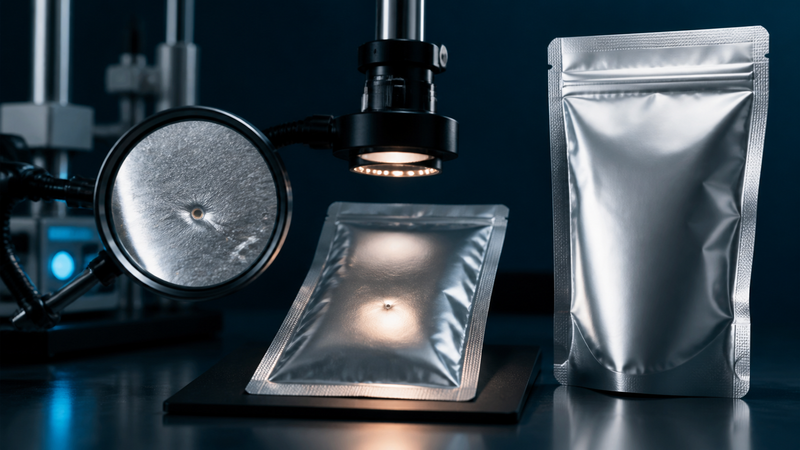
Aluminum foil offers outstanding protection from oxygen, moisture, light, and aroma loss, which is why it appears in demanding food, supplement, pharmaceutical, and industrial packaging. Yet foil is a thin metal layer. When it is flexed, folded, stretched, punctured, or abraded beyond its tolerance, microscopic holes can form. One pinhole may be almost invisible but can undermine the barrier that justified choosing foil in the first place.
The solution is not simply to specify the thickest foil available. A reliable pouch balances foil gauge, supporting films, adhesive, sealant, pouch geometry, product shape, converting conditions, and distribution hazards. This guide explains the main pinhole mechanisms and gives brand owners a practical prevention and validation plan.
Why Pinholes Matter
A pinhole does not always produce an immediate liquid leak. In dry products, the first consequence may be slow oxygen or moisture ingress, leading to rancidity, loss of crispness, discoloration, vitamin degradation, caking, or reduced aroma. In vacuum packs, air may gradually enter and destroy the visual vacuum. For liquids, fine powders, or products containing oil, the defect may progress to staining and leakage.
Foil should be understood as one part of a laminate. The common Mylar bag material structure often combines a polyester outer layer, a foil or metallized barrier, and a polyethylene sealant. The outer web protects print and contributes puncture resistance; the sealant protects the barrier from the product side and enables sealing. Adhesive bonds the layers so stress is shared. Poor support or poor bonding can concentrate strain in the foil.
Common Sources of Pinhole Damage
Flex cracking is a leading cause. Repeated bending during pouch making, gusset opening, vacuum evacuation, cartoning, and transport can fatigue the metal. Sharp folds are especially risky because they localize strain along a narrow line. A structure that performs well as a flat sheet may behave differently after it is folded into a gusseted pouch.
Product puncture is another mechanism. Dried bones, pasta edges, nuts, frozen pieces, metal components, and crystalline powders can press against the wall. Under vacuum or stacking load, the package conforms tightly to the product and magnifies that pressure. This is why high-barrier vacuum seal bags for food sometimes need a tougher nylon-containing structure or additional thickness even when the foil itself provides excellent barrier.
Converting and handling can introduce damage before filling. Wrinkled webs, excessive tension, misaligned rollers, debris on contact surfaces, aggressive slitting, worn forming shoulders, rough guide plates, and excessive heat can scratch or stretch the laminate. Dropping rolls on their edges or storing them in a way that creates telescoping can also produce hard creases.
Finished-pack design contributes as well. A tight corner radius, insufficient headspace, narrow seals, an overfilled gusset, or a zipper positioned too close to a fold can force the laminate into an unnatural path. During distribution, vibration repeatedly rubs adjacent pouches or the pouch against corrugated board. Cold temperatures may reduce flexibility in supporting polymers, while high altitude can expand headspace and stress seams and folds.
Choose the Structure Around the Hazard
Begin with the required shelf life and barrier, then map the physical hazard. Smooth powders and coffee may allow a lighter construction than bone-in food or sharp dehydrated ingredients. If puncture and flexing dominate, increasing the toughness of supporting films can be more effective than adding foil alone. Polyester brings dimensional stability and printability; nylon is often used for puncture resistance; polyethylene provides sealability and toughness. Each layer must be compatible with the product and process.
Foil thickness matters, but it is not an isolated guarantee. Thicker foil generally resists flex cracking better, yet it can still fail at a severe crease or sharp product point. Metallized film may offer better flex durability and lower cost but does not normally match intact foil’s absolute barrier. Transparent high-barrier coatings may be appropriate when metal detection, microwave use, or product visibility is important. Evaluate alternatives against measured barrier after flexing—not only supplier data on pristine flat film.
Pouch format changes the stress pattern. Flat aluminum foil pouches can minimize complex folds, while foil stand-up pouches add bottom-gusset geometry and shelf presence. A stand-up format may be the right commercial choice, but the gusset and bottom corners should be designed and tested for the expected fill weight. The best specification is the one that survives the actual package system.
Control Converting, Filling, and Distribution
At the converter, keep webs clean and correctly tensioned. Inspect rollers, forming hardware, and slitting components for burrs or contamination. Avoid excessive winding hardness and protect roll edges. Confirm that lamination is fully cured so layers share mechanical loads. During pouch making, optimize gusset formation and seal settings to avoid crushed folds or thermal distortion adjacent to seals.
At filling, remove sharp foreign material, control fill level, and prevent product from entering seals. If vacuum is used, choose an evacuation level that protects the product without forcing every edge against the film. Consider a tray, smooth inner wrap, product orientation control, or rounded product geometry for severe puncture hazards. Pack finished pouches so they cannot slide repeatedly against rough corrugated surfaces.
Distribution validation should reproduce credible hazards. Condition samples at expected temperatures, perform drop and vibration tests in the final shipping case, and include altitude or pressure exposure where relevant. Test both individual packs and full cases because compression and pouch-to-pouch abrasion appear only in the packed configuration.
How to Detect Pinholes
No single test covers every package. Visual inspection under transmitted light can reveal larger foil defects before filling. Dye penetration can help localize channels or holes but may be destructive and technique-sensitive. Vacuum chamber bubble testing is useful for gross leaks in sealed packages. Electrical conductivity or high-voltage methods may suit certain nonconductive products and structures. Helium or tracer-gas methods provide high sensitivity for specialized applications.
Barrier measurement can reveal damage that is too small for routine vision. Compare oxygen and moisture transmission before and after flex conditioning, pouch conversion, and distribution testing. For liquid products, pressure or squeeze testing may reveal leaks, but avoid arbitrary loads that do not represent the actual system. Agree on sampling, conditioning, method, and acceptance criteria before production. A zero-defect claim is meaningful only when the detection limit and inspection plan are defined.
Trend the results rather than recording only pass or fail. A rising leak rate by roll position, pouch lane, forming-tool setup, or shipping case can identify the mechanism before a customer complaint occurs. Retain tested samples and photographs, and correlate them with roll genealogy and machine settings. When a defect is found, quarantine the affected scope and confirm the failure location before changing materials. Otherwise, a team may add cost with a heavier structure while leaving a damaged roller, sharp forming edge, poor pack-out pattern, or uncontrolled vacuum setting untouched.
Prevention Checklist
- Describe product sharpness, fill weight, vacuum level, processing temperature, and distribution route.
- Select the complete laminate for barrier plus puncture and flex resistance.
- Avoid unnecessary hard folds and tight corner radii in the pouch design.
- Protect rolls from edge damage, debris, excessive tension, and hard winding.
- Control product orientation, fill level, seal cleanliness, and vacuum intensity.
- Validate finished packs after flex, drop, vibration, compression, and climate conditioning.
- Use a leak method with a documented detection limit and lot-based sampling plan.
Conclusion
Foil pinholes are best prevented by treating the pouch as a mechanical system. Excellent flat-film barrier is only the starting point. The laminate must survive folding, filling, sealing, product contact, case packing, and distribution without concentrating stress in the metal layer. Match the structure and format to the hazard, control every surface that touches the web, and test finished packages after realistic conditioning. That is how foil’s exceptional barrier becomes dependable shelf-life protection.